I’ve been writing about tax deed land this week. Cheap parcels. Google Earth research. OTC lists from county offices.
But here’s something I didn’t expect to find when I kept digging: condos at tax deed auctions.
Not land. Not houses. Condos.
And the more I looked at it, the more I realized this might actually be the smartest entry point for a first-time tax deed investor who wants a building — not just a piece of dirt.
Here’s why.
The Condo Advantage at Tax Sales
When most people think about tax deed investing, they picture abandoned houses in rough neighborhoods. And those exist. But condos show up at tax auctions too — and they come with a structural advantage that single-family homes don’t have.
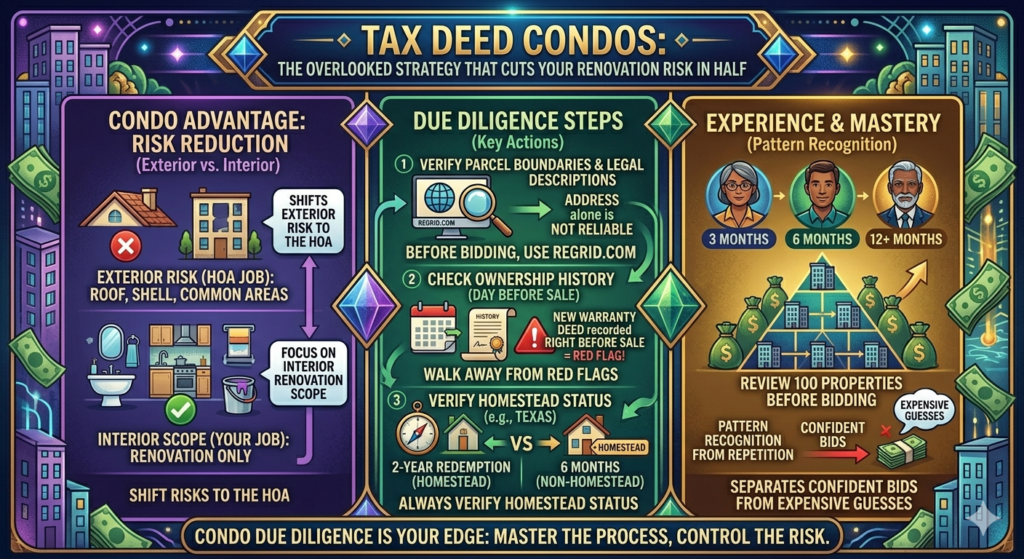
The HOA handles the exterior.
In a condo, the homeowners association is responsible for the roof, the building shell, the exterior walls, the common areas, and often the major building systems. As the unit owner, your responsibility is the interior of your unit only.
Think about what that means for a tax deed investor.
With a single-family house at a tax auction, you’re taking on the unknown condition of everything — roof, foundation, exterior, interior, systems. Any of those can be a surprise expense.
With a condo, the exterior risk is largely off your plate. You walk in, you assess the interior, you estimate what it costs to make it habitable or rentable, and that’s your renovation scope. Full stop.
For someone new to this, that’s a meaningful reduction in risk.
A Real Example: Two Condos, Two Strategies
Let me walk through a real scenario that illustrates how this plays out.
An investor — someone who had spent about a year studying tax deed investing before pulling the trigger — bid on two condos at a Texas auction.
Condo 1:
- Auction starting bid: ~$10,000
- Winning bid: $87,000
- Estimated ARV (after repair value): $337,000
- Potential equity created: $250,000+
Condo 2:
- Winning bid: $36,000
- Options: rent at $1,000/month or flip for approximately $70,000
Two different exit strategies. Both acquired at tax auction. Both condos — meaning exterior maintenance handled by the HOA.
The first is a significant flip opportunity. The second is a choice between immediate cash flow or a quick resale profit. Neither required dealing with roof conditions, foundation issues, or exterior structural problems.
That’s the condo advantage in practice.
The Research Process: Regrid and Legal Descriptions
Here’s where tax deed investing gets more technical — and where doing your homework before you bid separates successful investors from people who make expensive mistakes.
Don’t trust the address alone.
County tax auction listings include an address. But addresses can be imprecise, duplicated, or outdated. Before you bid on any parcel, verify the exact legal description and parcel boundaries.
Regrid (regrid.com) is a free tool that shows parcel boundaries on a map, pulled from county records. Enter an address or parcel ID and you can see the exact boundaries of what’s being sold — how big it is, where it sits relative to neighboring parcels, whether it’s what you think it is.
This matters more than you’d expect. Tax sale listings can be confusing. Parcel ID numbering systems vary by county. The address the county lists might match a different parcel than the one you think you’re bidding on.
Cross-reference the address against the parcel ID against the legal description. All three should point to the same thing. If they don’t — ask questions before you bid.
The Red Flag You Need to Know
Here’s a specific warning that experienced tax deed investors use as an automatic stop signal.
Check the ownership history on the day before the auction.
In most counties, deed transfers are recorded publicly and visible online through the county recorder or assessor’s website. Before you bid on any property, look up the ownership history.
If a new Warranty Deed was recorded in the days immediately before the auction — meaning the property changed hands right before the tax sale — that’s a significant red flag.
Why? Because it may indicate that someone with knowledge of the property and its issues transferred it specifically to create a clean break from whatever problems it has. It can also indicate a last-minute attempt to complicate the title situation.
This isn’t guaranteed to mean something is wrong. But it’s unusual enough that it warrants walking away and finding a different deal. There are always more auctions.
Texas Homestead: The Two-Year Trap
If you’re looking at tax deed investing in Texas specifically — or any state with homestead protections — understand the redemption period rules before you bid.
In Texas, properties that were the owner’s primary residence (homestead) at the time of the tax sale have a two-year redemption period. That means the original owner has two years after the auction to pay back what’s owed — plus penalties — and reclaim the property.
During those two years, you own the property but you can’t fully count on it. You can rent it out, but you need to account for the possibility that the original owner redeems it.
Compare that to non-homestead properties in Texas, which have a six-month redemption period. That’s a meaningful difference in how long your capital is at risk.
How to check homestead status: The county appraisal district website in Texas shows whether a property has a homestead exemption on file. This is public information. Check it before you bid.
Other states have their own redemption rules. Tennessee has a 12-month redemption period — though some sales qualify as “special sales” that bypass this. Pennsylvania’s Judicial Sales have no redemption period in most cases. Know the rules for the state you’re investing in.
The 100-Property Rule
Here’s a mindset point that keeps coming up from experienced tax deed investors.
Before you bid on anything, look at 100 properties.
Not 10. Not 20. One hundred.
Why? Because pattern recognition takes repetition. After you’ve looked at 100 parcels — checked their Regrid boundaries, searched their ownership history, looked them up on Google Earth, cross-referenced their legal descriptions — you develop an intuition for what looks normal and what looks off.
The investor who bids on the third property they’ve ever researched is making decisions without a baseline. The investor who bids on their first deal after reviewing 100 others has a framework for comparison.
This sounds tedious. It is, a little. But most of that research takes 5–10 minutes per property once you know what you’re looking for. One hundred properties is roughly 10–15 hours of work spread over a few weeks.
That’s not a lot of time to invest before putting real money on the line.
Putting It Together: The Condo Tax Deed Process
Here’s the workflow specifically for condos at tax auctions:
Step 1: Find upcoming tax auctions Bid4Assets, GovEase, and individual county websites list upcoming sales. Filter for condos or look through the full list.
Step 2: Verify the parcel Use Regrid to confirm the parcel boundaries and legal description match the listing. Cross-reference the parcel ID with the county assessor.
Step 3: Check ownership history Look up the deed history through the county recorder. Any recent transfers — especially in the days before the auction — are a red flag.
Step 4: Check homestead status For Texas properties, verify homestead exemption status through the county appraisal district. Know your redemption period going in.
Step 5: Assess the interior For condos, your risk is interior condition. If you can get a look inside before the auction — great. If not, price in an interior renovation budget conservatively.
Step 6: Know your HOA situation Contact the HOA before bidding. Find out the current dues, whether there are outstanding balances owed, and whether HOA liens survive the tax sale in that state. Some do.
Step 7: Set your maximum bid and don’t exceed it Know your ARV. Know your renovation budget. Know your exit — flip or rent. Work backward to your maximum allowable bid and don’t let auction momentum push you past it.
Why Condos Deserve More Attention in This Space
The tax deed investing conversation is dominated by land and single-family houses. Condos don’t come up much.
But for a first-time investor who wants to minimize renovation complexity — and who understands that the exterior is largely the HOA’s problem — condos at tax auctions represent a category worth paying attention to.
Less exterior risk. Clear renovation scope. Multiple exit strategies. And the same tax deed advantages that apply to any property: below-market entry, existing debt potentially wiped, motivated county sellers who just want the tax revenue.
Worth knowing about.
Not financial advice — just someone doing a lot of research and asking a lot of questions. Tax deed rules, redemption periods, and HOA lien survival vary significantly by state — always verify with a local real estate attorney before bidding.