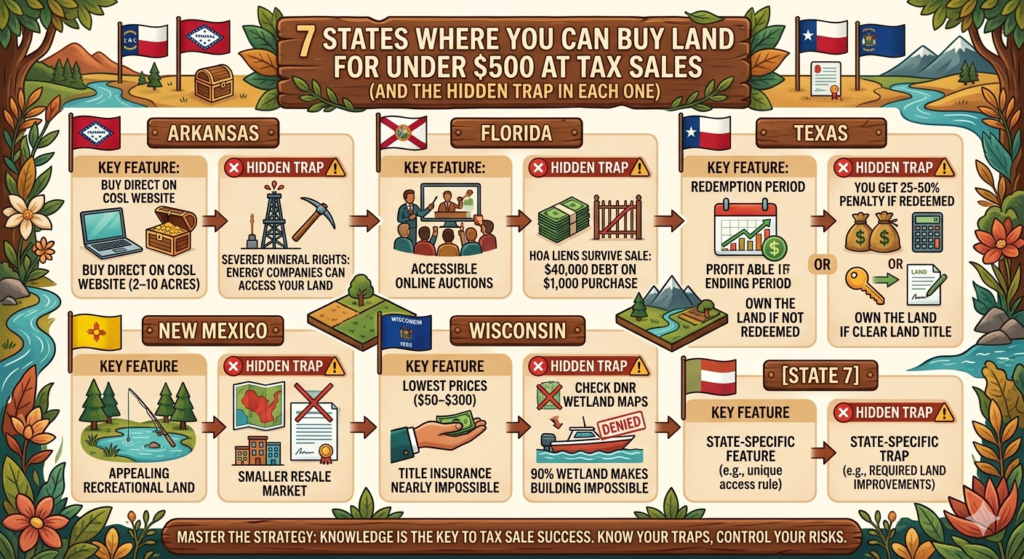
By now you know the basics of tax deed investing. Counties auction off land when owners stop paying taxes. Prices start at back taxes owed. Sometimes that means $500. Sometimes less.
But here’s what most guides skip: the rules are completely different depending on which state you’re in. The redemption period, the lien situation, the title process, the specific websites you use — all of it varies by state.
So let’s go through the seven states where cheap land opportunities are most accessible right now — and the specific trap in each one that you need to know before you bid.
#7: Arkansas — Best for Beginners
Arkansas is probably the most beginner-friendly state for cheap land acquisition — not because of the auction process, but because of what happens after.
Properties that don’t sell at Arkansas tax auctions move to a negotiated sale list managed through the state’s Commissioner of State Lands (COSL) office. You can browse available parcels directly on their website — cosl.org — and purchase without any competitive bidding. No auction nerves. No competing bids. Just find something you like and apply.
Prices on the COSL list regularly include 2–10 acre parcels in the $650 range. Sometimes less.
The hidden trap: mineral rights.
In many rural Arkansas parcels, the mineral rights have been severed from the surface rights. That means someone else owns what’s underground — oil, gas, minerals. And if a gas company has a lease on those mineral rights, they have the legal right to access your land to extract them.
You could buy a peaceful 5-acre parcel and find an energy company legally entitled to put equipment on it.
Always check whether mineral rights are included before you buy. The COSL listing will often indicate this — read it carefully.
Also watch for: landlocked parcels with no road access. Arkansas has plenty of them on the COSL list.
#6: Alabama — The Slow Burn
Alabama has a state-managed inventory of long-term tax forfeited properties. These are parcels that have been sitting in government hands for years — sometimes decades — without selling.
You can apply to purchase directly from the state. Prices are low. Competition is minimal.
The hidden trap: the three-year occupancy requirement.
In Alabama, buying the tax deed doesn’t automatically extinguish all prior claims. To fully clear title and eliminate any lingering rights from the previous owner, you typically need to actually occupy and use the land for three years — installing a fence, maintaining it, treating it as yours.
This is what’s called a “slow burn” investment. You’re buying, but you’re also starting a clock. For a buy-and-hold strategy where you’re planning to use the land anyway, this is fine. For a quick flip, it’s a complication.
Best use case: If you want recreational land you’ll actually use — hunting, camping, eventual cabin — Alabama’s process works well. If you want to flip in 60 days, look elsewhere.
#5: Florida — Online and Competitive
Florida runs almost all of its tax certificate and tax deed sales online — making it highly accessible from anywhere in the country. The process is well-documented, the platforms are user-friendly, and the inventory is substantial.
The accessibility is also the problem. Because it’s easy, everyone’s doing it. Competition is real, and prices at Florida auctions often reflect that competition.
The hidden trap: HOA liens that survive the sale.
Florida is one of the states where HOA (Homeowners Association) liens can survive a tax deed sale. This is the most dangerous trap in Florida tax deed investing.
A property in a planned community might have $40,000 in unpaid HOA dues attached to it. You win the tax deed auction for $1,000. Congratulations — you now owe $40,000 to the HOA.
This is not hypothetical. It happens.
Before bidding on any Florida property in a subdivision or planned community, contact the HOA directly. Ask for a statement of all amounts owed. If you can’t get that information before the auction, don’t bid.
#4: Texas — The Counterintuitive Redemption Period
Texas holds tax lien sales at the county courthouse on the first Tuesday of every month. It’s one of the most active tax sale markets in the country.
Here’s the part that surprises most people: Texas has a redemption period — typically six months for most properties, two years for homestead properties. The original owner can pay back the auction price plus penalties and reclaim their property during that window.
Most investors hear “redemption period” and think that’s a problem. In Texas, it’s actually structured in a way that makes it interesting.
The counterintuitive angle:
If the original owner redeems the property, they have to pay you back at your purchase price — plus a 25% penalty in the first year, 50% in the second year for homesteads.
So if you paid $5,000 at auction and the owner redeems in year one, you get $6,250 back. You made 25% in under a year without doing anything to the property.
If they don’t redeem, you own the property.
Either outcome can work in your favor if you priced the deal correctly.
The hidden trap: Homestead properties have that two-year redemption window. Verify homestead status through the county appraisal district before you bid. Two years is a long time to have capital sitting in a deal that might get redeemed.
#3: Oklahoma — Fastest Clean Title
Oklahoma holds its main tax resale auction in June every year. What makes Oklahoma particularly interesting is the speed of title transfer.
When you win at Oklahoma’s resale auction, ownership transfers immediately. No waiting. No redemption period on resale properties. You get the deed and you own it.
For investors who want to move quickly — buy, list, sell — Oklahoma’s timeline is attractive.
The hidden trap: procedural challenges.
Oklahoma’s tax sale process requires the county to follow specific notification procedures before selling a property. If the county made an error in that process — failed to properly notify the owner, missed a required step — the sale can potentially be challenged and voided even years later.
This means building on or significantly improving an Oklahoma tax deed property carries some risk until the title has been legally quieted through a Quiet Title action.
Budget for Quiet Title before you develop anything. For a raw land flip where you’re selling quickly to another investor, the risk is lower. For a long-term hold with improvements, get the title cleaned up first.
#2: New Mexico — Cheapest Entry Point
New Mexico manages its tax forfeited properties through a centralized state system. This is where you find some of the lowest prices in the country — parcels in the $50 to $300 range are not unusual, particularly for smaller desert parcels in rural areas.
The state manages the process efficiently and the inventory is browsable online.
The hidden trap: title insurance is nearly impossible to get.
New Mexico tax deed properties are notoriously difficult to insure with title insurance. Most title companies won’t touch them — or will only offer limited coverage with significant exceptions.
Why does this matter? If you ever want to sell to a buyer using conventional financing, their lender will require title insurance. No title insurance means cash buyers only.
Cash buyers exist. But your buyer pool is smaller, which means your sale takes longer and your price is lower.
New Mexico makes sense for: land you’re keeping for personal use, or land you’re selling cheaply to another cash investor who understands the title situation. It doesn’t work as well for properties you’re hoping to sell to end users with mortgages.
#1: Wisconsin — Northern Counties and the Wetland Warning
Wisconsin’s northern counties process tax forfeited land through dedicated county websites — often straightforward to navigate, with clear listings of available parcels and direct purchase options.
The northern Wisconsin landscape — lakes, forests, recreational areas — makes some of these parcels genuinely appealing for camping, hunting, or cabin sites.
The hidden trap: wetlands.
A significant percentage of cheap Wisconsin parcels are wetlands. And wetlands in Wisconsin are heavily regulated. Building is prohibited. Installing a septic system is prohibited. Even certain types of clearing or filling can trigger environmental violations.
A parcel that looks like a beautiful forested lot on Google Earth might be 90% designated wetland — legally buildable on 10% of the land at best, and only with significant regulatory approval.
Before buying any Wisconsin parcel, check the Wisconsin Wetland Inventory maps available through the state’s DNR (Department of Natural Resources) website. This is a free online tool that shows wetland designations by location.
If a parcel shows significant wetland coverage, price it accordingly — or pass.
The Three Rules That Apply Everywhere
Regardless of which state you’re investing in, these three checks are non-negotiable.
1. Google Earth first. Road access. Water proximity. Surrounding land use. Obvious environmental issues. This takes five minutes and eliminates most bad deals before you go further.
2. Budget for Quiet Title. Even a $500 parcel may need $1,500–$2,000 in legal fees to fully clear title before you can sell it to a buyer using financing. Factor this into your numbers from day one.
3. Verify local government liens. Some municipalities have liens for weed abatement, building demolition, or code enforcement that survive tax sales. Call the city or county before bidding. Ask specifically whether there are any outstanding municipal charges on the property.
Pennsylvania: Where You Actually Live
Since this blog is Philadelphia-focused, let me connect this back to where you actually are.
Pennsylvania is a tax deed state — we’ve covered that in depth. The Upset Sale, Judicial Sale, and Repository process all apply. And Pennsylvania has no redemption period on Judicial Sales — one of the cleaner structures in the country.
The other six states on this list are worth knowing about for investors who want to operate remotely — buying land online in states with favorable terms while living elsewhere. The fully remote, laptop-based model of land flipping makes geographic flexibility genuinely possible.
You don’t have to limit yourself to Pennsylvania.
Not financial advice — just someone doing a lot of research and asking a lot of questions. Tax sale rules change — verify current procedures with the relevant state or county office before purchasing.