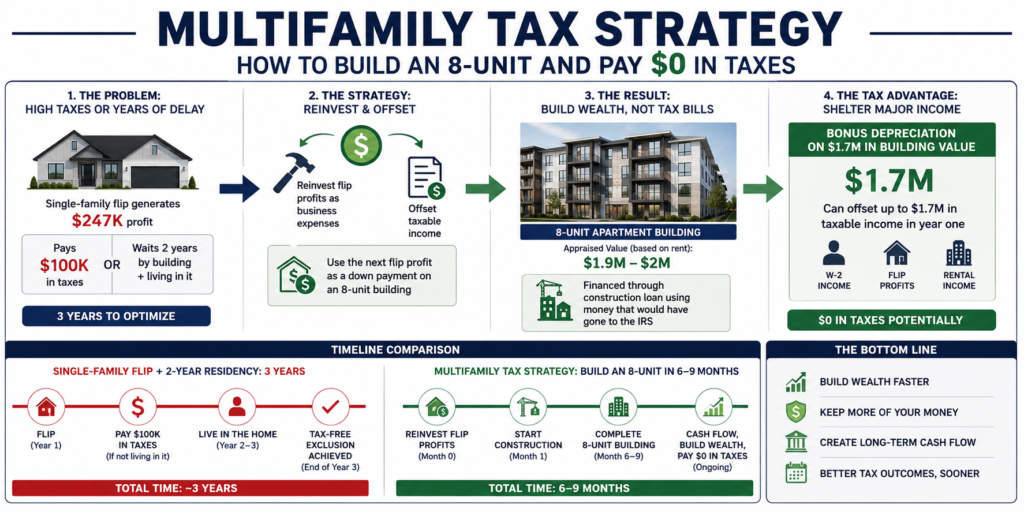
Multifamily tax strategy is the reason experienced developers stop flipping single-family homes and start building apartment buildings instead. The numbers aren’t even close.
Here’s the breakdown — from Jerome Maldonado’s framework — that made me rethink everything about the flip-and-repeat model.
The Single-Family Flip Tax Problem
Let’s say you build a single-family home and sell it for a $247,000 profit. Sounds great.
Then your accountant calls.
Depending on your state and income bracket, 30–40% of that goes to taxes. That’s roughly $100,000 gone before you’ve done anything with the money.
You have two options to avoid it:
Option 1: Pay the tax and move on.
Option 2: Live in the house for 2 years to qualify for the primary residence exclusion — $250,000 tax-free for single filers, $500,000 for married couples.
Option 2 sounds better until you do the math on time. Building takes 6–8 months. Living there takes 2 years. You’ve now spent nearly 3 years on one deal to avoid a tax bill.
That’s not a strategy. That’s a treadmill.
The Multifamily Tax Strategy That Changes Everything
Jerome Maldonado’s approach skips both of those options entirely.
Step 1: Reinvest instead of paying taxes.
Take your first flip profit and instead of writing a check to the IRS, reinvest it into building your next property. That reinvestment becomes a business expense — which offsets your taxable income. Tax bill: dramatically reduced.
Step 2: Use the second flip profit as a down payment on an 8-unit apartment building.
The rest of the construction cost gets financed through a construction loan. You’re not paying for the whole building out of pocket — you’re using your flip profit as the equity to access the financing.
Step 3: Build the 8-unit. Stabilize it.
An 8-unit apartment building generating solid rents in most markets appraises at $1.9M–$2M based on income. You built something worth nearly $2 million using profits that would have otherwise gone to the IRS.
The Multifamily Tax Strategy Weapon: Bonus Depreciation
Here’s where the multifamily tax strategy gets genuinely powerful.
Once the 8-unit is built, you commission a cost segregation study. The land isn’t depreciable — but the building value (roughly $1.7M) is. With bonus depreciation, you can accelerate that depreciation and take a massive deduction in year one.
The math:
- Building value eligible for depreciation: ~$1,700,000
- Bonus depreciation applied in year one: up to $1,700,000
- Taxable income offset: up to $1,700,000
That means between your W-2 income, your flip profits, and your rental income — you could be earning up to $1.7 million before you owe a single dollar in federal income tax.
Not a loophole. Not a gray area. This is exactly what the tax code was designed to incentivize — building housing, creating rental supply, investing in real property.
Multifamily Tax Strategy vs. Single-Family: The Real Comparison
| Single-Family Flip | Multifamily Tax Strategy | |
|---|---|---|
| Timeline | 3 years (build + live) | 6–9 months |
| Tax bill | $100,000+ | Near zero with depreciation |
| Asset created | Sold, gone | 8-unit you still own |
| Wealth built | One-time profit | Ongoing cash flow + equity |
Same starting capital. Completely different outcomes.
Why This Matters for Philadelphia
Philadelphia has land. It has demand. It has neighborhoods where 8-unit buildings make complete financial sense — and where construction costs are lower than coastal markets.
The multifamily tax strategy isn’t just for developers with deep pockets. It’s for investors who understand that the tax code rewards people who build housing — and who are willing to think one step beyond the single flip.
I’m not building an 8-unit tomorrow. But understanding this framework changes how I evaluate every piece of land I look at in Germantown and North Philly.
The question isn’t just “can I flip this?” It’s “what could I build here — and what would the tax picture look like if I did?”
According to IRS.gov, bonus depreciation on qualified improvement property allows real estate developers to front-load depreciation deductions significantly in the year a property is placed in service — making the multifamily tax strategy one of the most powerful legal tax reduction tools available to active real estate investors.
Use the Depreciation Calculator to model your own multifamily tax strategy numbers — plug in your building value and see exactly how much taxable income you can offset in year one before you talk to a CPA.
Not financial advice or tax advice — just someone doing a lot of research and asking a lot of questions. Always consult a licensed CPA before making any tax decisions.