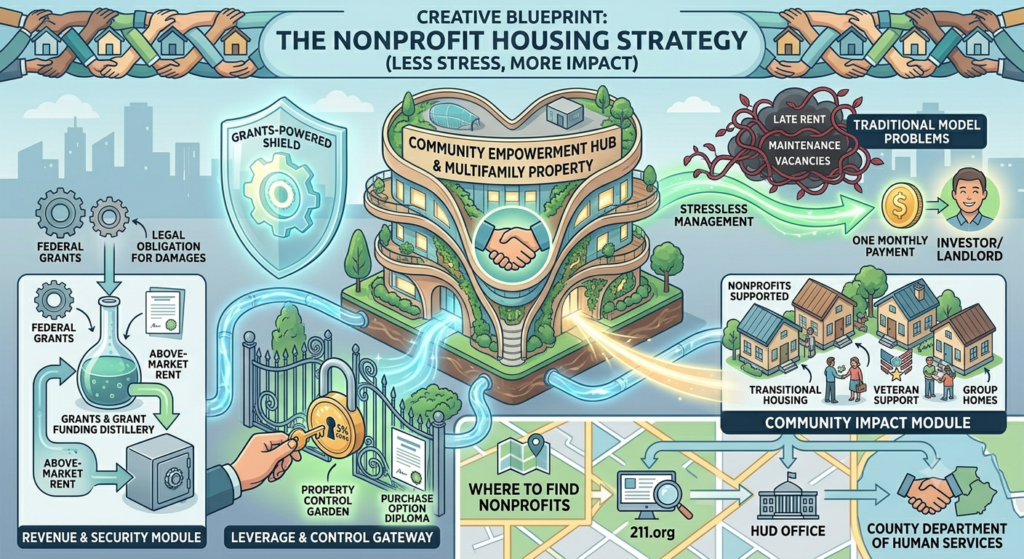
If you’ve been avoiding multifamily because the idea of managing ten different tenants sounds like a nightmare, the nonprofit housing strategy might completely change how you think about it.
I came across this through a case study on James Brewer, a real estate investor who figured out a way to lease entire multifamily buildings to nonprofit organizations — and the numbers he’s putting up are hard to ignore. $54,000 a month in debt service, $29,000 left over in net cash flow after everything. Not bad for a model most people have never heard of.
Here’s how the nonprofit housing strategy actually works.
What the Nonprofit Housing Strategy Actually Is
Instead of renting individual units to individual tenants, you lease your entire building to a single nonprofit organization under a master lease agreement.
The nonprofit takes over the whole building, places their clients in each unit — people in transitional housing, recovery programs, veteran support services, or group home situations — and pays you one fixed rent check every month.
You’re not dealing with ten tenants. You’re dealing with one organization.
That shift alone changes everything about how multifamily operates.
Why Nonprofits Pay More Than You’d Expect
This is the part that surprised me most about the nonprofit housing strategy.
Most investors assume that renting to a social services organization means accepting below-market rent. It’s actually the opposite. Nonprofits often pay above market rate because they need stable, dedicated housing for their clients and they have funding — from government grants, HUD contracts, and state programs — specifically allocated for housing costs.
They’re not negotiating you down. They need the space and they have the budget.
On top of that, if a tenant damages the unit, the nonprofit organization covers the repair costs. You’re not chasing an individual for damages. The organization has a legal obligation under the master lease to maintain the property and make it right. It functions like a corporate guarantee.
According to the U.S. Department of Housing and Urban Development, nonprofits receive billions in federal housing funding annually — which is exactly why they can afford to be reliable, long-term tenants.
How Master Lease Works in This Model
A master lease means the nonprofit leases the entire building from you as a single entity. They then sublease individual units to their clients on their end. That’s their job, not yours.
From your perspective, the structure looks like this:
You own or control the building → Nonprofit signs a master lease for the whole property → Nonprofit places clients in each unit → Nonprofit pays you one monthly check.
No individual lease agreements with ten different people. No chasing late rent from multiple tenants. No calling references on a dozen applicants. One contract, one organization, one payment.
James Brewer’s model takes this further — he uses lease options to control buildings before he even owns them. He signs a master lease on a building with an option to purchase later, gets the nonprofit in place, generates cash flow from day one, and exercises the purchase option when the timing works. His down payment went from 20% early on to around 5% as he refined the approach.
Who the Nonprofits Are
There are thousands of nonprofits across the U.S. actively looking for housing. In Philadelphia alone, the landscape includes:
Transitional housing organizations that work with people coming out of homelessness. Recovery housing programs that need stable residential space for people in drug and alcohol rehabilitation. Veteran support organizations that place formerly homeless vets into permanent housing. Developmental disability service providers that run group homes and supported living programs. Domestic violence shelters and transitional programs for survivors.
These organizations are not casual renters. They have case managers, compliance requirements, and funding that depends on maintaining stable housing for their clients. They have every incentive to be good tenants and to keep the relationship intact.
What Makes This Model Work Operationally
The other piece Brewer emphasizes is building your own management system rather than outsourcing everything.
Third-party property managers split their attention across dozens of properties. They’re slow on repairs, they miss details, and they charge fees that eat into your margins. Brewer moved to an in-house maintenance and operations team — people who work exclusively on his properties and know the buildings inside and out.
He also hired an operations manager so he’s not the one fielding calls about broken fixtures. His job is acquisitions and financing. The operations manager runs the day-to-day. That separation is what lets him scale without losing his mind.
For someone using the nonprofit housing strategy, this matters because the nonprofit’s case managers handle tenant issues on their end — but you still need your systems tight on the property side. Repairs need to happen fast. Buildings need to be maintained. That’s what keeps the nonprofit renewing the lease.
If you want to run the numbers before approaching a nonprofit, the Multi-Unit Cash Flow Calculator can help you figure out what rent you need to make the deal work at your target cash flow.
How to Find Nonprofits in Your Area
This is easier than most people expect.
Start with 211.org, which is a national database of social service organizations. Search your city and filter by housing — you’ll find dozens of organizations actively looking for residential space.
You can also contact your local HUD office directly. They work with nonprofit housing providers constantly and can point you toward organizations that have funding in place and need properties now.
County departments of human services are another direct line. They contract with nonprofits to place people in housing and often know exactly which organizations are currently looking for space.
In Philadelphia, the Office of Homeless Services and the Department of Behavioral Health both work with networks of housing nonprofits. A few phone calls can get you in front of the right people faster than you’d think.
Is This Strategy Right for Every Investor
Not necessarily.
The nonprofit housing strategy works best if you’re comfortable with the population being housed — people in recovery, transitional situations, or group home settings. The buildings need to be in decent condition and meet habitability standards, since nonprofits have compliance requirements of their own.
It also works better at scale. A single four-unit building can work, but the model really starts to shine when you’re controlling multiple properties and have systems in place to manage them efficiently.
For Philadelphia investors specifically, the density of nonprofits and the availability of multifamily rowhouses at various price points makes this an interesting angle worth exploring. The city has a significant need for transitional and supportive housing, which means demand from nonprofits is real and ongoing.
It’s not a passive strategy. It’s a system. But if you build the system right, the cash flow can be surprisingly stable.
Not financial advice — just someone doing a lot of research and asking a lot of questions.