ARV Real Estate: The Number I Didn’t Know When I Lost Money on My First Flip
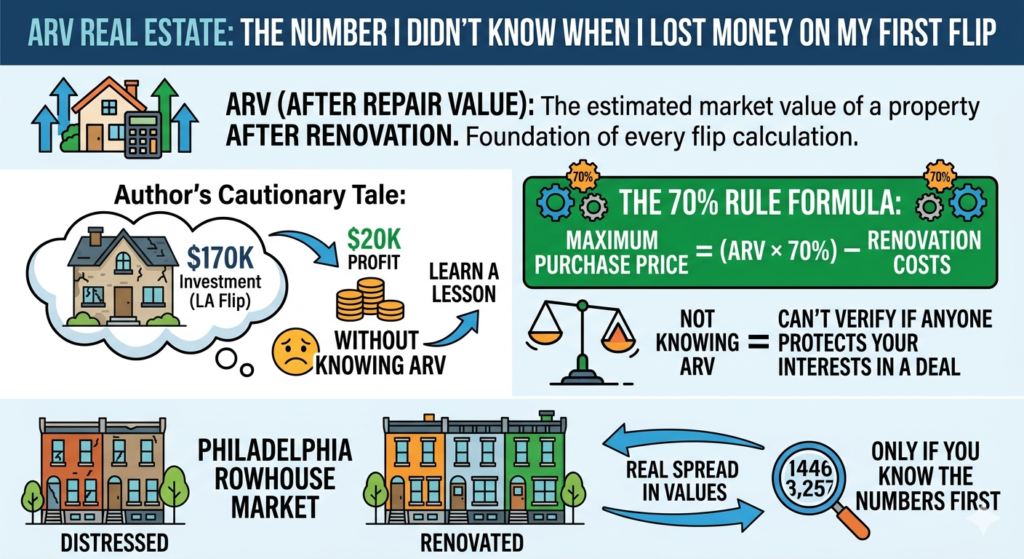
I want to tell you about the number I didn’t know when I wired $170,000 into a real estate deal in Los Angeles.
It’s called ARV real estate investors use as their starting point for every deal. After Repair Value. The estimated market value of a property after all renovations are complete.
I didn’t know what it was. I didn’t know how to calculate it. And I didn’t know that every serious investor uses ARV real estate calculations before they make an offer on anything.
Here’s what happened because I didn’t know it.
My First Flip
When I moved to the United States, I was newly divorced, still learning English, and trying to figure out how to build something for myself in a country where I didn’t know the rules yet.
Someone in my community told me about a company that handled fix-and-flip investments from start to finish. They found the deals. They managed the renovations. They sold the properties. All I had to do was bring the money.
I brought $170,000.
Thirteen months later, I got back $190,000. A $20,000 profit on a $170,000 investment over more than a year. Meanwhile, the property had sold for hundreds of thousands of dollars.
I knew something was wrong. I just didn’t have the language to explain what it was.
Now I do.
What ARV Real Estate Investors Actually Calculate
ARV real estate math starts with one number: the estimated market value of a property after all renovations are complete — not what the house is worth today in its distressed condition, but what it will be worth once it’s fully fixed up and ready to sell.
You calculate it by looking at comparable sales — what similar renovated homes in the same neighborhood have actually sold for recently. Not list prices. Sold prices.
This number is the foundation of every fix-and-flip calculation. Without it, you’re guessing.
The 70% Rule: How ARV Real Estate Math Works
Maximum Purchase Price = (ARV × 70%) − Renovation Costs
The 70% accounts for your profit, holding costs, closing costs, agent commissions, and the unexpected expenses that always show up during a renovation.
Let me show you what this looks like on a real Philadelphia example.
Say you find a rowhouse in Germantown. Comparable renovated sales in the area suggest an ARV of $220,000. Renovation estimate comes in at $45,000.
$220,000 × 70% = $154,000 $154,000 − $45,000 = $109,000
That’s your maximum offer price. If the seller wants $130,000, you either negotiate down or walk away.
What Happened on My Deal
Looking back at my Los Angeles flip with what I know now, I can see exactly what went wrong.
The company I invested with was making money at multiple points in the transaction — on the acquisition, on the renovation management, on the sale. Each layer of involvement came with fees and profit margins that came out of my return before I saw a dollar.
Was ARV real estate math being applied? Probably. But it was being applied to protect their margins, not mine. And because I didn’t know the number, I had no way to verify anything.
That’s the thing about not knowing ARV. It doesn’t just mean you might overpay for a property. It means you can’t evaluate whether anyone else is protecting your interests either.
Why I Moved to Philadelphia
After that experience, I decided I was done being a passive investor. I moved to Philadelphia specifically because the numbers work here in a way they don’t in Los Angeles.
In LA, properties are so expensive that the margin for error is razor thin. In Philadelphia, you can buy rowhouses for $80,000 to $120,000 in neighborhoods where renovated comps are selling for $200,000 to $280,000. The spread between distressed and renovated is real and workable.
But only if you know your ARV real estate numbers before you make an offer.If you’re looking at Philadelphia deals right now, the Philadelphia Deal Finder might help you spot the right neighborhoods.”
Calculate Your ARV Before You Make Any Offer
I built a free ARV calculator specifically for investors who don’t want to make the mistakes I made.
Put in your estimated ARV and renovation costs, and it tells you the maximum you should pay for any property — before you fall in love with it, before you wire any money, before you sign anything.
Run the numbers first. Always.
Not financial advice — just someone doing a lot of research and asking a lot of questions.