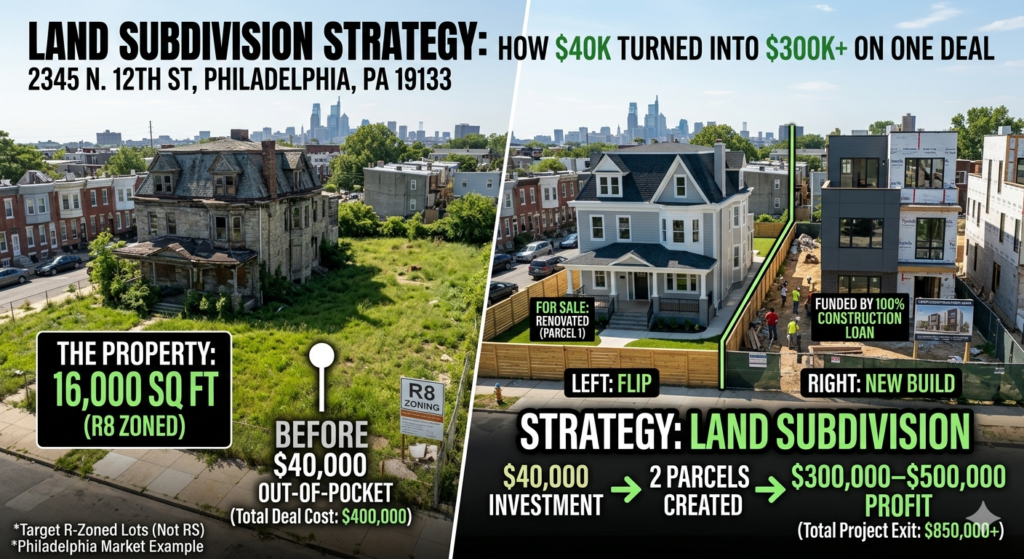
Land subdivision strategy is where the 70% rule goes somewhere most beginners never think to look — and the numbers are genuinely hard to ignore.
I came across this on TikTok recently. Most real estate content there is noise. But occasionally something makes me stop. This was one of those times.
The Starting Point: Buy Right With the 70% Rule
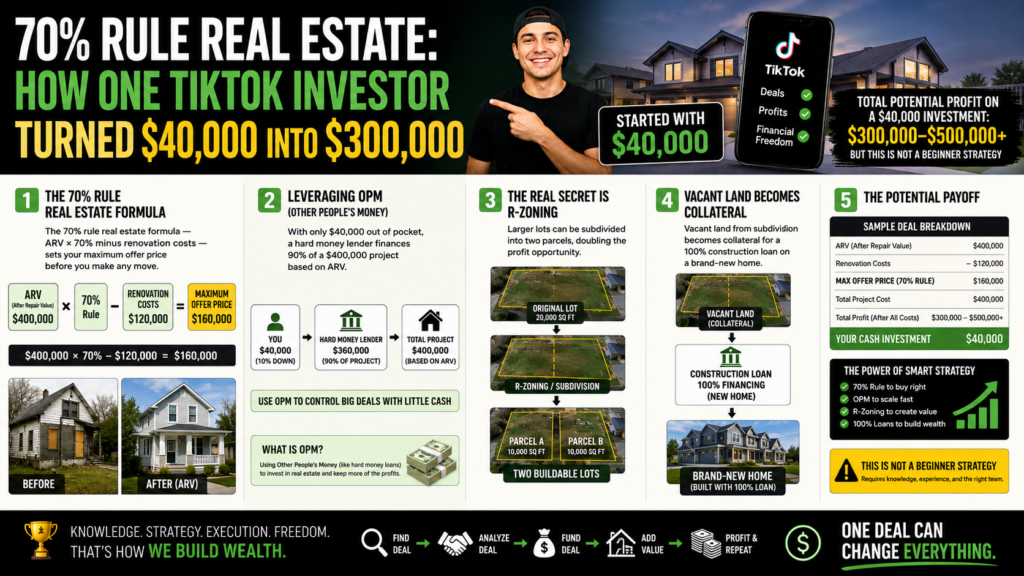
Before the land subdivision strategy even comes into play, the deal has to make sense on paper. The 70% rule formula looks like this:
ARV × 70% − Renovation Costs = Maximum Purchase Price
On a $600,000 ARV property with $75,000–$100,000 in renovation:
$600,000 × 70% = $420,000 $420,000 − $87,500 = $332,500 maximum offer
The strategy targets a $300,000 purchase price with a $75,000–$100,000 renovation budget. Total project cost: roughly $400,000. Of that, the investor puts in only $40,000 of their own money — about 10%. The rest comes from a hard money lender based on ARV.
Renovate Fast, Sell Faster
The timeline is tight by design. Two months to renovate. Two months to sell. Four months total.
Every month the property sits costs money — loan interest, holding costs, taxes. Speed protects your margin. But the flip itself isn’t the real play here.
The Real Secret: Land Subdivision Strategy
This is where the strategy goes somewhere unexpected.
The key is targeting properties zoned R — not RS (single-family residential).
- RS zoning = one house per lot. Period.
- R zoning (like R8 = one home per 8,000 sq ft) = if your lot is larger than the minimum, you can subdivide.
Here’s the real example of the land subdivision strategy in action:
You buy a 16,000 sq ft lot zoned R8. You subdivide into two 8,000 sq ft parcels. You renovate the existing home on parcel one and sell it. On parcel two — now vacant land you own free and clear — you use the land as collateral to secure a 100% construction loan from a bank.
You build a new home. Depending on the market, that new construction is worth $1,000,000+.
| Profit on renovated home | $150,000–$200,000 |
| Profit on new construction | $200,000–$300,000+ |
| Total on a $40,000 investment | $300,000–$500,000 |
My Honest Reaction to This Land Subdivision Strategy
The 70% rule part? Accessible to anyone willing to learn it.
The land subdivision strategy and construction loan part? That requires experience, lender relationships, and risk tolerance most first-time investors don’t have yet. I’ll be honest — the version of me who wired $170,000 into my first Los Angeles flip without understanding the basics would have gotten this wrong.
This is not a beginner strategy. But understanding how the land subdivision strategy works makes you a better investor regardless of where you are.
Land Subdivision Strategy in Philadelphia
Philadelphia is actually an interesting market for this. The city has a mix of zoning designations, and there are neighborhoods where larger lots exist at prices that still make the numbers work.
If you’re serious about a land subdivision strategy in Philadelphia, start with the zoning map — specifically R-zoned properties with larger-than-standard lots in neighborhoods with strong ARVs. That research takes time. But for investors who do it, the opportunity is real.
According to Census.gov, Philadelphia has a significant inventory of larger residential lots in transitioning neighborhoods — particularly in parts of North Philly, Germantown, and along the Delaware — that could qualify for subdivision under the right zoning conditions.
Use the Property Subdivision Strategy Calculator to check whether a specific Philadelphia property could work for this strategy before you make any offer.
Not financial advice — just someone doing a lot of research and asking a lot of questions.