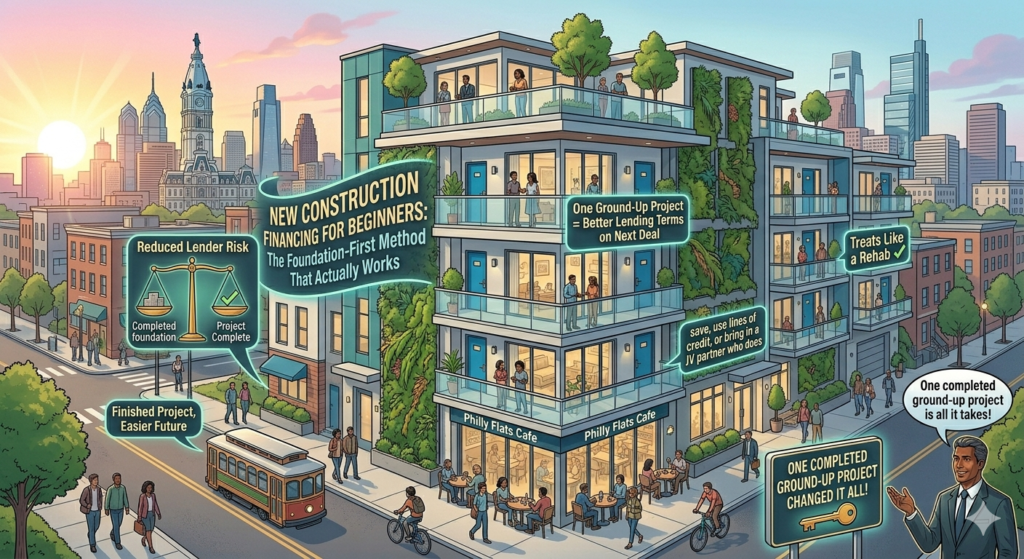
New construction financing is where most investors hit a wall. Not because the money doesn’t exist — but because lenders want a track record you don’t have yet.
I’ve flipped three houses. Not recently — life happened, I took a break — but I’ve been through the process enough times to know that flipping is just the beginning for me. The road I see looks like this: get back into flipping, build a single-family from scratch, then multi-unit, eventually apartment development.
So I spend a lot of time studying how developers actually get from point A to point B. And lately I’ve been deep in new construction financing — because that’s where things get complicated fast.
The Problem With New Construction Financing When You’re New
Construction loans are a different animal from hard money or DSCR loans. Lenders want to see that you’ve done this before. They want a track record — completed ground-up projects, ideally more than one.
If you’re coming from the rehab world like most investors do, that track record doesn’t exist. And lenders aren’t going to hand you $600K to build something from scratch just because you’ve flipped a few houses. The risk profile is completely different.
I came across an interview with a developer who had the exact same problem — no construction track record. He’d done rehabs, but the moment he tried to pivot to new construction, lenders shut the door. Too risky. Not enough experience.
Here’s the strategy he used to get around it.
The Foundation-First New Construction Financing Strategy
Simple in theory, even if it takes capital upfront.
Step 1 — Buy the Land Yourself
Don’t go to a lender for this part. Use your own money, a line of credit, a partner — whatever you have access to. Buy the land and get your permits and approvals in order. Owning the asset already changes the conversation with lenders.
Step 2 — Fund the Early Stages Yourself
This is the key move in the foundation-first new construction financing approach. Pay for excavation and foundation out of pocket. He spent around $200K to get to this point — land, permits, excavation, foundation done.
Why does this matter? Because once the foundation is in, the risk profile of your project changes completely. You’re no longer asking a lender to fund a vacant lot. You’re asking them to fund a project that already has a foundation sitting on it. To a lender, that starts to look a lot more like a rehab than a ground-up build. The scary part — where anything can go wrong — is already behind you.
Step 3 — Now Go to the Lender
At this point, you’re walking in with land, permits, and a foundation. The lender is essentially financing the framing and everything that comes after — a much lower-risk position for them. He got funded at this stage when he couldn’t get a single callback before.
What Happened With His Project
He put in his $200K, got the foundation done, secured new construction financing, and completed the build. The finished property appraised at $900K–$920K. He refinanced, paid back the lender, and pulled out his original $200K in the process.
One completed project. That’s all it took to change his position with lenders entirely.
When he went to do his second project, his original lender still dragged their feet. So he went to a different lender — one that saw one completed ground-up project on his resume and gave him the terms he wanted.
One project. That’s the threshold for new construction financing credibility.
Why This Makes Sense for a Philadelphia Roadmap
When I think about my own path — flipping now, then eventually doing a ground-up single-family, then multi-unit — this strategy is the bridge between those two worlds.
The flips build capital and credibility. The foundation-first approach on a first new construction project gets you into the lender conversation. And from there, the track record builds itself.
According to BiggerPockets, the single biggest barrier to new construction financing for experienced rehabbers is the absence of a ground-up track record — which is exactly what the foundation-first method is designed to solve without waiting years to build experience another way.
Philadelphia makes this particularly interesting right now. Land in transitioning neighborhoods — Germantown, parts of North Philly, areas along the Delaware — is still relatively affordable. Getting a foundation in the ground on a single-family lot here is a realistic first step toward building a new construction financing track record.
What If You Don’t Have $200K?
He addressed this directly. His answer: save it, use credit lines, or bring in a partner who has the capital.
That’s not that different from how a lot of first flips get funded. The money has to come from somewhere. The difference here is that instead of going to a hard money lender day one, you’re using that capital to de-risk the project yourself — and then the lender comes in when you’ve already done the hard part.
If I were at this stage right now, I’d be looking at a JV partner — someone who brings the capital, I bring the project management and the hustle. That’s how a lot of developers get their first ground-up new construction financing deal done.
The Takeaway on New Construction Financing
The foundation-first method basically says: take the risk off the lender’s plate in the early stages, and they’ll show up for the rest. It’s not glamorous, and it requires real capital upfront. But if your goal is to eventually build — not just flip — it’s one of the most practical frameworks I’ve come across.
I’m filing this one away for when I get there. And based on everything I’m studying, I think I’ll be there sooner than later.
Use the Pre-Build Cost Estimator to map out your full foundation-first budget before you approach any lender — including land, permits, excavation, and foundation costs.
Not financial advice — just someone doing a lot of research and asking a lot of questions.