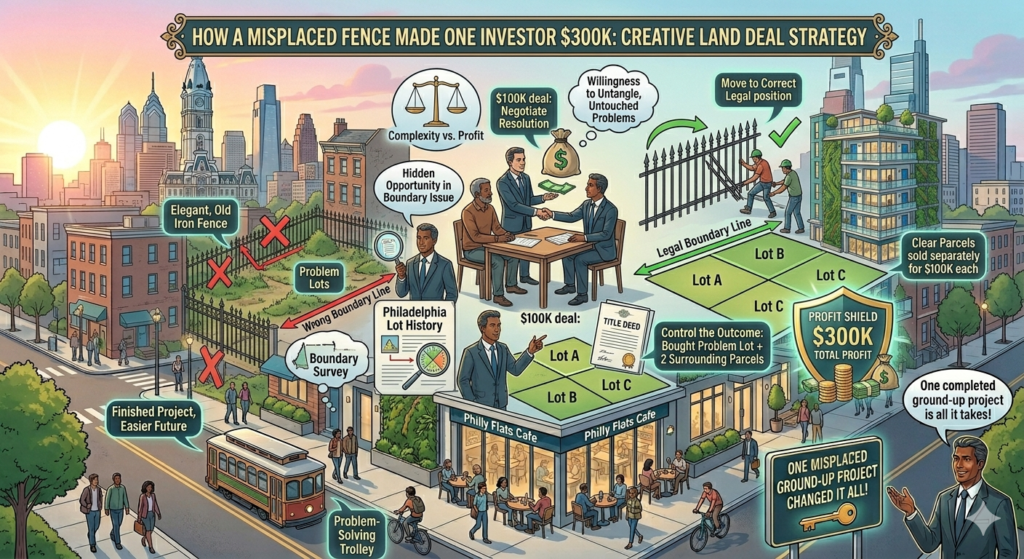
A creative land deal doesn’t always start with a perfect property. Sometimes it starts with a fence in the wrong place.
I’ve been watching a lot of investor interviews lately — part of studying how experienced developers actually think. And this one stopped me cold. Not because it was complicated. Because it was so simple, and most people would have walked right past it.
A guy made $300,000 because of a fence that didn’t belong.
The Setup: A Creative Land Deal Nobody Else Wanted to Touch
Here’s the situation. There was a property with a fence that had been sitting in the wrong location for years. Not slightly off — wrong enough that part of a neighboring structure had actually been built past the true property line. Nobody had bothered to fix it.
Then a builder bought the lot next door. He wanted to build on it, but the misplaced fence made that impossible — the buildable area was effectively blocked. The builder was stuck.
That’s when this investor heard about it and made a call. That call turned into a creative land deal worth $300,000.
The Offer: $100K to Move a Fence
The builder told him: if you can get that fence moved to the correct property line, I’ll pay you $100,000.
Simple offer. But here’s the catch — to move the fence, the investor first had to actually own the property the fence was sitting on. And if he bought it and couldn’t resolve the boundary issue? He’d be left holding a worthless lot.
Most people would have walked away right there. Too complicated, too risky, too many moving parts.
He didn’t walk away. He structured a creative land deal instead.
How He Structured the Creative Land Deal — Step by Step
Step 1: He purchased the problem property — the one with the misplaced fence — and demolished the old structure on it.
Step 2: He also acquired the lot on the other side of the builder’s property. Another neighboring parcel that most people weren’t paying attention to.
Step 3: With both lots now in his control, he moved the fence to its correct legal position.
Three moves. That’s the entire creative land deal.
The $300K Breakdown
Once everything was repositioned, here’s how the money came in:
| Land freed up when fence moved — sold to builder | $100,000 |
| First lot sold (the one with the old fence) | $100,000 |
| Second neighboring lot sold | $100,000 |
| Total profit | $300,000 |
Three transactions. All stemming from one misplaced fence that everyone else saw as a headache.
What This Creative Land Deal Actually Teaches You
When I watched this, my first thought was: how many situations like this exist right now that nobody is looking at?
This wasn’t a hot market deal. It wasn’t about timing the market or finding undervalued property in a gentrifying neighborhood. It was about seeing a problem that everyone else saw as a headache and figuring out that the headache was actually the opportunity.
The builder couldn’t build. The fence was in the wrong place. The neighboring lots were just sitting there. None of that looked like money to most people.
But to someone willing to dig into the details — pull the survey, understand the property lines, make a phone call — it was a $300K creative land deal waiting to be solved.
According to BiggerPockets, boundary disputes and encroachment issues are among the most common title problems in older urban markets — and investors who understand how to resolve them can often acquire problem parcels at significant discounts precisely because other buyers walk away.
The Philadelphia Angle on Creative Land Deals
Philadelphia has decades of irregular lot configurations, rowhouse conversions, old survey lines, and properties that have changed hands so many times that boundary questions come up more than you’d think.
Creative land deals in and around Philly aren’t just about finding cheap vacant lots. They’re about understanding what’s actually going on with a parcel — legally, physically, and in terms of what’s possible to build. A weird lot that looks unbuildable on Zillow might be a completely different story once you pull the actual survey and talk to the neighbors.
Don’t automatically skip the complicated ones. The fence was in the wrong place for years. Most people just saw a problem. One guy saw $300K.
Use the Land Potential Analyzer to evaluate any Philadelphia parcel before you walk away — including irregular lots and boundary situations that might be hiding a creative land deal.
Not financial advice — just someone doing a lot of research and asking a lot of questions.