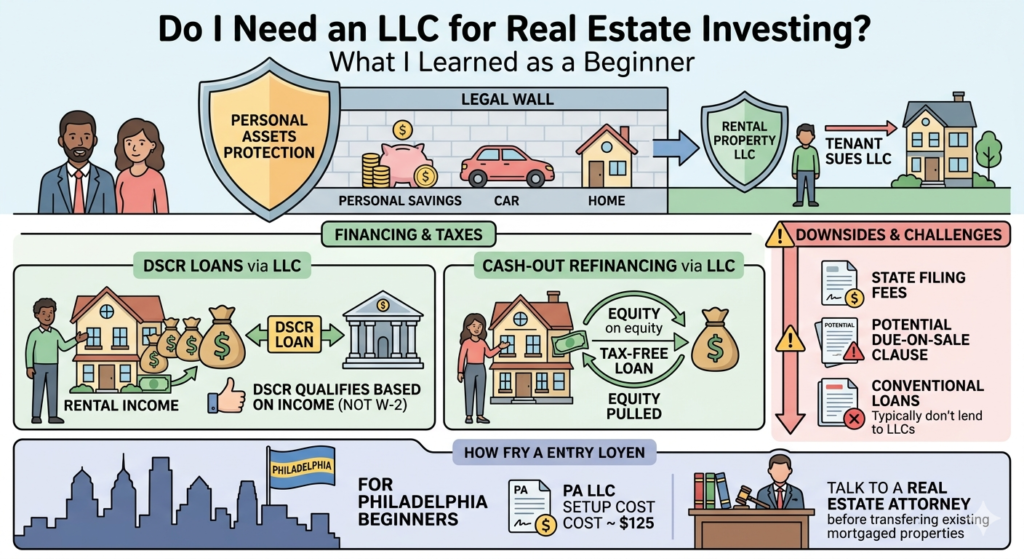
LLC real estate investing is one of those terms I kept seeing everywhere when I first started researching. Every investor, every YouTube video, every podcast — “put it in an LLC, protect yourself, separate your assets.” I nodded along like I understood what that meant.
I didn’t really understand what that meant.
So I went down a rabbit hole. Here’s what I actually learned.
What Is an LLC, Exactly?
LLC stands for Limited Liability Company. It’s a business structure that creates a legal separation between you personally and your business activities.
In plain English: if something goes wrong with your rental property — a tenant sues you, there’s a major accident, someone gets hurt — the LLC is what gets sued, not you personally. Your personal bank accounts, your car, your other assets are protected.
Without an LLC, you’re investing as an individual. Which means everything you own is potentially on the table if something goes wrong.
That’s the core reason investors use LLC real estate investing structures. It’s not about tax tricks or fancy strategies. It’s about basic protection.
Why LLC Real Estate Investing Makes Sense for Rentals
Real estate is a liability-heavy business in a way that, say, running an Etsy shop isn’t.
You have tenants living in your property. Tenants can fall down stairs. Tenants can have disputes. Tenants can claim all kinds of things. You have contractors coming in and out. Code violations, habitability issues, all kinds of potential legal exposure.
An LLC creates a wall between your investment property and your personal life. If a tenant sues your LLC, they’re going after the LLC’s assets — not your personal savings.
This is why experienced investors often put each property in its own separate LLC. One problem property can’t drag down everything else.
The DSCR Connection to LLC Real Estate Investing
Here’s where LLC real estate investing gets interesting for investors who are financing their properties.
When you move a property into an LLC and designate it as a rental, it becomes eligible for DSCR loans — the kind that qualify based on the property’s rental income instead of your personal W-2. DSCR loans don’t care about your personal income. They care about whether the property cash flows.
So the LLC isn’t just about protection. It also opens up financing options that aren’t available to individual borrowers.
The Cash-Out Refinance Angle
Another reason investors use LLC real estate investing structures: cash-out refinancing.
When you refinance through an LLC using a DSCR loan, you can pull equity out of the property as cash. Because it’s a loan — not income — it’s generally not taxable. You’re borrowing against the value you’ve built, not selling anything.
That cash can go toward another investment, renovations, whatever you need. The property keeps generating rental income. You keep the asset. You just also have a chunk of cash to work with.
This is the strategy I keep seeing repeated by experienced investors, and it makes more sense every time I see it explained with real numbers.
The Downsides of LLC Real Estate Investing
LLCs have costs. Filing fees vary by state. In Pennsylvania, it’s around $125 to set up. But there are also annual fees and potentially state taxes depending on your structure.
Due-on-sale clause. If you have an existing conventional mortgage and transfer the property to an LLC, your lender can technically call the loan due immediately. This is a real risk. Talk to a real estate attorney before doing this.
Financing can be harder. Conventional loans (Fannie/Freddie backed) typically don’t lend to LLCs. That’s why DSCR loans become important in LLC real estate investing — they’re designed for investment entities.
More paperwork. Separate bank accounts, separate bookkeeping, annual filings. It’s not complicated, but it’s more than investing as an individual.
According to IRS.gov, LLCs are treated as pass-through entities by default — meaning the profits and losses pass through to your personal tax return, which simplifies the tax side of LLC real estate investing significantly compared to a corporation.
Do You Need an LLC Before Your First Property?
The general consensus I’ve found: ideally yes, set it up before you buy. But if you’re just starting out and don’t have a property yet, don’t let the LLC question paralyze you. Learn the basics, talk to a real estate attorney in your state, and get it set up when you’re ready to move.
For Philadelphia specifically — Pennsylvania LLC rules are pretty straightforward, and there are attorneys who specialize in real estate entity structuring if you want someone to walk you through it properly.
I’m not there yet. But I’m adding it to the list of things to do before I buy my first investment property.
Use the Rental Property ROI Calculator to run your numbers before you set up your LLC structure — knowing what the property will actually return helps you decide whether the setup costs make sense for your first deal.
Not financial advice or legal advice — just someone doing a lot of research and asking a lot of questions.