OTC tax deed land deals are the ones hiding in places most people won’t bother to look — and that’s exactly what makes them valuable.
I just wrote about land flipping for under $1,000. But a follow-up question kept nagging at me: if this is such a good strategy, why isn’t everyone doing it?
The answer is that most people give up at exactly the moment the opportunity gets interesting.
The Problem With Easy-to-Find Land Deals
If a land deal is listed on a major auction platform, searchable online, and easy to find — other investors have already seen it. You’re competing. The price reflects that competition.
The deals with real margin aren’t the easy ones. They’re OTC tax deed land parcels hiding in county offices that most investors won’t bother to contact.
The Magic Question That Unlocks OTC Tax Deed Land
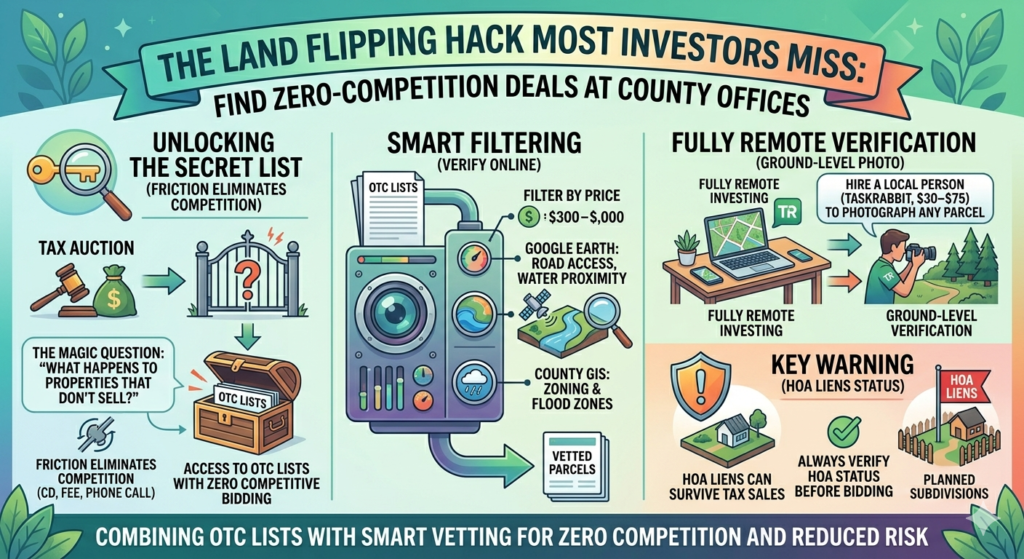
When a county holds a tax sale auction and a parcel doesn’t sell — no bidders, or the minimum bid wasn’t met — that parcel doesn’t disappear. The county still owns it. They still want to get rid of it.
These unsold parcels go into what different counties call different things: a “property vault,” an OTC list, a repository, or a surplus property list. Whatever the name, the concept is the same: OTC tax deed land the county couldn’t sell at auction, available for direct purchase without competitive bidding.
The magic question to ask any county tax office:
“What happens to properties that don’t sell at your tax sale auction?”
That one question unlocks access to a list of OTC tax deed land you can buy directly — no auction, no competing bids, often at prices that reflect the county’s desire to just get them off their books.
Some counties email you the list. Some post it on their website. Some — and this is where it gets interesting — only provide it on a CD. Or charge a $50 processing fee. Or make you come in person to request it.
Why the Inconvenient OTC Tax Deed Land List Is the Best List
Most investors hear “they only provide it on CD” or “there’s a $50 fee” and move on. Too much hassle.
That reaction is exactly why those OTC tax deed land lists are valuable.
If getting the list requires a CD player, a small fee, or a phone call to a county clerk — 90% of casual investors won’t bother. The list you have to work slightly harder to obtain is the list with the least competition.
Friction is your friend. Lean into it.
How to Work the OTC Tax Deed Land List
Once you have the list, here’s how to filter it efficiently.
Step 1: Import into a spreadsheet. Put every parcel into Excel or Google Sheets. Columns for parcel ID, address or location, county, minimum purchase price, and acreage.
Step 2: Filter by price. Sort lowest first. Set a budget threshold — say, $5,000 or less. Everything above that gets set aside for now.
Step 3: Quick location check. For each remaining OTC tax deed land parcel, look it up on Google Maps. Is there a road touching the property? If not — landlocked, skip it. Is there water nearby? Flag it. What’s the surrounding area like? This step takes 2–3 minutes per parcel once you get efficient.
Step 4: Deeper research on survivors. Pull the county GIS record. Check zoning. Look for flood zone designation, conservation easement, or deed restrictions.
Step 5: Check for HOA liens.
This one is critical and easy to miss on OTC tax deed land.
Most tax deed sales wipe out existing mortgages and liens. But HOA liens don’t always get wiped — it depends on the state and the specific sale structure. If you purchase a parcel with an outstanding HOA lien, you may inherit that debt along with the property.
Before you buy any OTC tax deed land parcel in a planned development or subdivision, verify the HOA status. Call the county. Ask specifically whether HOA liens survive the tax sale. A $2,000 parcel with a $15,000 HOA lien attached is not a deal. It’s a liability.
The TaskRabbit Solution for Remote OTC Tax Deed Land Research
You’ve found an OTC tax deed land parcel that looks promising on Google Earth. Good road access. Decent location. Reasonable price. But you want eyes on the ground before you commit.
TaskRabbit.
TaskRabbit is a platform where you can hire someone locally to do tasks for you. Post a job asking someone in that county to drive by the parcel, take photos from the road and surrounding area, and send them to you.
Cost: typically $30–$75 depending on the location and distance.
What you get: current photos, a ground-level view that satellite images can’t provide, and confirmation that what Google Earth shows is actually what’s there.
For a $500 OTC tax deed land parcel, spending $50 on a TaskRabbit site visit is reasonable insurance. For a $3,000 parcel, it’s almost mandatory.
The HOA Lien Problem in OTC Tax Deed Land — In Detail
When a property goes through a judicial tax sale in Pennsylvania, most liens are extinguished — mortgages, judgment liens, municipal liens.
But HOA liens occupy a gray area. Some states treat them as superior liens that survive tax sales. Pennsylvania’s treatment depends on the specific circumstances and how the HOA lien was recorded.
The practical rule: if an OTC tax deed land parcel is located in a subdivision with an active HOA — look for uniform street names, similar housing styles, a neighborhood association name — do extra verification before you buy. Call the county. Call a title company. Ask specifically about HOA lien survival.
The Complete OTC Tax Deed Land Workflow
- Identify target counties — Pennsylvania has 67 counties. Start with a few in areas you find interesting (Pocono region, Central PA, rural southwest PA)
- Call the county tax claim bureau — Ask the magic question. Get on the OTC list. Accept whatever format they offer, even if it’s inconvenient
- Import and filter the list — Price, location, road access
- Quick Google Earth check — Water nearby? Road access? Surrounding context?
- Deeper GIS research — Zoning, flood zone, deed restrictions, HOA status
- TaskRabbit site visit — For anything you’re seriously considering
- Purchase — Pay the county directly. Get the deed
- List and sell — LandWatch, Zillow, Facebook Marketplace, Land.com
The whole process runs from your laptop. The site visit is the one step that requires another human being — and you can hire that human on TaskRabbit for less than a dinner out.
According to BiggerPockets, OTC tax deed land investing consistently attracts less competition than auction-based strategies precisely because of the additional steps required to access county surplus property lists — the friction that discourages most investors is exactly what creates the opportunity for those willing to make the phone call.
Use the Land Potential Analyzer to evaluate any OTC tax deed land parcel before you purchase — check road access, zoning, water proximity, and comparable land sales before you commit to anything.
Not financial advice — just someone doing a lot of research and asking a lot of questions.