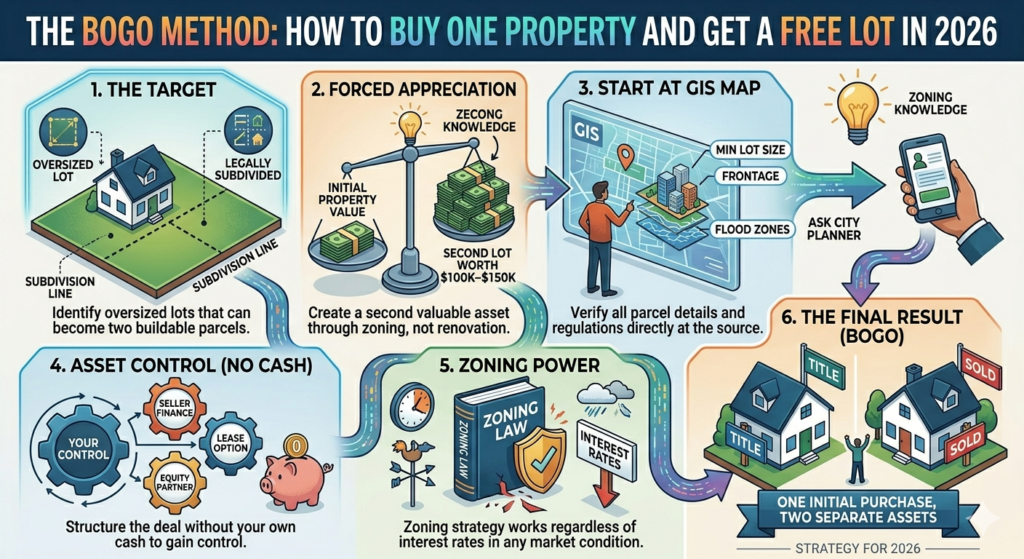
Lot subdivision investing is the most creative reframe I’ve seen for forcing appreciation without renovation work. The BOGO Method — Buy One, Get One — means you buy one property and engineer a second lot out of the same land. No extra purchase. Just smarter acquisition.
Stop Looking for Fixer-Uppers: The Lot Subdivision Investing Mindset Shift
Most beginner investors go hunting for distressed properties — the peeling paint, the broken porch, the house that needs everything. But you’re leaving money on the ground. Literally.
Lot subdivision investing targets properties with underutilized land — specifically, lots big enough to subdivide into two separate buildable parcels. You buy one property, split the lot, and suddenly you have a second piece of land worth $100K–$150K that didn’t exist before.
That’s forced appreciation. You created value through paperwork and zoning knowledge, not renovation work.
What to look for:
- Properties with lots noticeably larger than their neighbors
- Corner lots — these often have frontage on two streets, which makes subdivision easier
- Homes built in the 1970s–80s with oversized backyards
- Areas where zoning already allows smaller minimum lot sizes
In Philadelphia, this is genuinely interesting. The city has a patchwork of zoning codes, and there are pockets — especially in the outer neighborhoods — where large lots exist that haven’t been developed. The trick is knowing where to look and how to read the rules.
Lot Subdivision Investing Starts at the Zoning Map, Not Zillow
Before you get excited about any specific property, you need to verify that subdivision is actually legal. This is where most people stop — and where the lot subdivision investing opportunity lives.
Step 1: Pull the GIS map.
Philadelphia’s GIS is publicly available. Find the property, identify the zoning designation (R1, R2, RSA-5, etc.), and look up what that code allows.
Step 2: Find the minimum lot size.
This is the most important number in lot subdivision investing. If your lot is 12,000 square feet and the zoning code requires a minimum of 5,000 square feet per lot, you can legally create two lots.
Philadelphia’s zoning is actually more permissive than people think in certain categories. RSA-5, which covers a huge swath of the city’s rowhouse neighborhoods, allows relatively small minimum lot sizes.
Step 3: Check the constraints.
- Road frontage — each new parcel needs legal access to a street
- Flood zones — FEMA maps show if part of the lot is in a flood plain, which kills buildability
- Wetlands — less common in urban Philly but relevant in surrounding counties
- Slope and drainage — affects construction feasibility
Step 4: Just ask.
Walk into the city planning office (or call) and ask: “Is this parcel legally subdivisible under its current zoning?” City planners answer this question constantly. It’s their job. You’ll get a direct answer faster than any amount of internet research.
Philadelphia’s L&I and the city planning department are both publicly accessible — and having that conversation is a skill worth building for any serious lot subdivision investing strategy.
How to Structure Lot Subdivision Investing With No Money Down
The BOGO method doesn’t require you to buy the property outright before you extract the value. Three ways to structure it with little or no cash:
1. Seller Finance or Lease Option
Negotiate a 12–24 month lease option with the seller. You control the property, go through the subdivision process during that window, and create the second lot before you actually close on the purchase. By the time you buy, the value is already there.
The seller gets a committed buyer and monthly payments. You get time to do the lot subdivision investing work that creates the profit.
2. Bring in an Equity Partner
If you’ve found a legitimate lot subdivision investing deal — real numbers, real zoning confirmation, real comps on what the subdivided lot would sell for — you can take that to a private money investor and split the upside.
The key is presenting a packet, not a phone call. A real document that lays out the opportunity including the risks. Investors who’ve been around appreciate honesty about the downside — it builds trust faster than a perfect-sounding pitch.
3. Wholesale the Contract
Put the property under contract with an “and/or assigns” clause, which lets you transfer the contract to another buyer. Find an investor who wants the deal, charge an assignment fee — numbers like $30K are realistic on good lot subdivision investing deals — and walk away with cash without ever closing on the property yourself.
Why Lot Subdivision Investing Works Regardless of Interest Rates
Most real estate strategies are interest rate dependent. When rates are high, cash flow compresses, buyers pull back, and deals get harder to pencil.
Zoning doesn’t care about interest rates.
The value of a subdividable lot is determined by what comparable lots sell for in that market — not by what a mortgage costs this month. If you create a new buildable parcel in a neighborhood where lots sell for $120K, that lot is worth $120K whether rates are at 4% or 8%.
That’s the developer mindset behind lot subdivision investing: stop reacting to the market and start creating value independent of it. Land doesn’t lie. The numbers either work or they don’t — and you can verify them before you commit a dollar.
What Lot Subdivision Investing Looks Like in Philadelphia
Philadelphia is one of the more interesting cities for this strategy because of how fragmented the lot landscape is. Decades of population shifts, abandonment, and redevelopment have left some neighborhoods with genuinely unusual lot configurations.
What I’d focus on for a Philadelphia lot subdivision investing play:
- Germantown, Mt. Airy, West Oak Lane — older housing stock, larger lots, lower price points
- Corner properties near transit — SEPTA access adds value to any new buildable parcel
- Philadelphia Zoning Code — the city’s zoning map is at phila.gov and the code is searchable
- Philadelphia Land Bank — city-owned vacant lots are sometimes available for development
According to BiggerPockets, lot subdivision investing is one of the highest-return forced appreciation strategies available to individual investors precisely because the value creation happens through zoning knowledge and paperwork rather than construction — making it accessible to investors without large renovation budgets or contractor networks.
Use the Strategy Score Rankings to evaluate whether lot subdivision investing fits your current situation — capital level, market access, and timeline — before you start pulling GIS maps on specific properties.
Not financial advice — just someone doing a lot of research and asking a lot of questions.