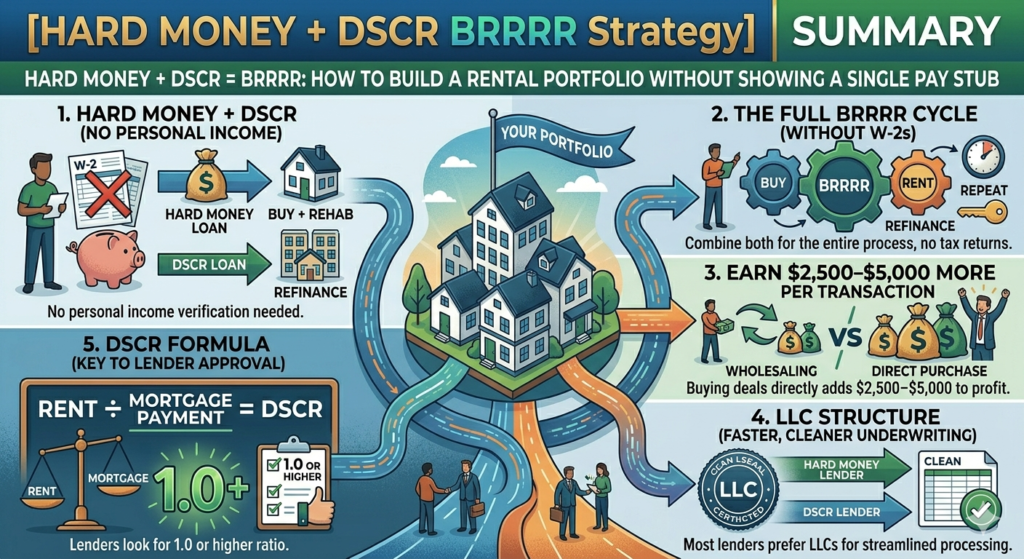
Hard money DSCR loan combination is the financing strategy that changed how I think about building a rental portfolio. If you’ve ever tried to get a traditional bank loan for an investment property, you already know how painful it is — two years of tax returns, W-2s, proof of income, a perfect credit score. For someone where tax returns don’t exactly scream “give her a mortgage,” this has always felt like a wall.
What Is the Hard Money DSCR Loan Combo?
Hard money is a short-term loan based on the property’s value — not your income. You use it to buy and rehab a property fast. Rates are higher (usually 10–14%), but the approval process is quick and they don’t care about your W-2.
DSCR loans (Debt Service Coverage Ratio) are long-term loans where the lender looks at the property’s rental income — not your personal income. As long as the rent covers the mortgage (typically a DSCR of 1.0–1.25+), you can qualify.
Put the hard money DSCR loan together and you get the full BRRRR cycle:
- Buy with hard money
- Rehab the property
- Rent it out
- Refinance with a DSCR loan (pay off the hard money)
- Repeat
No pay stubs. No income verification. No sitting across from a bank officer explaining why your Schedule C looks the way it does.
Why the Hard Money DSCR Loan Strategy Is a Bigger Deal Than It Sounds
Most people who get into real estate start by assigning contracts — finding deals and flipping the paperwork to another buyer for a fee. It works, but you’re doing all the legwork and handing the profit to someone else.
When you actually buy the deal yourself using hard money, you keep the full spread. We’re talking an extra $2,500 to $5,000 per deal that would’ve otherwise gone to the end buyer. Over a few deals, that adds up fast.
The shift is going from being a middleman to being the actual investor. And the hard money DSCR loan combo is what makes that possible — even without a ton of cash or a clean income history.
The LLC Question for Hard Money DSCR Loan Borrowers
This strategy works best when you’re operating inside an LLC.
Why? Because hard money lenders and DSCR lenders are lending to the business, not to you personally. That means:
- No personal income verification
- Cleaner separation between your personal finances and investment activity
- Faster underwriting — DSCR lenders don’t need to dig into your personal tax returns
What if you already have an Inc (corporation) instead of an LLC?
The short answer: it depends on the lender. Some hard money DSCR loan lenders will work with S-corps or C-corps, but many prefer LLCs because the structure is simpler and more common in real estate. If you already have an Inc, call a few lenders directly and ask before you go set up a new entity.
For most people starting from scratch, LLC is the move.
What DSCR Actually Looks At in a Hard Money DSCR Loan
DSCR = Monthly Rental Income ÷ Monthly Debt Payment
If a property rents for $1,500/month and your mortgage payment is $1,200/month, your DSCR is 1.25 — which most lenders will approve.
Most hard money DSCR loan lenders want:
- DSCR of 1.0 or higher (some go down to 0.75 with conditions)
- Credit score of 660–680+
- The property to be rent-ready or already rented
That’s it. They’re not asking where your income comes from.
Hard Money Basics for the Hard Money DSCR Loan Combo
Hard money isn’t cheap — but it’s fast and flexible:
| Interest rates | 10–14% typical |
| Loan term | 6–18 months (short-term bridge) |
| LTV | Usually 65–75% of ARV |
| Points | 2–4 points upfront |
| Approval | Days, not weeks |
The goal is never to stay in a hard money loan. You get in, do the rehab, get a tenant, then refinance into the DSCR side of the hard money DSCR loan combo as fast as possible to stop paying those high rates.
Is the Hard Money DSCR Loan Strategy Right for You?
This combo solves a very specific problem: how do you get financing when your income on paper doesn’t reflect reality?
If you’re self-employed, have inconsistent income, or are just getting started — the hard money DSCR loan combination is worth understanding deeply before you go anywhere near a conventional lender.
The BRRRR method isn’t new. But using hard money plus DSCR to fund it without a traditional income history? That’s the part that actually opens the door for people like us.
According to BiggerPockets, hard money DSCR loan combinations have become one of the most widely used financing structures for self-employed real estate investors since 2022 — precisely because DSCR underwriting eliminates the personal income documentation that blocks so many otherwise qualified borrowers from conventional financing.
Use the BRRRR Calculator to model your full hard money DSCR loan cycle — plug in purchase price, rehab cost, ARV, and projected rent to see your post-refinance cash flow before you commit to any deal.
Not financial advice — just someone doing a lot of research and asking a lot of questions.