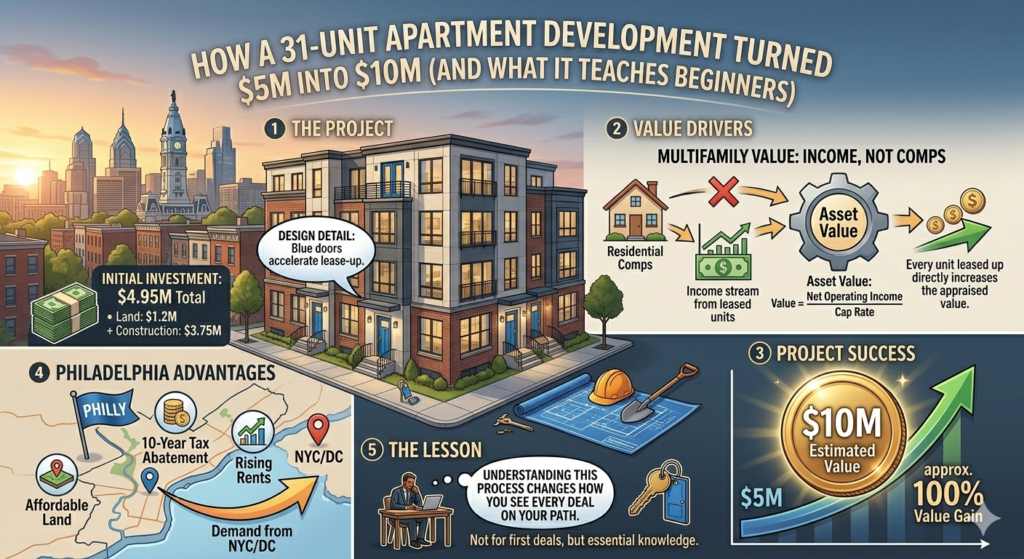
Apartment development cost $4.95 million. End value: $10 million. That’s the story of a 31-unit project on Taylor Street that completely changed how I think about real estate at scale.
When I first started looking at real estate, I was thinking about $100,000 rowhouses and $40,000 flips. Then I came across this project — and my brain had to stretch in a completely different direction.
Here’s exactly what was built, what it cost, and what it teaches beginners about how development actually creates value.
The Apartment Development Cost Breakdown
| Land acquisition | $1,200,000 |
| Construction cost | $3,750,000 |
| Total apartment development cost | $4,950,000 |
| Current estimated value | $10,000,000 |
Nearly $5 million in. Roughly $10 million in value created.
The project completed in late February. At the time of the video, the building was about 50% leased. And here’s the critical thing — the $10 million valuation isn’t fixed. It goes up as occupancy goes up.
That’s not how residential real estate works. That’s how commercial multifamily works. Understanding the difference changes everything.
Why Occupancy Drives Value — Not Comps
In residential real estate, your house is worth what comparable houses sold for. Comps drive value.
In commercial multifamily — anything above 4 units — value is driven by income. Specifically, by the cap rate.
Value = Net Operating Income ÷ Cap Rate
If your building generates $500,000 in annual net income and the market cap rate is 5%, your building is worth $10,000,000.
Watch what happens when occupancy increases:
- 50% occupied → less income → lower value
- 80% occupied → more income → higher value
- 95% occupied → maximum income → maximum value
This is why the focus after hitting the apartment development cost target is purely on leasing up. Every unit filled directly increases the appraised value of the asset. You’re not just collecting rent — you’re building equity with every signed lease.
The Blue Front Door Detail
This is the part I keep thinking about.
In a market where multiple apartment buildings are competing for the same tenants, one specific design choice was mentioned: blue front doors.
That’s it. Blue doors.
The reasoning: differentiation. When someone is driving around looking at apartments or scrolling through listings, you want your building to be the one they remember. A distinctive color choice costs almost nothing relative to a $4.95 million apartment development cost — but it creates a visual identity that makes the property stick in people’s minds.
In a 50% leased building where every vacant unit suppresses asset value, anything that accelerates leasing matters. A building that leases up in 4 months versus 8 months is worth significantly more money, faster.
Breaking Down the Apartment Development Cost Per Unit
Land: $1.2M Land cost per unit = $38,700. This is actually reasonable for a project this size. Land is often the most negotiable part of any apartment development cost — which is why developers spend so much time finding the right parcel at the right price.
Construction: $3.75M Construction cost per unit = $121,000. This covers foundation, framing, mechanical, electrical, plumbing, and finishes. At $121K per unit for new construction, this is on the efficient end.
Total apartment development cost per unit: $159,700 Estimated value per unit at stabilization: $322,600
That’s the spread. That’s what development creates — value that didn’t exist before.
Could This Apartment Development Cost Structure Work in Philadelphia?
Philadelphia is actually one of the better markets in the country for this kind of development right now.
Land is still relatively affordable. Compared to Charlotte, Austin, or Phoenix, Philadelphia still has parcels available at reasonable prices — especially in transitioning neighborhoods like Germantown, parts of North Philly, and areas along the Delaware.
The 10-Year Tax Abatement. Philadelphia offers a 10-year tax abatement on new construction. Not paying property taxes for a decade directly improves NOI — and therefore asset value — on any new development.
Rising rents with affordable entry. A 1-bedroom in Germantown goes for $1,500/month. A 2-bedroom pushes $2,200. For new construction with modern finishes, you can command a premium — while apartment development costs here remain lower than coastal metros.
According to Census.gov, Philadelphia’s population growth — driven partly by people priced out of New York and DC — has created sustained demand for new rental product that well-designed buildings absorb quickly.
The Honest Reality: This Isn’t a Beginner’s First Deal
A $5 million apartment development cost is not where most people start. It’s not where I’m starting.
The path looks more like:
- First flip or house hack — learn the fundamentals
- Small multifamily — 4–8 units, understand landlording at scale
- First small development — maybe 6–10 units with a construction loan
- Larger multifamily acquisition — buy existing value-add
- Ground-up development at scale — 20, 30, 50+ units
Nobody starts at 31 units. But understanding what’s possible at the end of that road — how $5M becomes $10M, how occupancy drives value, how design details affect leasing velocity — changes how you think about every step along the way.
I’m looking at 4-unit buildings in Germantown right now. That’s the right place to start.
Use the House Build Cost Calculator to model your own development numbers — including land, construction, and projected value at stabilization — before you commit to any project.
Not financial advice — just someone doing a lot of research and asking a lot of questions.