I’ve spent a lot of time on this blog writing about multifamily investing. Duplexes, triplexes, fourplexes, BRRRR strategies, NOI calculations. And I stand by all of it — multifamily is a legitimate wealth-building path.
But here’s something I’ve been thinking about lately.
Everyone is chasing the same deals. Multifamily inventory is tight, cap rates have compressed, and competition from institutional investors has made finding good deals harder than it was five years ago.
Meanwhile, there are three commercial property types that most residential investors never even consider — and that’s exactly what makes them interesting.
Why Commercial Real Estate Works Differently
Before getting into the specific property types, one thing worth understanding: commercial properties are valued the same way multifamily properties are — by income, not by comps.
Property Value = NOI ÷ Cap Rate
This means you can engineer value through operations. Raise rents, reduce expenses, change the lease structure — and you directly increase what the property is worth. You’re not waiting for the neighborhood to carry you.
The other thing worth knowing: commercial leases are typically longer than residential leases. Three, five, ten years. That stability changes the math on cash flow significantly.
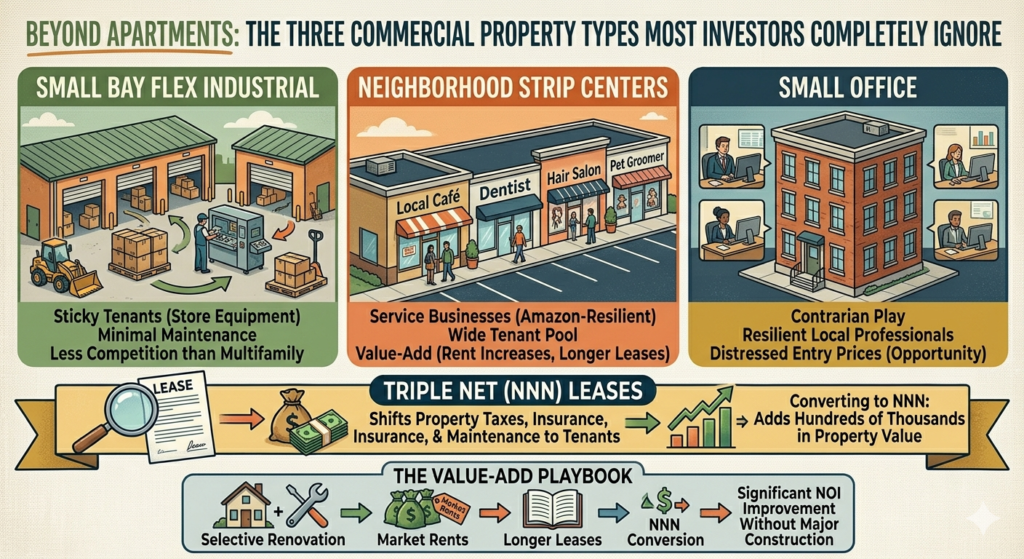
Property Type 1: Small Bay Flex Industrial
This is the one that gets the least attention and arguably has the most going for it right now.
Small bay flex industrial buildings are exactly what they sound like — a single building divided into multiple smaller units, each with a combination of office space in the front and warehouse or workshop space in the back. The back has a large roll-up door so vehicles, equipment, and inventory can move in and out easily.
Think about the businesses that use these spaces: plumbers, electricians, HVAC contractors, small manufacturers, catering companies, auto detailers, landscaping companies. Every city and suburb has dozens of these businesses — and they all need space to store equipment, park vans, and run basic operations.
Why this works as an investment:
Tenants who move equipment and inventory into a space don’t move out easily. Relocating a plumbing supply operation is a serious undertaking. These tenants tend to stay — and renew — because leaving is genuinely disruptive to their business.
The spaces themselves require minimal maintenance. There’s no luxury finishes to worry about, no high-end appliances to replace, no aesthetic expectations to meet. Tenants want functional, clean, and secure. That’s it.
And because most residential investors never look at industrial properties, competition for good deals is significantly lower than in the multifamily market.
In the Philadelphia area, you can find these buildings in Northeast Philly, Norristown, Conshohocken, and throughout the suburbs — often at cap rates that would be hard to find on comparable multifamily.
Property Type 2: Neighborhood Strip Centers
Not the big regional malls. Not the power centers anchored by a Target or a Home Depot. The small neighborhood strip center — five to ten units, anchored by a pizza place, a nail salon, a local restaurant, a dry cleaner.
This category got a bad reputation during the retail apocalypse narrative of the 2010s. And large format retail did struggle. But neighborhood strip centers serving local, service-based businesses have been quietly resilient.
Here’s why: you can’t get a haircut on Amazon. You can’t order a nail appointment for next-day delivery. A neighborhood pizzeria isn’t competing with e-commerce — it’s competing with the pizzeria two blocks away.
The tenant pool for neighborhood strip centers is also wide. If a tenant leaves, you’re not looking for a specific national retailer to replace them — you’re looking for any of dozens of local service businesses that need affordable, visible retail space.
The value-add play:
Many smaller strip centers are owned by original developers who’ve held them for decades. Rents are often significantly below market. Leases are month-to-month or short-term. The physical condition may be dated.
Bring rents to market, sign tenants to five-year leases, update the parking lot and facade — and you’ve moved the NOI meaningfully without a major renovation. At a 7% cap rate, every $10,000 in annual NOI improvement adds roughly $143,000 in property value.
Property Type 3: Small Office — The Contrarian Play
This one requires the most conviction because the narrative around office is genuinely bad right now.
Remote work gutted large format office. Downtown Class A towers in major cities have vacancy rates that would have been unthinkable in 2019. “Office is dead” has become conventional wisdom.
But conventional wisdom creates opportunity — specifically in the segment that the bad narrative doesn’t actually apply to.
Small, local professional office space — the kind used by insurance agents, financial advisors, therapists, accountants, chiropractors, and similar businesses — has held up much better than the headline numbers suggest. These are businesses that need a physical presence in their community. Their clients come to them. Remote work doesn’t apply.
And because “office” is currently a dirty word in commercial real estate, you can buy small office buildings at prices per square foot that would have been impossible five years ago.
The play:
Find a small office building — 5,000 to 15,000 square feet — that’s partially vacant and trading at a distressed price because of the negative office sentiment. Divide the space into smaller suites (800 to 1,500 square feet) targeting local professional tenants. Price competitively. Fill the vacancies.
As occupancy improves and NOI increases, the value follows. You bought at distressed cap rates and stabilized to market cap rates — that spread is your return.
This requires more patience and more leasing expertise than industrial or retail. But the entry prices in many markets make the risk-reward compelling for investors willing to do the work.
The NNN Lease: Why Commercial Landlords Sleep Better
One structural advantage of commercial real estate that residential investors often don’t realize exists: the Triple Net lease, or NNN.
In a standard residential lease, the landlord pays property taxes, building insurance, and most maintenance costs. These expenses come out of rent revenue and directly reduce NOI.
In a Triple Net lease, the tenant pays property taxes, building insurance, and maintenance costs — on top of base rent. The landlord receives base rent and has almost no operating expenses.
The math on this is significant.
Say you own a small strip center where the total property taxes and insurance run $30,000/year. In a gross lease structure, those costs come out of your NOI. In a NNN structure, tenants cover them — and your NOI is $30,000 higher.
At a 7% cap rate:
$30,000 ÷ 0.07 = $428,571 in added property value
Same property. Same rents. Different lease structure — and almost half a million dollars in value difference.
Converting existing month-to-month or gross leases to NNN leases at renewal is one of the highest-leverage value-add moves in commercial real estate. It requires negotiation and sometimes a period of below-market rent to incentivize tenants to accept the new terms. But the value creation is real.
The Commercial Value-Add Playbook
Across all three property types, the value-add approach follows the same framework:
Renovate selectively. Roof, HVAC, parking lot, exterior paint, updated lighting. Focus on what affects function and first impression — not cosmetic upgrades tenants don’t value.
Bring rents to market. Long-held properties often have rents 20–40% below current market. Each lease renewal is an opportunity to close that gap.
Extend lease terms. Month-to-month tenants represent income risk and reduced property value. A signed five-year lease from a creditworthy tenant adds stability that appraisers and buyers recognize.
Convert to NNN where possible. The single highest-impact lease structure change available in commercial real estate.
Execute all four and you’ve moved the NOI significantly — which at commercial cap rates means meaningful value creation without major construction.
Where This Fits on My Roadmap
I’m not buying a strip center tomorrow. My current focus is building experience, capital, and relationships in the residential and small multifamily space first.
But I find commercial real estate genuinely compelling — specifically because everyone else is looking somewhere else. The investors competing for every decent duplex in Philadelphia aren’t calling on small industrial buildings in Norristown. That gap is interesting.
When the time comes, I’ll be looking at it seriously.
Not financial advice — just someone doing a lot of research and asking a lot of questions.