Welcome back to my journey of learning the ins and outs of real estate investment. Usually, we talk about fixing and flipping houses or buying existing rentals. But recently, while studying some advanced strategies, I came across a story that completely blew my mind and reshaped how I look at commercial real estate.
Honestly, I always thought that building commercial properties (like shopping centers or office buildings) was only for massive construction companies or billionaire developers with special licenses. I never imagined it was something an individual investor like me could even dream of.
But I was wrong. And this story taught me a strategy so brilliant that I can’t stop thinking about it. Imagine eventually reaching a point where you own a prime commercial building, with top-tier tenants, generating massive cash flow, and having zero mortgage debt on it.
Sounds like a fantasy, right? Let me break down the strategy I learned.
The “Strategic Partial Sale” Strategy
The core of this approach isn’t about building something and selling it immediately for a quick profit. It’s a long-term play focused on eliminating risk and securing perpetual income.
Here is the blueprint:
- The Total Investment: The investor buys land and constructs a commercial building. Let’s say the total cost (land + construction) is $1 million.
- The Brilliant Twist: Instead of selling the whole thing, or keeping the whole thing and struggling with a massive mortgage, the investor sells only a “part” of the project.
- Debt Elimination: The goal of this partial sale is very specific: generate exactly enough cash to pay off the entire $1 million investment (the land cost and the construction debt).
- The Result: The investor now owns the remaining portion of the building completely free and clear. They have their initial capital back, and they have no mortgage.
Passive Income Heaven
Because the remaining property has no debt, every single dollar of rent collected becomes pure profit (minus basic operating costs).
In the scenario I studied, the investor secured well-known, reliable brands as tenants (think major fast-food chains or national retailers). These tenants provide a stable, long-term income stream—roughly $100,000 a year in pure, debt-free cash flow.
Can “Regular People” Really Do This?
This is the part that got me excited. Is this opportunity only for a select few?
The answer is NO. Legally, any individual can be a developer. You don’t need a special license to be the “owner” who builds a property.
However, the barrier isn’t the law; it’s complexity and capital. A regular investor can’t do this alone. To pull this off, you need to build a “Dream Team” of professionals to play the parts you can’t:
- Architects & Engineers: To design the vision.
- A Licensed General Contractor: To actually do the building.
- Commercial Real Estate Brokers: To find the right land and, crucially, pre-lease spaces to top tenants before you even start building (which helps get financing).
- Lawyers & Accountants: To handle the complex contracts, partial sale structure, and taxes.
So, while a “regular person” can do this, they must act as the conductor of an orchestra, not the solo musician.
Final Thoughts: My Future Goal
Reading about this strategy has given me a new ultimate goal. The idea of strategically developing a property, selling part of it to eliminate all debt, and then holding the rest for perpetual, stress-free income… it’s just brilliant.
I know I’m not ready for a million-dollar development deal today. I still have a lot to learn in the residential space. But just knowing that this path exists for individual investors like me? It’s inspiring.
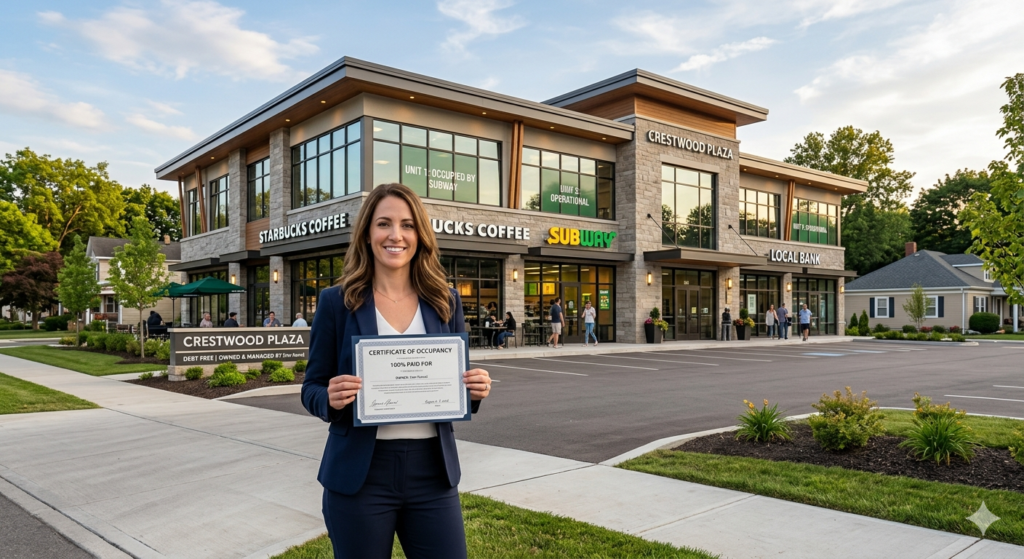
I keep imagining myself standing in front of a building I developed, holding a certificate of occupancy, and knowing it’s 100% paid for. It’s a beautiful daydream, and one that I’m now going to start actively planning for.