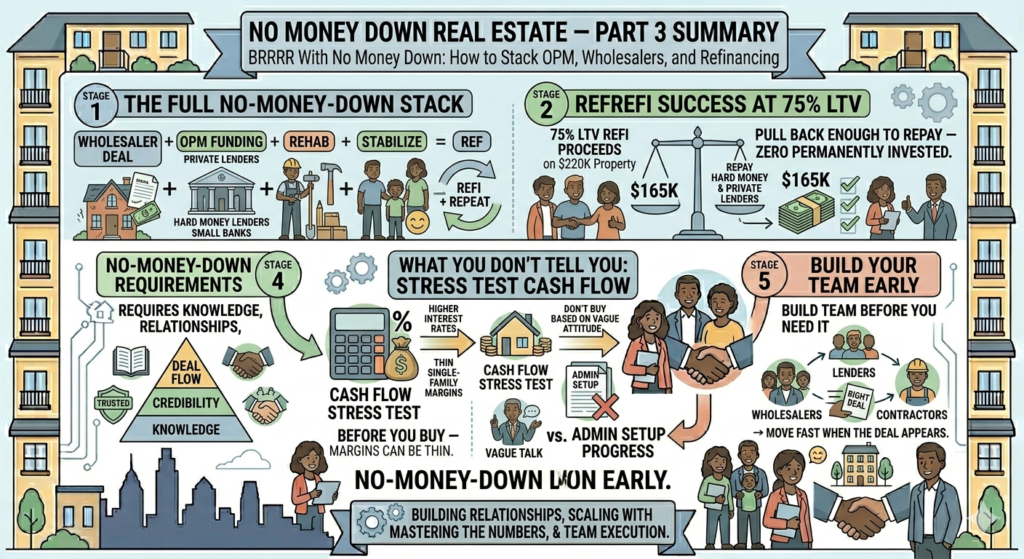
BRRRR no money down is where theory becomes a real transaction. We’ve covered the money side — OPM sources. We’ve covered the deal side — wholesalers. Now let’s talk about what it actually looks like when you put it all together with real numbers.
The Full BRRRR No Money Down Stack
Here’s the framework, end to end:
- Build your team first — hard money lender, private lender, wholesaler relationships, contractor, title company
- Get a deal from your wholesaler network that meets your criteria
- Fund it with OPM — hard money for acquisition and rehab
- Rehab and stabilize — get it rented, NOI optimized
- Refinance into long-term financing, pull capital back out
- Repeat with the same capital recycled into the next deal
None of your own money permanently tied up. The tenants pay the mortgage. The asset appreciates. You move on to the next one.
That’s the BRRRR no money down loop. Simple in concept. Here’s what it looks like with real numbers.
A Real Example: Philadelphia Rowhouse BRRRR No Money Down
A wholesaler sends you a 3-bedroom rowhouse in West Philadelphia.
| ARV (After Repair Value) | $220,000 |
| Wholesaler asking price | $105,000 |
| Estimated repairs | $45,000 |
| Total cost basis | $150,000 |
| Equity at ARV | $70,000 |
70% Rule Check: Hard money lenders typically want all-in costs at or below 70% of ARV.
$220,000 × 0.70 = $154,000 max. Your all-in: $150,000 ✅ — deal passes.
Funding the BRRRR No Money Down Deal:
- Hard money lender covers 90% of purchase + 100% of rehab
- Your out of pocket: roughly $10,500 (10% of purchase)
- Or — a private lender covers that 10% gap
- Your out of pocket: $0
The Rehab Phase
This is where a lot of BRRRR no money down deals fall apart — not because the financing didn’t work, but because the rehab went sideways.
Hard money lenders release rehab funds in draws — you complete a phase of work, they inspect, they release the next chunk. Which means your contractor needs to be able to front costs temporarily, or you need a small working capital cushion.
Vet your contractors before you need them. Get multiple bids. Check references. Build a 10–15% contingency into every rehab budget — because something always comes up.
Stabilization: Getting It Rent-Ready
Once rehab is done, you need a tenant fast. Every month the property sits vacant is a month you’re paying hard money interest with no income coming in.
For a single-family in West Philadelphia, you’re looking at market rents somewhere in the $1,400–$1,800 range depending on condition and exact location. Price it right, screen tenants properly, and get it occupied.
The Refinance: Getting Your Capital Back Out
Now you go to a conventional or portfolio lender with a stabilized, rented property appraised at $220,000.
Most lenders will do a cash-out refinance at 75–80% LTV on an investment property:
$220,000 × 0.75 = $165,000 loan Hard money loan balance: ~$150,000 Cash out: $15,000 back in your pocket
Plus you’ve repaid the private lender who covered your down payment gap.
Net result: you own a rented property in West Philadelphia with a conventional 30-year loan. Your tenants are covering the mortgage. You’ve recycled your capital and you’re ready for the next BRRRR no money down deal.
Does the BRRRR No Money Down Deal Actually Cash Flow?
Let’s stress test this honestly.
| Monthly rent | $1,600 |
| Mortgage (30yr, 7.5%, $165K) | -$1,154 |
| Taxes + Insurance | -$350 |
| Property management (10%) | -$160 |
| Maintenance reserve (5%) | -$80 |
| Vacancy reserve (5%) | -$80 |
| Monthly cash flow | -$224 |
Negative. Slightly.
This is the part too many YouTube videos skip past. At today’s interest rates, a lot of BRRRR no money down deals in expensive markets don’t cash flow strongly after refinance. The strategy still builds equity. It still gets your capital back. But the monthly cash flow might be thin or slightly negative depending on the numbers.
This doesn’t make the strategy wrong. It means you have to know going in what you’re optimizing for — equity building, capital recycling, cash flow, or some combination. Run the post-refi numbers before you buy, not after.
According to BiggerPockets, BRRRR no money down deals at today’s rates work best when investors focus on equity creation and capital recycling rather than monthly cash flow — and underwrite accordingly from the start.
What BRRRR No Money Down Actually Requires
Knowledge — ARV, rehab estimating, cap rates, loan structures, and refinance math before deal one. Not after.
Relationships — Hard money lender, private lender, wholesaler, contractor, title company, property manager. You’re building a team.
Credibility — Private lenders especially want to know you know what you’re doing. Your first deal is the hardest because you don’t have a track record yet.
Deal flow — You might look at 20 deals before one meets your criteria. That’s normal. That’s the business.
Execution — Managing contractors, lenders, tenants, timelines, and unexpected problems simultaneously. It’s a skill set you build, not a hack you stumble into.
Where to Start If You’re Not Ready to Pull the Trigger Yet
Build the team before you need it.
Call two or three hard money lenders in Philadelphia and ask their criteria. Show up to one REI meetup and introduce yourself to a wholesaler. Run the numbers on five deals you’ll never buy — just to practice the math. Open a relationship with a community bank and have a conversation about investment property lending.
By the time the right BRRRR no money down deal shows up, you want all of that already in place. The investors who move fast on good deals are the ones who built their infrastructure before they needed it.
Use the BRRRR Calculator to model your own BRRRR no money down deal — plug in purchase price, rehab, ARV, and refinance terms to see exactly what your post-refi cash flow and equity position look like before you make any offer.
Not financial advice — just someone doing a lot of research and asking a lot of questions.