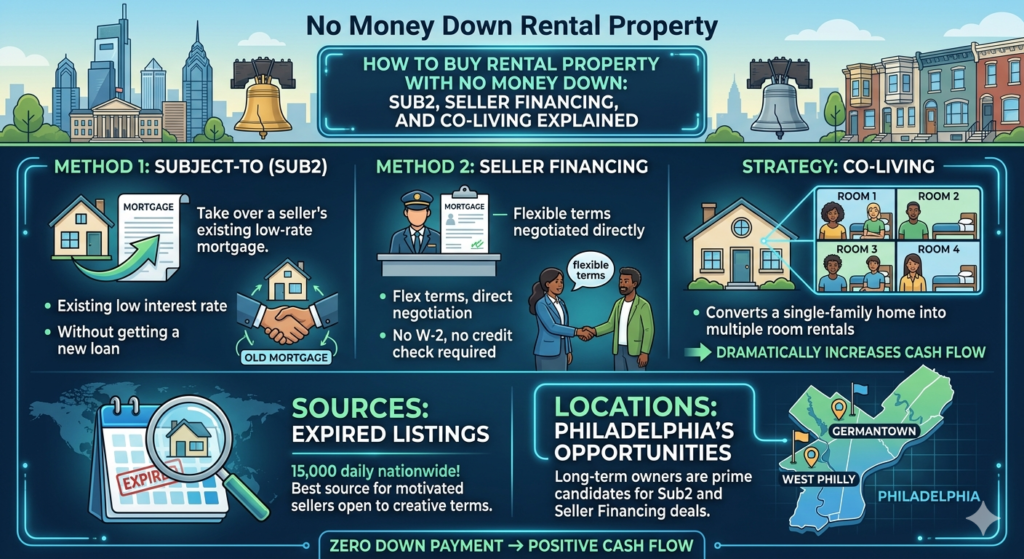
Co-living real estate strategy is one of the most underrated ways to maximize cash flow on a property you bought with creative financing. When I first heard “buy a house with no money down,” I rolled my eyes. But the more I’ve been researching, the more I realize there are legitimate ways to do this — they just require a different kind of work than saving up a down payment.
Here are three strategies worth understanding, with co-living real estate strategy as the one that surprised me most.
Why Traditional Financing Is Broken Right Now
The current market isn’t really an inventory problem. There are houses available. The issue is affordability — interest rates have made monthly payments on a standard mortgage genuinely difficult for a lot of buyers and investors. That affordability gap is exactly where creative financing strategies live.
Strategy 1: Sub2 — Take Over the Seller’s Mortgage
Sub2 is short for “subject to the existing financing.” Instead of getting your own loan, you take over the seller’s current mortgage payments. The loan stays in the seller’s name, but you get the deed and control of the property.
Why would a seller agree to this? More reasons than you’d think — they’re behind on payments and need out fast, they’re relocating and can’t wait for a traditional sale, or they’re burned-out landlords who just want the headache gone.
And here’s why it’s interesting right now: if a seller has a mortgage from 2020 or 2021, they might have a 3–4% interest rate locked in. You take over that loan, you’re carrying that rate — not today’s 7%+ rates.
Quick example: a seller bought in 2021 at 3.5% on a $250,000 loan. Their monthly payment is around $1,120. If you bought that same property today with a new loan at 7%, you’d be paying closer to $1,660 a month. Sub2 saves you $500+ a month from day one.
The catch: there’s a due-on-sale clause in most mortgages. The lender can technically call the loan due when ownership transfers. In practice this rarely happens — lenders don’t love calling performing loans — but it’s a real risk you need to understand.
Strategy 2: Seller Financing — The Seller Becomes Your Bank
Seller financing works when the seller owns the property outright. Instead of going through a bank, you negotiate terms directly — interest rate, down payment, monthly payment, loan term. All of it is negotiable.
When does a seller say yes?
- They’ve owned the property for decades and have a huge capital gains tax bill coming if they sell outright — spreading payments over time reduces that hit
- They want steady monthly income instead of a lump sum
- The property doesn’t qualify for traditional financing anyway
Where to find seller financing deals:
Expired listings — around 15,000 properties expire from MLS daily nationwide. These are sellers who couldn’t sell the traditional way.
Landwatch.com — good for finding land and small multifamily with seller financing already built in, sometimes with $0 down.
Investorlift.com — pre-negotiated Sub2 and seller finance deals already in escrow.
Strategy 3: Co-Living Real Estate Strategy — Turn One House Into Multiple Income Streams
This is the one I hadn’t thought much about before — and it’s genuinely clever.
Instead of renting a single-family home to one tenant for one monthly payment, the co-living real estate strategy converts the space into individual room rentals. Bedrooms, converted dining rooms, finished garage spaces — each one becomes a separate rental unit.
Platforms like PadSplit connect landlords with tenants looking for furnished room rentals. Individual rooms can rent for around $875 a month. If you have a 4-bedroom house plus a converted space, you’re looking at potentially $4,000+ a month in rent versus maybe $1,800 for the whole house to one tenant.
Where Co-Living Real Estate Strategy Gets Really Interesting
Combined with Sub2, the co-living real estate strategy becomes powerful fast.
Buy a house Sub2 with a low inherited interest rate. Convert it into a co-living setup. Now your rental income is significantly higher than a standard rental, and your mortgage payment is lower than what a new loan would cost today.
Example:
- Sub2 mortgage payment at 3.5%: ~$1,120/month
- Co-living rental income (5 rooms × $875): ~$4,375/month
- Monthly spread: ~$3,255 before expenses
That’s the co-living real estate strategy working at full power — creative acquisition combined with income optimization.
It’s more management-intensive than a standard rental — more tenants, more turnover, more communication. But the numbers can work out significantly better than a traditional single-tenant rental.
According to BiggerPockets, co-living real estate strategy has grown significantly in urban markets as housing affordability pressure pushes more renters toward shared living arrangements — which means demand for well-managed co-living properties is strong and growing.
The Part That Actually Takes Work
All three strategies sound great on paper. The harder part is:
- Finding motivated sellers who are open to creative terms
- Building enough credibility that sellers trust you with their biggest asset
- Knowing how to structure deals so they actually work for both sides
- Understanding the legal side — especially with Sub2, which has real risks if not done properly
Philadelphia has a lot of long-term owners — people who bought 20 or 30 years ago, have low or no mortgage, and are getting tired. Germantown, West Philly, Kensington — these neighborhoods have motivated sellers if you know how to find them and talk to them. The co-living real estate strategy works especially well in Philadelphia’s rowhouse stock, where larger homes with multiple bedrooms convert naturally into room-rental setups.
Use the Philadelphia House Hacking Calculator to model your co-living real estate strategy numbers — plug in room rental rates vs whole-house rental to see exactly what the income difference looks like before you commit to a property.
Not financial advice — just someone doing a lot of research and asking a lot of questions.