I’d been assuming depreciation on a rental property was just one flat number you spread out over decades, until I came across cost segregation real estate strategies and realized that’s not actually how it has to work. This isn’t something I’ve done myself, but it’s exactly the kind of thing that made me want to understand the mechanics before I ever bought a multi-unit property.
What Cost Segregation Real Estate Actually Means
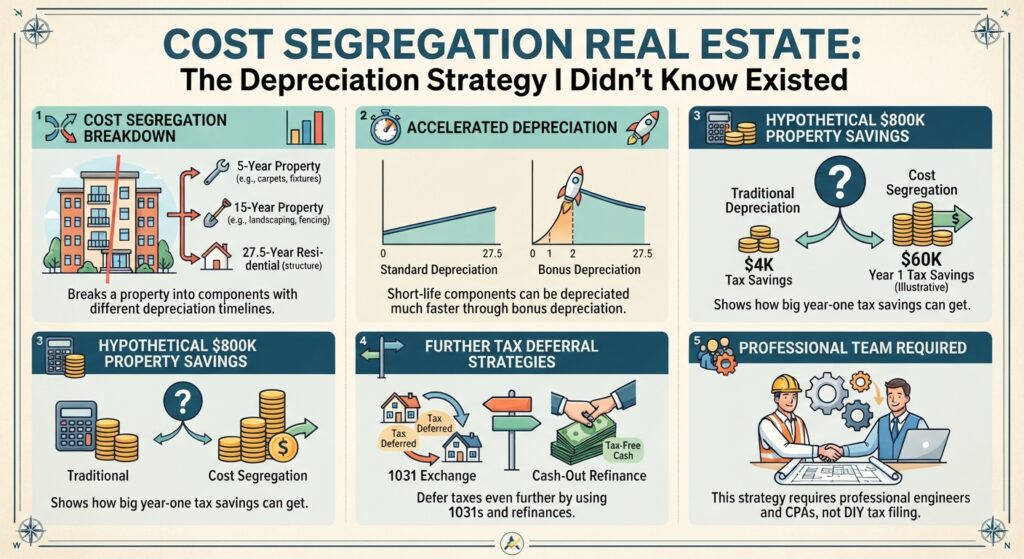
Normally, a rental property depreciates over roughly 27.5 to 39 years, treated as one single asset. Cost segregation real estate studies break that same property down into its individual components — things like flooring, light fixtures, and windows — which the IRS treats as having much shorter useful lives, sometimes 5, 7, or 15 years instead of decades.
Why the Short-Life Components Matter So Much
This is where bonus depreciation comes in. Once those shorter-life components are separated out through a cost segregation real estate study, some of that value can potentially be depreciated much faster — in some cases, within the first year of ownership — instead of spread evenly over the life of the building. Land value itself is excluded from any of this; only the building and its components qualify, and typically 80 to 90% of a purchase price gets allocated to the building for these purposes.
A Hypothetical to Make the Math Concrete
To understand the shape of this, take a hypothetical $800,000 multi-unit property. If a cost segregation real estate study reclassified a meaningful chunk of that value into short-life components, the owner could potentially deduct a large amount against taxable income in year one, which lowers what’s actually owed to the IRS that year. That tax savings, combined with normal cash flow and principal paydown, is part of why some investors treat the tax side of a deal as seriously as the rent roll itself.
1031 Exchanges and Deferring Taxes Long-Term
Cost segregation real estate strategies often get talked about alongside 1031 exchanges, where proceeds from selling one property roll directly into another, deferring capital gains tax rather than eliminating it. A cash-out refinance is sometimes mentioned in the same conversation too, since pulling equity out through a refinance isn’t treated as taxable income the way a sale would be.
Why This Isn’t a DIY Project
Every source I’ve read on cost segregation real estate is clear about one thing: this requires an engineer-led study and a CPA who actually specializes in real estate, not a general accountant doing it as a side task. There’s also something called the IRS real estate professional status that can affect how much of this benefit an investor can actually use, and the requirements around it are specific enough that I wouldn’t try to summarize them here — that’s a conversation for a CPA, not a blog post.
Where I’m At With This
I haven’t done a cost segregation study myself, and I’m not going to pretend I fully understand every rule around it. What I do know is that it’s a real strategy real investors use, and it’s changed how I think about the total return on a property — not just rent minus expenses, but what happens on the tax side too. According to the IRS website on depreciation, depreciation rules for real property are detailed and property-specific, which is exactly why professional guidance matters here more than almost anywhere else in real estate investing. If you want to see how depreciation plays into a property’s numbers more generally, my depreciation calculator is a decent starting point before you ever talk to a CPA about something like this.
Not financial advice — just someone doing a lot of research and asking a lot of questions. Talk to a licensed CPA before making any tax decisions.