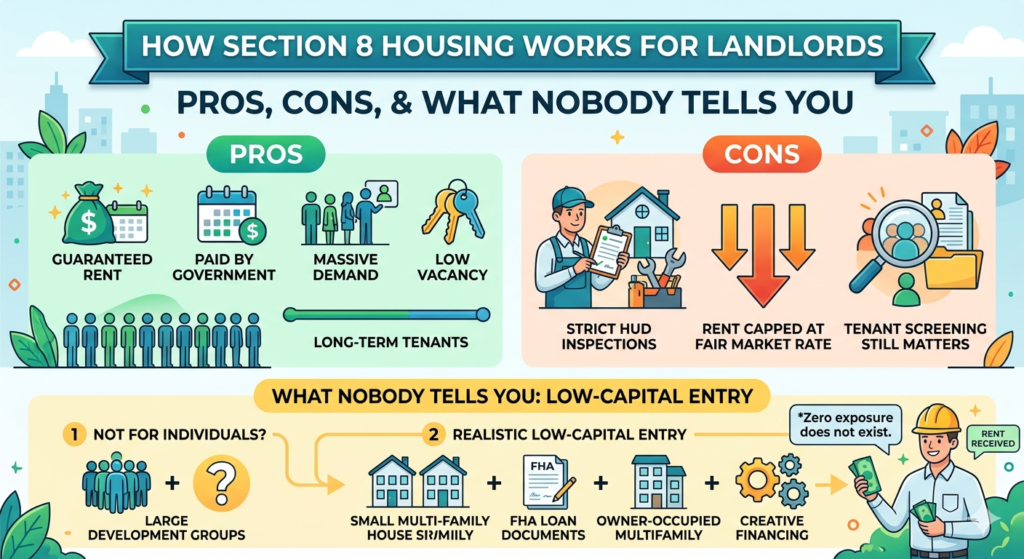
If you’ve spent any time on real estate social media lately, you’ve probably seen someone claim that Section 8 investing is the ultimate low-capital, government-guaranteed income stream. Seven million people on the waitlist. Stable rent checks straight from the government. Little to no money down.
It sounds almost too clean. So I went and actually looked into how this works — because “the government pays your rent” deserves a more careful look than a 60-second video.
Here’s what I found.
What Section 8 Actually Is
Section 8 is the informal name for the Housing Choice Voucher Program, administered by the U.S. Department of Housing and Urban Development (HUD). It’s a federal program that helps low-income families, elderly, and disabled individuals afford housing in the private market.
Here’s how it works from a landlord’s perspective:
A tenant receives a voucher from their local Public Housing Authority (PHA). The voucher covers a portion of their rent — typically the difference between 30% of their income and the fair market rent for their area. The landlord receives that portion directly from the government, and the tenant pays the rest.
So if the fair market rent for a two-bedroom in your area is $1,400, and the tenant’s 30% share is $400, the PHA sends you $1,000 every month — directly, reliably, on time.
That’s the part that gets highlighted in the videos. And it’s real.
The 7 Million Number
Yes, approximately 7 million people are on Section 8 waitlists across the country. In some cities, the waitlist is so long it’s been closed for years — meaning no new applicants are even being accepted.
What that tells you as an investor: demand for affordable rental housing is not going away. If you own a property that’s Section 8 approved and you have a good tenant, turnover is low and demand is high. These tenants often stay for years because finding another Section 8-approved unit is not easy.
That’s a real advantage. Vacancy is expensive. Long-term tenants who pay on time — even if part of that payment comes from the government — are valuable.
How You Actually Make Money on Section 8
The business model is straightforward:
You buy a rental property. You apply to your local PHA to become a Section 8 landlord — this involves an inspection of the property to make sure it meets HUD’s Housing Quality Standards. Once approved, you rent to a voucher holder. The PHA pays their portion of the rent directly to you every month.
The rent you can charge is tied to the PHA’s Payment Standard for your area — which is based on fair market rents. You can’t charge dramatically above market, but you also don’t have to worry about chasing rent payments from a tenant who’s struggling.
The “Little to No Capital” Claim — What’s Actually Going On
This is the part that needs unpacking, because “no money down Section 8” sounds like a magic trick.
Here’s what people actually mean when they say this:
Option 1: Government and State Financing Programs In some states, there are programs specifically designed to fund affordable housing development — Low-Income Housing Tax Credits (LIHTC), HOME Investment Partnerships, Community Development Block Grants. These programs can fund acquisition and renovation of properties that will be used for affordable housing.
The catch: these programs are primarily aimed at nonprofits, housing developers, and experienced operators — not individual investors buying their first rental. The application process is complex, competitive, and slow. This is not a beginner strategy.
Option 2: NACA or Low Down Payment Loans If you’re buying a small multifamily (2-4 units) as an owner-occupant and renting to Section 8 tenants, you can use low down payment programs like NACA or FHA loans. That’s the “low capital” entry point that actually makes sense for individual investors.
Option 3: Seller Financing or Subject-To Some investors acquire Section 8 properties through creative financing — buying subject-to existing financing or negotiating seller financing where the seller acts as the bank. These strategies exist but require deal-finding skills and negotiation experience.
The honest reality: “No capital” usually means someone else’s capital — a loan, a program, a partner. There is no strategy where you acquire real property with genuinely zero financial exposure. What varies is how much of your own money is at risk and in what form.
The Pros Nobody Argues With
Guaranteed rent payment. The government portion of the rent comes in on time, every month, regardless of what’s happening in the tenant’s life financially.
High demand, low vacancy. With millions on waitlists, approved Section 8 units don’t sit empty long.
Longer tenancies. Voucher holders tend to stay because moving means finding another approved unit — which is hard. Stable, long-term tenants reduce your turnover costs significantly.
Predictable income. The PHA sets payment standards annually. You know what you’re getting.
The Cons Nobody Leads With
Inspection requirements are strict. Before you can rent to a Section 8 tenant, your property must pass a Housing Quality Standards inspection. Items that might slide in a regular rental — a broken window latch, peeling paint, a non-functioning outlet — will fail a Section 8 inspection. You may need to invest in repairs before you ever see a rent check.
Annual inspections. It doesn’t stop at move-in. The PHA inspects Section 8 units annually. You have to maintain the property to their standards consistently.
Rent is capped at fair market rate. In appreciating markets where rents are rising fast, your Section 8 rent may lag behind what you could charge on the open market. You can request rent increases, but they’re subject to PHA approval.
Tenant screening still matters. The voucher guarantees the rent subsidy — it doesn’t guarantee a good tenant. You still screen for rental history, references, and behavior. The government pays part of their rent; you still live with the consequences of a bad tenancy.
Not all markets work. Section 8 payment standards vary dramatically by location. In some markets, the PHA rates are competitive with market rent. In others, they’re well below. Do the math for your specific area before assuming the numbers work.
Does This Make Sense in Philadelphia?
Philadelphia has a significant Section 8 population and an active PHA. Fair market rents in the Philadelphia area are set annually by HUD, and for a two-bedroom they’ve been in the range of $1,400 to $1,600 depending on the zip code.
For a landlord buying in neighborhoods where market rents are at or near those levels, Section 8 can work well. The guaranteed payment and high demand are real advantages in a city where tenant turnover and vacancy can be expensive.
The inspection requirements are actually a benefit in disguise — they force you to maintain the property, which protects your asset long-term.
My Take
Section 8 investing is a legitimate strategy with real advantages — particularly the payment stability and demand depth. For someone building a rental portfolio who wants predictable income and low vacancy, it’s worth understanding seriously.
The “no money down” framing is mostly marketing. The actual low-capital entry points — owner-occupied multifamily with a low down payment loan, or creative financing on existing rentals — are real but come with their own requirements and limitations.
What I’d say: don’t dismiss Section 8 because of how it gets talked about online. And don’t buy into it because someone made it sound effortless. Like everything else in real estate, the truth is in the details.
Not financial advice — just someone doing a lot of research and asking a lot of questions.