I keep seeing people say “you need money to make money” in real estate. And honestly, for a long time I kind of believed it. But then I came across this deal — a real one, not a hypothetical — and it made me rethink everything.
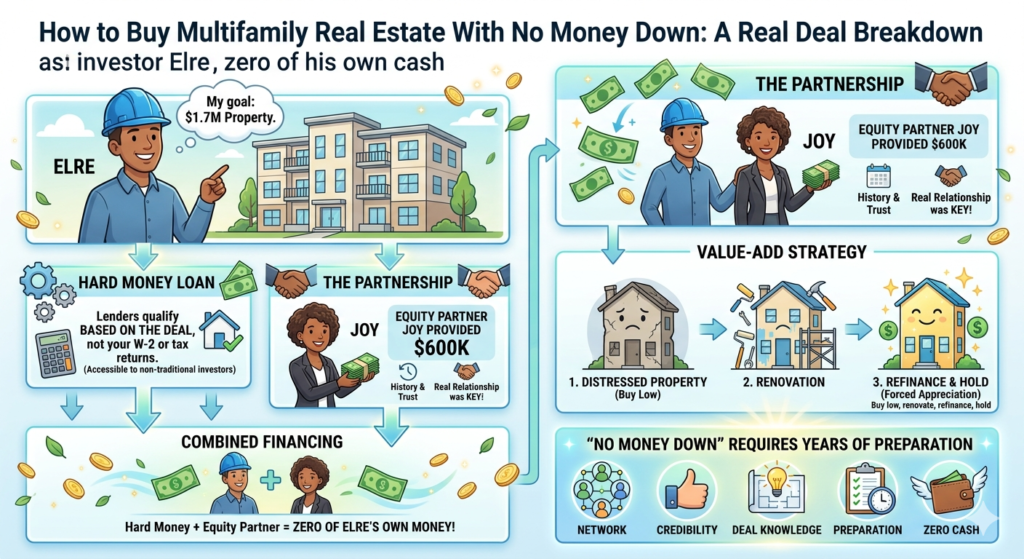
An investor named Elre bought a 16-unit apartment building for $1.7 million. His own money in the deal? Zero.
Here’s exactly how he did it.
Step 1: Finding the Deal
Elre’s son found the property on Krexy.com, a commercial real estate platform. The building was called Fort King Oaks, and it was listed by a long-term owner who was using his own son as the realtor.
That detail matters. When a long-term owner is selling — especially through a family member — it often means they’re motivated. They’re not a developer trying to squeeze every dollar. They want out, and there’s usually room to negotiate.
This is something I’ve been paying attention to more lately. The deal starts way before the financing. It starts with finding the right seller.
Step 2: Identifying the Value-Add Opportunity
Elre and his team didn’t just see a 16-unit building. They saw what it could become.
This is called a value-add strategy — you buy a property that’s underperforming, renovate it, raise rents, and force appreciation. The building wasn’t in its best shape, which is exactly why the numbers worked. A turnkey property that’s already fully renovated and fully occupied? The price reflects that. You’re paying for someone else’s work.
A distressed or underperforming property? That’s where you can actually manufacture equity.
Step 3: The Financing Stack
This is the part that gets interesting. Here’s how they put the deal together:
Hard money loan: $1.5 million
- 10% interest rate
- 2-year term
- No prepayment penalty
Hard money lenders don’t care about your W-2. They care about the deal — the property’s income, its value, and your exit strategy. In this case, the building’s numbers supported the loan.
Investor equity: $600,000 from a partner named Joy
This is where Elre’s personal cash requirement hit zero. Joy provided the down payment and equity. She wasn’t a random stranger — they had an existing relationship, and Elre walked her through the deal in detail before she committed.
Total capital going in: $2 million ($1.5M loan + $500K renovation budget, with Joy covering the equity portion).
Step 4: The Numbers
- Purchase price: $1.7 million
- Renovation budget: $300,000
- Total all-in cost: $2 million
- Projected value after renovation: $3 million+
If they sell after renovations, Joy gets her $600K back plus a profit split. Elre gets his cut too. But their actual plan is to refinance and hold — pull cash out of the newly appraised value and keep the building for long-term wealth.
That’s basically the BRRRR strategy applied to a 16-unit building. Buy, renovate, refinance, hold.
What Made This Work
A few things had to line up for this deal to happen:
The property cash flowed. Hard money lenders and future refinance lenders both need to see that the building can cover its debt. If the rents don’t support the loan, none of this works.
Elre had a real relationship with his investor. Joy didn’t find him on the internet last week. They had history. That matters a lot when you’re asking someone to write a $600,000 check.
They had a clear exit strategy. Refinance after renovation. That’s how the hard money loan gets paid off. Without a credible exit, no hard money lender touches the deal.
The seller was motivated. Long-term owner, family realtor, value-add property. All signs pointed to negotiation room.
The Part Nobody Talks About
“No money down” sounds sexy. And technically, Elre put in zero of his own cash. But here’s what actually had to exist for that to happen:
- A network that includes investors with $600K available
- Enough credibility that someone trusts you with their money
- The knowledge to underwrite a deal and present it convincingly
- A hard money lender relationship
- The ability to manage a 16-unit renovation
That’s not nothing. That’s years of work. The money was zero. The preparation wasn’t.
I’m not saying this to be discouraging — I’m saying it because I think the “no money down” framing skips the most important part of the story. The deal was possible because of everything that came before it.
What This Means If You’re Earlier in the Game
If you’re not there yet — no investor network, no hard money relationships, no track record — this deal isn’t your next move. But it’s a useful blueprint for what you’re building toward.
Start smaller. Build the track record. Find your Joy. Learn to underwrite deals well enough that someone trusts you with their capital.
Philadelphia has plenty of value-add multifamily sitting around — older rowhomes converted to duplexes and triplexes, small apartment buildings with deferred maintenance, long-term owners who are tired. The inventory is there. The strategy is real. It’s just a matter of being ready when the right deal shows up.
Not financial advice — just someone doing a lot of research and asking a lot of questions.