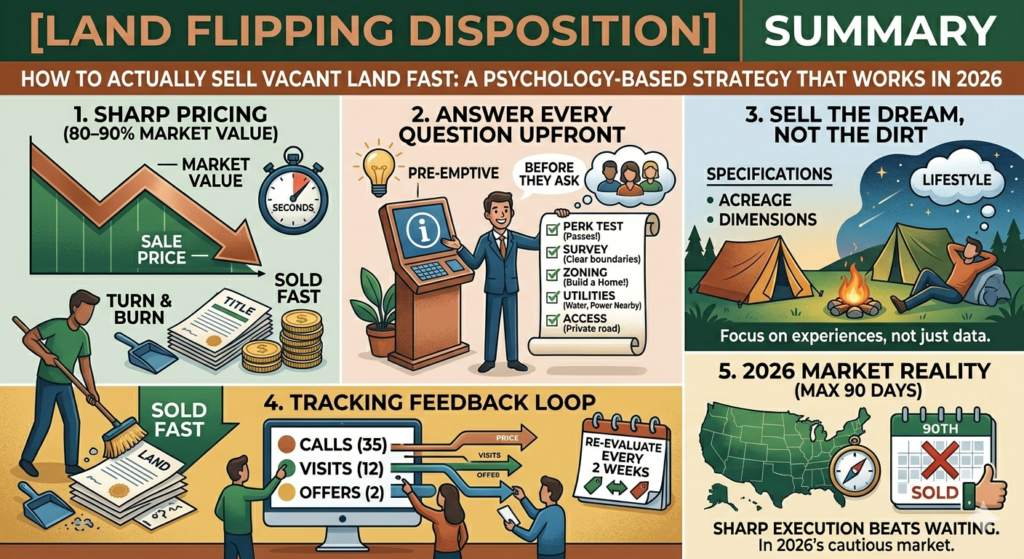
I’ve been deep in the land flipping rabbit hole lately, and the more I learn about acquiring land, the more I realize that the disposition side — actually selling it — is where most investors leave money on the table. Or worse, where deals go to die.
I came across a strategy breakdown recently that reframed how I think about land sales entirely. It’s less about the listing and more about understanding why buyers hesitate — and removing every single one of those hesitations before they even have a chance to form.
Here’s what actually works in 2026.
The Biggest Mistake Land Investors Make: Chasing the Top Dollar
Everyone wants to sell at maximum value. That’s obvious. But here’s the thing — in land investing, the investors who actually make the most money aren’t the ones squeezing every last dollar out of each deal. They’re the ones turning deals over fast.
The “turn and burn” philosophy: price your land at 80–90% of market value and sell it in weeks, not months. If comparable lots in your area are selling for $210K, list at $190K. You’ll get more inquiries, more offers, and a faster close — which means you can move on to the next deal sooner.
The math actually works in your favor here. Two deals at $20K profit each, both closed in 60 days, beats one deal at $30K profit that sat on the market for 8 months. Every time.
But — and this is the part people skip — this only works if you bought right in the first place. If you’re acquiring land at 80–100% of market value, there’s no room to price competitively and still make money. The profit in land flipping is made at the buy, not the sell. That’s the foundation everything else is built on.
In Philadelphia, this plays out in places like the outer neighborhoods where there are still vacant lots scattered between rowhouses — some owned by the city, some by private sellers who haven’t thought about their land in years. The acquisition price matters enormously.
Eliminate Buyer Objections Before They Ask
Think about buying a Ferrari from a dealer who can’t answer a single question about the car. You’d walk out. Land buyers are the same way — except land has way more potential gotchas than a car, and buyers know it.
The deals that fall apart are almost always information gaps. Buyer gets excited, goes to do their due diligence, can’t find answers, gets cold feet, cancels. That’s a preventable loss.
What to include in every land listing upfront:
- Perk test results — has the soil been tested for septic system viability? This is huge for rural or semi-rural lots. If it passed, say so loudly. If it hasn’t been done, get it done before you list.
- Survey status — is the lot surveyed? Are the boundaries clearly marked? Ambiguity here kills deals.
- Zoning details — what can actually be built on this land? Residential, commercial, mixed-use? What are the setbacks?
- Utilities — water, sewer, electric — what’s available and what’s the cost to connect?
- Access — is there a legal road frontage or easement? You’d be surprised how many vacant lots in Philly have weird access situations.
- Liens or back taxes — especially relevant if you picked this up at a tax sale or sheriff sale. Buyers want a clean title.
If you can answer all of these questions in the listing itself, you’ve already eliminated 80% of the reasons buyers back out. The goal is to make a buyer feel like they’ve already done their due diligence just by reading your listing.
Sell the Dream, Not the Dirt
This is the part that feels a little woo-woo but is actually just good marketing.
Nobody buys vacant land because they want dirt. They buy it because of what they imagine doing with it — building a house, parking an RV, hunting on fall weekends, putting up a cabin for the family, running a small farm. The land is just the vehicle for that vision.
Your listing description should make them feel it.
Instead of: “0.75 acre vacant lot, zoned residential, no utilities on site.”
Try: “Imagine waking up on your own piece of Pennsylvania. 0.75 acres of quiet, wooded land — enough room for a cabin, a fire pit, and a little breathing room from the city. Perk test passed. Survey done. It’s ready when you are.”
Same facts. Completely different emotional response.
This applies to photos too. Don’t just post a blurry aerial shot and call it a day. Walk the lot. Shoot in golden hour if you can. Show the treeline, the cleared area, the view. Give buyers something to picture themselves in.
Philadelphia-area land — particularly in the surrounding counties like Chester, Montgomery, or Bucks — has real lifestyle appeal for buyers who want proximity to the city without paying city prices. Lean into that. “45 minutes from Center City” is a selling point, not an afterthought.
The System: Track Everything, Adjust Fast
This is where land flipping starts to feel like an actual business instead of a hobby.
The investors who consistently move inventory aren’t just listing and praying. They’re running a feedback loop:
Track your numbers:
- How many phone inquiries per week?
- How many site visits?
- How many written offers?
- Where are deals falling apart — at the offer stage, during due diligence, at closing?
Each drop-off point tells you something. Lots of calls but no visits? Your price is attracting lookers but the photos aren’t converting. Lots of visits but no offers? Something in the due diligence is scaring people off — find out what.
When a deal falls through, ask why. Not in a defensive way — genuinely ask the buyer what made them walk. That feedback is free market research. Use it.
The 2-week rule: Evaluate every listing every two weeks. If you’re not seeing meaningful activity — calls, visits, offers — drop the price. Don’t wait 90 days and wonder what happened. Land that sits too long starts to feel like there’s something wrong with it, even if there isn’t. Momentum matters.
The target: no listing sits longer than 90 days. If it does, something is off — price, marketing, information quality, or all three.
Why This Matters More in 2026
The title of the strategy I was studying is literally “Why Nobody’s Buying Vacant Land in 2026” — and the honest answer is: it’s a tougher market. Interest rates have changed buyer behavior. People are more cautious. Due diligence cycles are longer. Buyers have more options and less urgency.
That means the bar for a good listing is higher than it was two or three years ago. A mediocre listing that would have sold in a hot market just sits now. The investors who are still moving land are the ones who’ve tightened up their systems — better information, better marketing, faster price adjustments.
The fundamentals of land flipping still work. The execution just has to be sharper.
The Philadelphia Angle
I think about this in the context of vacant lots in Philly constantly — there are thousands of them, and the city has been slowly trying to address blight through programs like the Land Bank. But there are also private sellers, tax delinquent properties, and sheriff sale opportunities that are still very much in play.
If I ever get to the disposition side of a Philadelphia land deal, here’s what I’d focus on:
- Know the zoning cold — Philadelphia’s zoning code is dense but it matters enormously to buyers
- Lead with proximity and connectivity (“walkable to the El,” “10 minutes to 30th Street Station”)
- Address the utility question immediately — a lot of Philly vacant lots have existing infrastructure nearby which is actually a selling point
- Price to move, not to maximize — especially in a market where buyers are cautious
I’m still in the research and acquisition phase on the land side. But studying the disposition strategy first actually makes you a better buyer — because you’re thinking about who your end buyer is before you even make an offer.
Not financial advice — just someone doing a lot of research and asking a lot of questions.