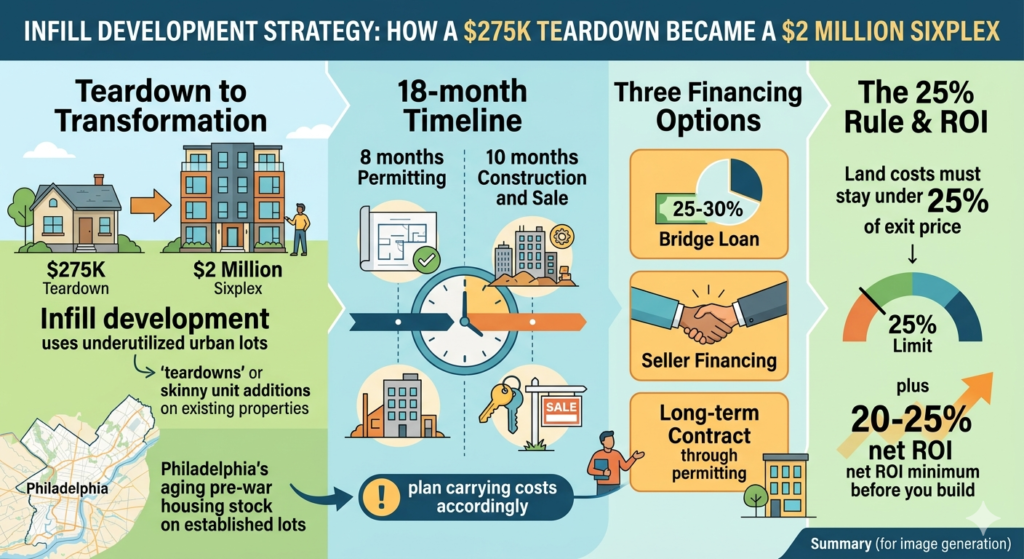
The infill development strategy is one of the most overlooked paths to serious real estate wealth — and it’s hiding in plain sight in cities like Philadelphia.
You don’t need raw land. You don’t need a greenfield site outside the city. You need an old house on a good lot in an established neighborhood, the patience to get through permitting, and the discipline to run the numbers before you fall in love with the deal.
Here’s how the infill development strategy actually works.
What Infill Development Strategy Actually Means
Infill development is building on underutilized land within an already-developed urban area. Most of the opportunity sits in pre-1950s neighborhoods — the kind of dense, established blocks you find throughout Philadelphia, Chicago, Seattle, and Portland — where aging housing stock sits on lots that could support significantly more density.
Two main approaches:
Complete teardown. The existing structure is too far gone to rehab economically. You demolish it and build new from scratch. The lot is the asset. The building is just in the way.
Skinny unit addition. The existing house sits on one side of the lot, leaving usable land on the other. You build a narrow additional unit — sometimes called a skinny unit — on the remaining portion without touching the original structure. Two income-producing assets on one lot.
Philadelphia rowhouse blocks are particularly well-suited to infill development strategy because the existing street grid, utility infrastructure, and zoning patterns often allow for additional density without major variances.
The 18-Month Timeline You Need to Plan For
Infill development strategy doesn’t move fast. Understanding the timeline upfront is what separates developers who make money from those who run out of capital waiting.
Phase 1 — Planning and permitting: approximately 8 months. Design, engineering, and municipal approvals. In major cities, commercial and multi-unit permitting takes significantly longer than single-family residential. Budget the full 8 months and don’t assume it will move faster. If it does, that’s a bonus.
Phase 2 — Vertical construction and sale: approximately 10 months. Once permits are in hand, construction moves relatively quickly on infill projects because the site is already served by utilities and infrastructure. Sale process runs concurrently with the final construction phase.
Total: 18 months from acquisition to close of sale. That’s your holding cost window.
Financing the Infill Development Strategy
The gap between land acquisition and construction financing is where most first-time infill developers get stuck. Three options that work:
Bridge loan. Put down 25 to 30% on the land, finance the rest with a bridge loan that carries you through the permitting phase. Higher cost than permanent financing but gives you the capital to control the site while you work through approvals.
Seller financing. Negotiate directly with the seller on rate and down payment. Motivated sellers on distressed properties — the teardown candidates — are often open to creative terms. A seller carry at below-market rate during your permitting phase can significantly reduce carrying costs.
Long-term contract. Negotiate a purchase contract that gives you the permitting period — 8 months — before you close. You control the site, you’re working through approvals, but you haven’t paid for the land yet. No carrying costs on the acquisition until you’re ready to build. This is the most capital-efficient structure if you can negotiate it.
Use the House Build Cost Calculator to stress test your construction budget before you commit to any financing structure. Know your numbers before you sign anything.
The Math Behind the Infill Development Strategy
The case study: a deteriorated house acquired for $275,000. Demolished. Replaced with a six-unit building — a sixplex — valued at $2 million on completion.
That kind of return doesn’t happen by accident. It happens because the developer applied three non-negotiable financial rules before breaking ground.
The 25% rule. Total land-based costs — purchase price, closing costs, demolition, site prep — must stay at or below 25% of the projected final sale price. If you’re targeting a $2 million exit, your all-in land costs can’t exceed $500,000. This single filter eliminates most deals before you get emotionally invested.
ROI floor of 20 to 25%. After all costs — construction, financing, carrying costs, commissions — your net profit needs to hit at least 20 to 25%. That margin is what protects you when permitting takes longer than planned, construction costs come in over budget, or the market softens before you sell.
Builder grade finishes. Standard quality throughout. $100 to $175 per square foot depending on your market. Upgrading finishes beyond neighborhood comparables doesn’t produce a dollar-for-dollar return at appraisal. Spend where it counts — layout, systems, durability — and control cost everywhere else.
According to the Urban Land Institute, infill development in established urban neighborhoods consistently outperforms suburban greenfield development on a risk-adjusted basis because demand drivers — walkability, transit access, employment proximity — are already proven.
Developer vs. Builder: Understanding Both Roles
One of the most important distinctions in infill development strategy is the difference between what a developer does and what a builder does.
The developer finds the land, analyzes the numbers, confirms zoning, secures financing, and navigates permitting. The developer decides what gets built and underwrites whether it’s worth building.
The builder executes the approved plan. They manage subcontractors, handle day-to-day construction decisions, and deliver the finished product.
On small infill projects, the same person often wears both hats. Understanding both roles matters because each has different skills, different timelines, and different failure modes. Developers who think like builders focus too much on construction details and not enough on deal structure. Builders who think like developers underestimate how long and expensive the pre-construction phase really is.
Know which role you’re in at any given moment — and what decisions belong to each.
Why Philadelphia Is a Natural Fit for Infill Development Strategy
Philadelphia’s housing stock is aging. Large portions of the city — Germantown, West Philadelphia, Kensington, North Philadelphia — have pre-war housing on lots that were built for a different era of housing density.
Zoning in many Philadelphia neighborhoods allows for multi-unit development with relatively straightforward variances. The city’s existing infrastructure — water, sewer, electric, street grid — is already in place. And demand for new, code-compliant housing in walkable neighborhoods continues to outpace supply.
The infill development strategy doesn’t require you to move to a new city or find land no one else has discovered. It requires you to look at old blocks with new eyes — and ask what the lot could support, not just what’s sitting on it today.
Not financial advice — just someone doing a lot of research and asking a lot of questions.