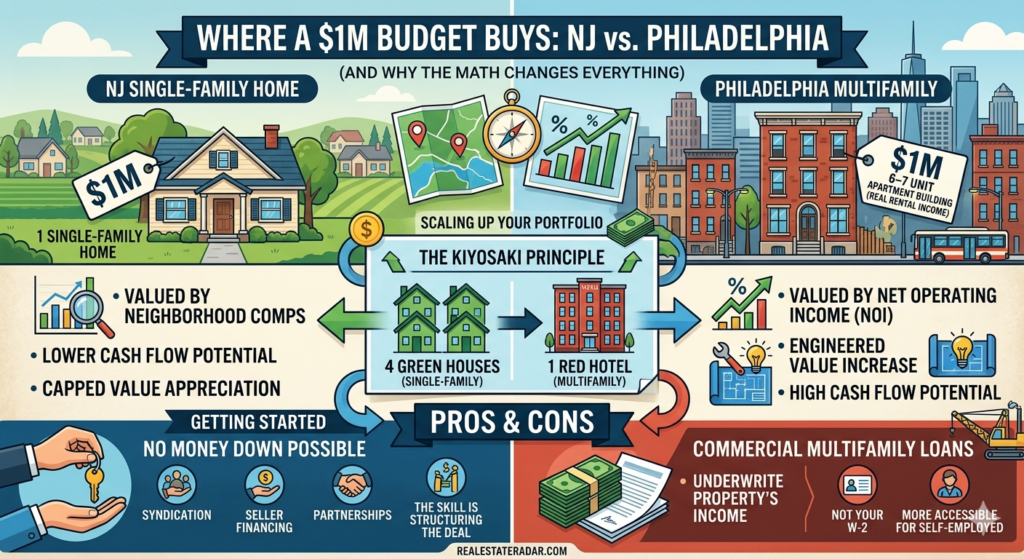
Multifamily vs single family investing — same budget, completely different game. If you grew up in the New York/New Jersey area, a million dollars in real estate sounds like a starter home. Maybe. If you’re lucky and it doesn’t need a new roof.
I spent time in Fort Lee, New Jersey. I know what that market looks like. A million dollars gets you a decent single-family house, a mortgage that makes your eyes water, and one tenant: yourself.
Then I moved to Philadelphia. And the math broke my brain a little.
Multifamily vs Single Family: Same Budget, Different Universe
Let’s just look at the numbers side by side.
In northern New Jersey — anywhere within commuting distance of Manhattan — $800,000 to $1 million buys you a single-family home. Three bedrooms, maybe four. One unit. One family. Zero rental income unless you’re renting out a basement.
In Philadelphia? That same budget gets you into small apartment building territory. A 6-unit or 7-unit building in a solid Philadelphia neighborhood. Six families paying you rent every month.
That’s not a small difference. That’s a completely different category of investment. The multifamily vs single family comparison here isn’t even close.
Robert Kiyosaki’s Monopoly Rule
If you’ve ever read Rich Dad Poor Dad — or watched any Robert Kiyosaki interview — you’ve heard the Monopoly analogy. Four green houses, then trade them in for a red hotel.
The green houses are your single-family homes and small rentals. You’re building cash flow, building equity, building experience. But the red hotel — the apartment building — is where the math genuinely changes.
Here’s the core of the multifamily vs single family debate: single-family homes are valued by comps. What did the house next door sell for? That’s your ceiling. You can renovate every inch of that property and still be capped by whatever the neighborhood supports.
Apartment buildings are valued by income. Specifically, by Net Operating Income — your rental revenue minus operating expenses. Every dollar you add to NOI adds roughly $15 to $20 of property value depending on the cap rate in your market.
Raise rents. Reduce vacancies. Cut unnecessary expenses. You’re directly engineering the value of the building.
That math doesn’t exist in single-family.
The No Money Down Question
Here’s where it gets interesting. Kiyosaki has been saying for decades that “I don’t have the money” is not the real problem. The real problem is not knowing how to structure a deal.
In multifamily specifically, there are legitimate structures that allow you to get into deals with little or none of your own capital:
Syndication — You find the deal, analyze it, manage it. Investors bring the capital. You split the returns.
Seller Financing — The seller acts as the bank. You negotiate terms directly. No traditional lender, no traditional qualification process.
Partnership — Someone brings money. You bring the deal, the knowledge, the sweat equity.
BRRRR into Multifamily — Use a flip or cash-out refinance to generate capital, then roll it into a multifamily down payment.
None of these are magic. All of them require skill, credibility, and the ability to find and analyze good deals. But “I don’t have $150,000 for a down payment” is not automatically the end of the conversation in multifamily vs single family.
Why Multifamily Loans Are Actually Easier to Get
This surprised me when I first learned it. Commercial multifamily loans — for 5+ unit buildings — don’t underwrite you the same way a conventional mortgage does.
With a conventional mortgage on a single-family home, the bank wants your W-2, tax returns, debt-to-income ratio, two years of employment history. If you’re self-employed or your reported income is low, you’re fighting uphill.
Commercial multifamily loans underwrite the property. Does the building generate enough income to cover the debt? That’s the primary question. Your personal income matters less than the NOI of the asset.
Which means, paradoxically, it can be easier to get a loan on a $600,000 apartment building than on an $80,000 rowhouse — if the building’s numbers are solid. That’s one of the most underappreciated advantages in the multifamily vs single family debate.
According to BiggerPockets, commercial multifamily loans consistently have lower denial rates for self-employed borrowers than conventional single-family mortgages — precisely because the underwriting focuses on asset performance rather than personal income documentation.
So Why Is Everyone Still Buying Single-Family?
Familiarity, mostly. Single-family homes are what people know. You can find them on Zillow. The process feels more accessible even when the math isn’t better.
Multifamily deals — especially anything above 4 units — require you to think differently. You’re analyzing income statements, not just square footage. You’re finding deals off-market because the good ones rarely hit LoopNet. You’re talking to commercial brokers, not residential agents.
It’s a steeper learning curve. But it’s the curve that leads to the red hotel.
The Multifamily vs Single Family Math in Philadelphia
I keep coming back to Philadelphia for exactly this reason. The price point makes the math work in a way that it simply doesn’t in New Jersey or New York.
A $600,000 to $800,000 budget that buys you one house in Bergen County buys you a cash-flowing 6-unit apartment building in West Philadelphia or Germantown. Same dollars. Completely different asset.
And if you’re someone who can’t easily document income — self-employed, business owner, irregular earnings — the commercial multifamily loan structure is actually more forgiving than the conventional mortgage you’d need for that New Jersey house.
The city that people wrote off for decades is quietly becoming one of the most interesting markets for exactly this kind of multifamily vs single family analysis. The numbers make sense here in a way they stopped making sense in most other East Coast markets years ago.
Use the Multi-Unit Cash Flow Calculator to run actual numbers on a Philadelphia multifamily deal — plug in units, rents, and expenses and see what the building is worth based on its income.
Not financial advice — just someone doing a lot of research and asking a lot of questions.