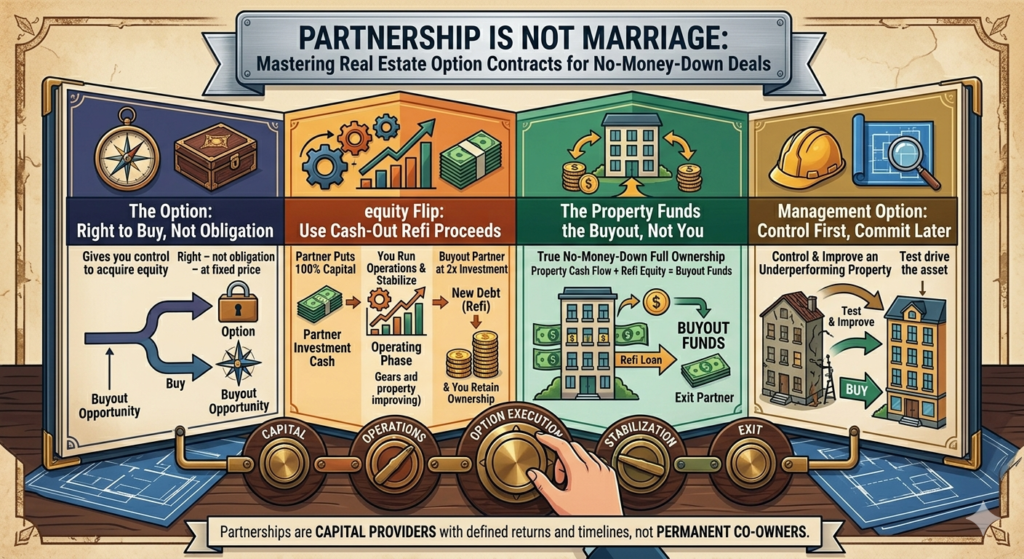
Option contract real estate strategy is what separates investors who think three steps ahead from everyone else. Most no-money-down strategies involve a partner — someone puts up the capital, you find the deal and run the operations, you split the profits.
That’s fine as a starting point. But here’s the question nobody asks upfront: what’s the exit?
If you build a portfolio where you permanently own 50% of everything, you’ve built half a portfolio. The investors who think ahead don’t just structure the entry. They structure the exit from the partnership before they ever sign the operating agreement. That’s what option contract real estate strategy is for.
What Is an Option Contract in Real Estate?
An option contract real estate agreement gives you the right — but not the obligation — to purchase something at a predetermined price within a specific timeframe.
You’ve probably heard of options in the stock market. Same principle in real estate. You lock in the right to buy a property (or a partner’s share of a property) at a fixed price, at some point in the future.
The key word is right. Not obligation. If the deal goes sideways, you don’t exercise the option. If everything goes according to plan — which it will if you executed the value-add correctly — you use that option contract real estate right to take full ownership.
Strategy 1: The Partner Equity Buyout Using Option Contract Real Estate
You find a deal. A small apartment building, a duplex, a fourplex. You don’t have the down payment. A capital partner does.
You structure a 50/50 LLC:
- Partner puts up 100% of the down payment
- You find the deal, manage the renovation, run the operations
- Profits split 50/50
Standard so far. But here’s what you add to the operating agreement — an option contract real estate clause to purchase your partner’s 50% interest at a fixed price within a defined window.
Example:
- Partner puts in $150,000 as the down payment
- Option terms: you can buy their 50% for $300,000 (2x their investment) anytime between Year 3 and Year 5
- If you don’t exercise by Year 5, you forfeit your interest and the partner takes full ownership
Here’s how it plays out. Over three to five years, you execute your value-add plan. Rents go up. NOI improves. The property appreciates. By Year 4, the building that was worth $600,000 at purchase is now worth $900,000.
You do a cash-out refinance at 75% LTV:
- $900,000 × 0.75 = $675,000 new loan
- Original loan balance: ~$420,000
- Cash out: ~$255,000
You use $300,000 of that to exercise the option contract real estate buyout — purchasing your partner’s 50% at the agreed price.
Result: you own 100% of a $900,000 property. Your partner got 2x their money. You spent none of your own cash.
The property bought out your partner. Not you.
Why the Option Contract Real Estate Clause Has to Be Optional
The buyout has to be your right, not your obligation.
If the operating agreement says you must buy out the partner at Year 5 regardless of where the property is, that’s a liability, not an asset. What if the market dips? What if the value-add didn’t execute as planned?
The option contract real estate structure protects you. If things go well, you exercise it and take full ownership. If things don’t go as planned, you let it expire — you lose your interest, but you also walk away without being personally on the hook for $300,000 you can’t pay.
Get a real estate attorney to draft this. The difference between an option and an obligation is a few sentences — and potentially hundreds of thousands of dollars.
Strategy 2: The Management Option Contract Real Estate Approach
This one is for underperforming properties that can’t yet qualify for traditional financing — but have real potential.
Maybe the NOI is too low for a bank to lend against it. Maybe the seller has an inflated price expectation. Maybe it’s partially vacant and the numbers just don’t work yet.
Instead of walking away, you propose this option contract real estate structure:
You take over full management of the property — running operations, filling vacancies, optimizing expenses — with an option to purchase at the seller’s asking price within a defined period.
During the management period, you implement your business plan. Rents go up, vacancy goes down, NOI improves. Once it hits the target numbers, you exercise your option, get a DSCR loan based on the new NOI, and close the purchase.
The seller gets their price — eventually. You get time to build the value before you’re committed to buying. You’ve effectively controlled an asset and improved it without owning it yet.
According to BiggerPockets, management option contracts are one of the most underutilized real estate acquisition strategies precisely because they require negotiation skill and a clear value-add plan — two things most beginners haven’t developed yet.
“Partnership Is Not Marriage”
Most people think of a real estate partnership the way they think of a marriage — in it together, indefinitely, for better or worse. That framing leads to bad deals. You accept permanent 50% ownership because “that’s just how partnerships work.”
It doesn’t have to work that way.
A partnership is a tool. It solves a specific problem — the capital problem — for a specific period of time. Once that problem is solved, the partnership has served its purpose.
When you structure every partnership with a clear timeline, a fixed buyout price, and an option contract real estate clause to take full ownership, you’re not just being strategic. You’re being honest with your partner about what the relationship is.
What This Option Contract Real Estate Strategy Actually Requires
A performing asset. The strategy depends on the property generating enough value appreciation and cash flow to fund the buyout. If you overpay at acquisition or the value-add doesn’t execute, there’s no refi proceeds to exercise the option with.
A well-drafted operating agreement. Option terms — price, window, what happens if you don’t exercise — need to be crystal clear and legally sound. Get an attorney involved.
A capital partner who understands the structure. The pitch is simple: “You put in $150K. In five years you get $300K guaranteed if I exercise the option. If I don’t, you get the property. Either way, your downside is protected.”
Execution. The option is only as valuable as your ability to create the value that funds it.
Use the Subject To Calculator to model your partnership buyout scenario — plug in your value-add projections, refi proceeds, and option price to see if the numbers work before you sign any operating agreement.
Not financial advice — just someone doing a lot of research and asking a lot of questions.