Before I moved to Germantown, I spent weeks apartment hunting in Philadelphia. And somewhere in the middle of all that scrolling and touring, I stumbled onto something I wasn’t expecting — loft apartments carved out of old churches.
We’re talking stained glass windows still intact. Original wooden pew shelving built into the walls. Vaulted ceilings so high you forget you’re in a residential unit. It was unlike anything I’d seen in LA, New York, or DC — and I’ve lived in all of them.
I didn’t end up in one of those. I found a converted historic school building in Germantown instead — exposed brick, weird angles, the kind of place that has a story. But those church lofts stayed in my head.
And then I started walking around Germantown and noticing just how many churches there are. Like, an almost absurd number. Boarded up ones, active ones, half-renovated ones. It got me curious: why does Philadelphia have so many churches? And what happens to them when they close?
Why Does Philadelphia Have So Many Churches?
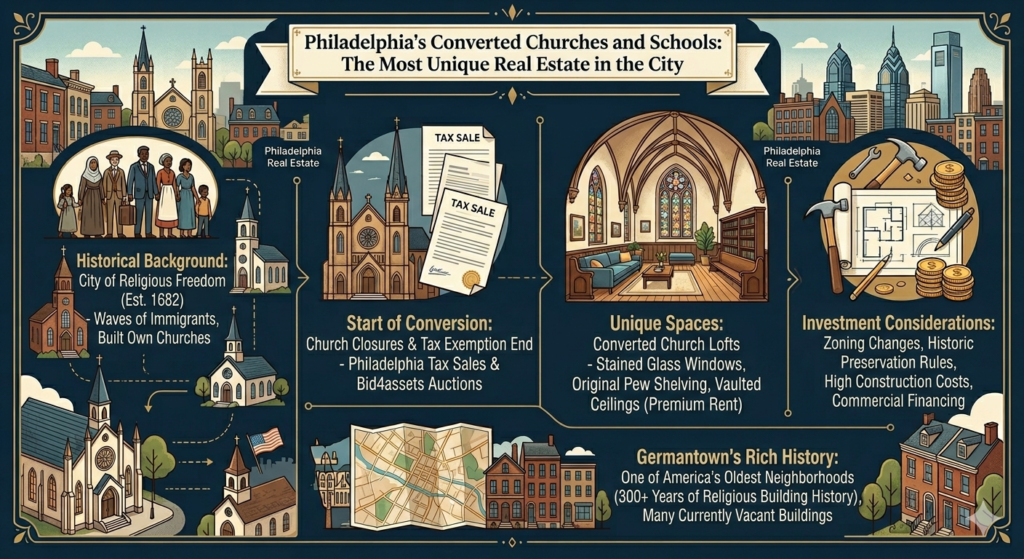
The short answer: Philadelphia was literally founded on religious freedom.
William Penn, a Quaker, established the city in 1682 with a radical idea for the time — that people of any faith could live and worship here without persecution. That open-door policy attracted wave after wave of religious communities, and each one built their own church.
Then came the immigration waves:
- Irish immigrants → Catholic parishes
- German settlers → Lutheran and Reformed churches
- Italian communities → more Catholic churches
- The Great Migration of Black Americans from the South → Baptist churches, AME congregations
Every new community that arrived in Philadelphia built a church as their anchor. It was how you established roots, found your people, spoke your language, and navigated a new country.
Germantown specifically — where I live now — was settled by German Quakers in 1683. It’s one of the oldest neighborhoods in America. Some of these church buildings have been standing for over 200 years.
So when you’re walking down Germantown Avenue and you pass five churches in three blocks, you’re not just looking at buildings. You’re looking at 300 years of immigrant history stacked on top of each other.
Kind of blew my mind when I put it together.
So What Happens When a Church Closes?
Here’s where it gets interesting from a real estate perspective.
Church attendance in America has been declining for decades. Congregations shrink, maintenance costs pile up, and eventually some churches just can’t keep the lights on. When that happens, the building has to go somewhere.
And here’s something most people don’t know: churches don’t pay property taxes — but only as long as they’re actively operating as a religious organization. The moment a church closes and the nonprofit status lapses, the building becomes taxable property like any other.
If the new owner — whether it’s a developer, an LLC, or an individual — doesn’t pay those taxes? It can eventually end up in a Philadelphia Tax Sale or on Bid4Assets.
That’s how some of these extraordinary historic buildings become available to regular buyers. Not always — plenty get snapped up by developers quickly. But it happens more than you’d think.I’ve been going through real Philadelphia tax sale listings lately — here’s how I analyze them.
How Do You Actually Buy a Church or School Building?
A few different paths:
Standard sale — If a church closes and sells voluntarily, it goes on the open market like any other commercial property. You’d find these on Zillow (sometimes), LoopNet, or CoStar. Search “church for sale Philadelphia” and you’ll find active listings.
Tax Sale / Bid4Assets — If taxes went unpaid after the religious exemption lapsed, it could show up in Philadelphia’s tax sale inventory. These can be significantly underpriced — but come with more complexity.
Direct outreach — If you see a boarded-up church you love, you can actually look up the owner through OPA (Philadelphia’s Office of Property Assessment) and reach out directly. Sometimes congregations are desperate to sell and haven’t formally listed yet.
Schools follow a similar path — the School District of Philadelphia has sold off dozens of closed school buildings over the years through a formal disposition process.
Is Converting a Church or School Easy?
I want to be straight with you here: no, it’s not easy. But it’s not impossible either.
The main hurdles:
Zoning changes — Churches and schools are rarely zoned residential. Converting to apartments or lofts requires going through Philadelphia’s zoning variance process, which takes time, money, and often a lawyer.
Historic Preservation — Many of these buildings are on historic registries. That means you can’t just gut everything. There are rules about what you can change and what has to stay. The stained glass? You might be required to keep it. Which, honestly, is part of what makes these properties so special — but it adds cost and complexity.
Construction costs — These buildings were not designed to be apartments. The structural work, HVAC, plumbing, and electrical costs can be enormous. Those soaring ceilings look incredible, but heating them is expensive.
Financing — Standard residential mortgages won’t work here. You’re looking at commercial loans, bridge loans, or hard money lending — all of which require more capital and experience.
Why It’s Still Worth Paying Attention To
Here’s my take after going down this rabbit hole:
The converted church and school lofts I toured in Philadelphia were some of the most genuinely unique living spaces I’ve ever seen. Stained glass. Original woodwork. 20-foot ceilings. That’s not something a new construction building can replicate.
From an investment perspective, that uniqueness commands premium rents. People pay more for a place with a story. And in a city like Philadelphia — where there’s real development pressure and a growing population of people priced out of New York and DC — distinctive properties hold their value.
Is buying and converting a church my next move? Absolutely not. I’m still in the early stages of learning this market, and a project like that requires capital and experience I’m still building.
But am I going to keep walking past those boarded-up churches in Germantown and wondering? Definitely yes.
Not financial advice — just someone doing a lot of research and asking a lot of questions.