Sheriff Sale Philadelphia: How to Buy a Property at the Courthouse Auction (Part 2)
Philadelphia sheriff sale Bid4Assets is how the city runs its courthouse auctions now — and most beginners have no idea the process even moved online.
If online auctions feel like eBay — a timer, a number going up, a button you click from your couch — Philadelphia Sheriff Sales are something else entirely. Real deputies. Open bidding. Properties that can go for a fraction of market value. And a process that moves fast once you win.
I’ve been obsessed with figuring this out, so here’s everything I found.
What Is a Philadelphia Sheriff Sale?
When a homeowner can’t pay their mortgage or property taxes, the property gets taken over and sold at a public auction. The Philadelphia Sheriff’s Office runs these on behalf of the court — the goal isn’t to get top dollar, it’s to recover what’s owed to the lender or the city. That’s why prices can look shockingly low.
Philadelphia sheriff sales happen monthly — typically the first or second Wednesday of each month. In 2023 alone, approximately 1,200 properties were sold at sheriff sales due to mortgage foreclosures, not counting tax lien sales. That’s a lot of inventory most people don’t know how to access.
Philadelphia Now Does It Online Through Bid4Assets
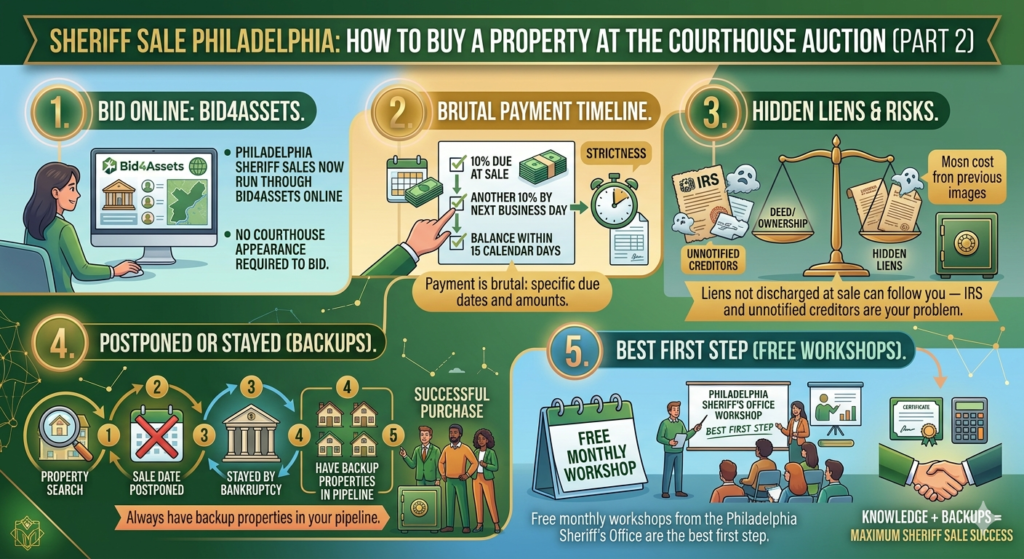
Here’s something that surprised me: Philadelphia sheriff sale Bid4Assets is now the official platform. Philadelphia County moved its foreclosure auctions online — you can research, register, and bid from your laptop without showing up at the courthouse.
The Philadelphia Sheriff’s Office also runs free monthly workshops where you can learn the process directly from a Deputy Sheriff. English and Spanish both offered. If you’re serious about this — go to one first. Free information from the people actually running the auction is a no-brainer.
Step by Step: How Philadelphia Sheriff Sale Bid4Assets Works
Step 1: Find the properties
The upcoming sale list is published on phillysheriff.com and on Bid4Assets. For every property you’re interested in, you need to:
- Pull deed and title history through Philadelphia’s city records
- Check for outstanding liens (water bills, tax liens, contractor liens)
- Drive by the property — no interior inspection before bidding
- Run your ARV and renovation estimate
It is the buyer’s sole responsibility to research liens, encumbrances, and easements. Nobody hands you a clean title summary. You do this yourself — or pay an attorney.
Step 2: Register and deposit
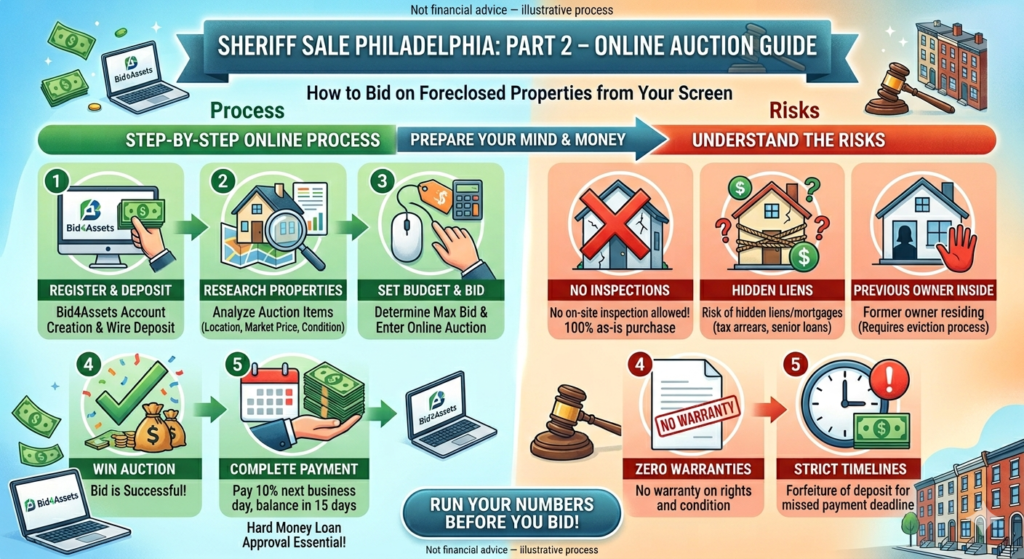
Create a Bid4Assets account — free and quick. Only certified check, money order, or wire transfer accepted for deposits. ACH, credit card, and direct deposit are rejected.
One deposit covers all auctions closing on that date. Allow up to 48 business hours for deposit acknowledgment — don’t wait until the night before.
Step 3: Bid with discipline
You must have 10% of your bid in cash or certified check at the sale. The next 10% is due by 5:00 PM ET the first business day after the auction. The remaining balance is due within 15 calendar days. No exceptions — miss the deadline and you forfeit your deposit and may be banned from future sales.
This is not Hubzu with a 30-day window. Have your hard money lender ready before you bid on anything. Run your carrying costs through the Hard Money Loan Calculator so there are no surprises when the clock starts.
Step 4: You win — now what?
Within a month or two, the sheriff posts a schedule of distribution. If there are no objections, the property gets deeded to you.
Important: the vast majority of sheriff sales are postponed or stayed by bankruptcy. A property you’ve researched for weeks can get pulled the morning of the auction. Always have backup properties in your pipeline.
The Risks Nobody Talks About With Philadelphia Sheriff Sale Bid4Assets
Liens that survive the sale
Lien holders not notified 30 days in advance are not automatically discharged. IRS liens may require additional steps. You could win a property and discover you also inherited $30,000 in IRS debt or contractor liens. Title search before you bid is not optional.
The previous owner might still be inside
If someone is living in the property when you buy it, you cannot just change the locks. Pennsylvania eviction takes time and money — budget for this possibility, especially in Philadelphia where tenant protections are strong.
You’re buying completely as-is
No inspections, no contingencies. You’re bidding based on what you can see from outside and whatever public records show. Add a 25–30% buffer to your renovation estimate. Always.
Use the Sheriff Sale Bid Calculator to stress-test your max bid against ARV, renovation costs, and carrying costs before you set foot near an auction.
What Makes Philadelphia Different
Philadelphia has its own tax lien sale process separate from mortgage foreclosures — so you’ll see both types in the system. Tax lien properties can be acquired for less, but tend to come with more complicated title issues.
Philadelphia’s older housing stock also means higher likelihood of lead paint, old wiring, and deferred maintenance that doesn’t show up until you’re mid-renovation. Factor that into your renovation buffer.
Is Philadelphia Sheriff Sale Bid4Assets Right for a Beginner?
Higher risk than Hubzu or Auction.com — but potentially higher reward. Properties coming through the courthouse have often been in foreclosure for nearly two years, sitting vacant and unmaintained. That’s why prices can be so low. The market is discounting all that uncertainty.
My approach for now: attend a free Sheriff’s Office workshop first. Research a few properties on Bid4Assets without bidding — just to practice the process. Build the muscle before you put real money on the line.
The opportunity is real. The risk is real. Preparation is what tips the balance.
Part 3 compares online auctions and Sheriff Sales side by side — which one makes more sense for a first-time investor, what the actual risk profiles look like, and how to decide which path fits where you are right now.
Not financial advice — just someone doing a lot of research and asking a lot of questions.