Philadelphia tax sale properties looked simple at first. Pull up the list. Check a few addresses. Find a deal. Done.
Three hours later I was deep in government websites, accidentally almost signing up for a monthly subscription, and genuinely questioning my life choices.
But I also found something that made my jaw drop. Here’s what actually happens when you try to analyze Philadelphia tax sale properties from scratch — no mentor, no course, just you and a laptop.
Step 1: Finding the Philadelphia Tax Sale Properties List
The Philadelphia tax sale properties list lives on Bid4Assets — the city runs its auctions through this platform. Every month, properties with delinquent taxes get listed there with a starting bid of $1,600.
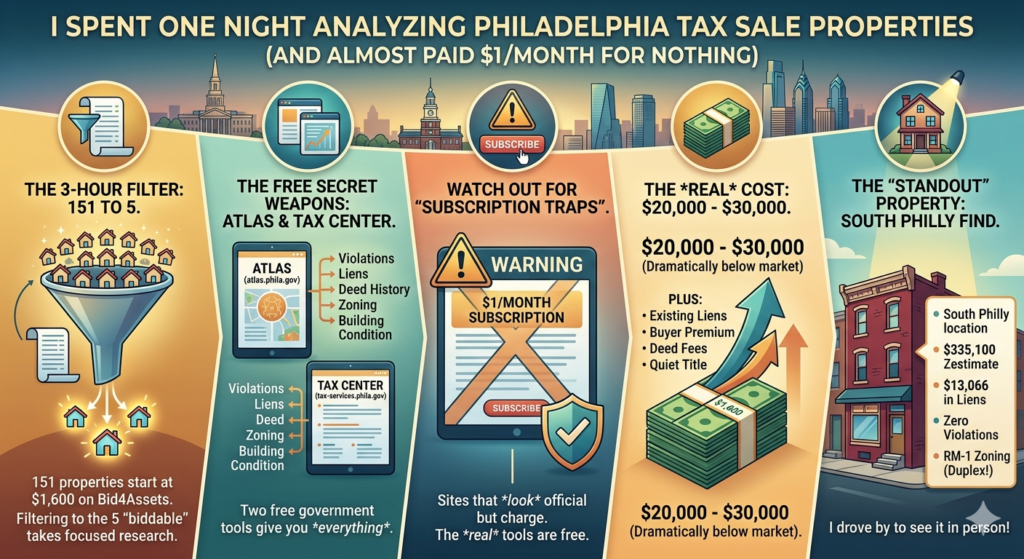
I pulled up the list for the upcoming May sale. 151 properties. All starting at $1,600.
My first reaction: this can’t be real.
My second reaction: okay, how do I figure out which ones are actually worth looking at?
Step 2: The First Filter — Cut the Obvious Nos Fast
151 Philadelphia tax sale properties is a lot. I needed to cut it down fast.
What I immediately skipped:
- Mixed commercial/residential zoning — too complicated for a first deal
- Properties in neighborhoods I already knew had high vacancy
- Anything that looked like it might be a vacant lot rather than a building
This got me down to maybe 40–50 properties worth a second look.
Step 3: AI Pre-Screen for Philadelphia Tax Sale Properties
Before diving into each property manually, I used AI to help pre-screen the list — inputting addresses and asking it to flag anything worth digging into based on neighborhood, zip code, and basic property type.
This got me to maybe 15–20 Philadelphia tax sale properties worth actual research.
Then the real work started.
Step 4: Google Maps — 60 Seconds Per Property
For each remaining Philadelphia tax sale property I pulled up Google Maps and Street View.
What I was looking for:
- Does the building look structurally intact?
- Is it clearly abandoned or just neglected?
- What does the surrounding block look like?
- Are neighboring properties maintained or vacant?
Properties that looked like complete demolition candidates or were surrounded by abandoned buildings — gone. Next.
This left me with maybe 10 Philadelphia tax sale properties worth deeper research.
Step 5: Zillow Check
Quick Zestimate lookup for each remaining address.
I’m not treating the Zestimate as gospel — it’s an estimate. But it gives me a ballpark. If Zillow shows $180,000 on a Philadelphia tax sale property in a neighborhood where renovated homes sell for $200,000 — the margin isn’t there. If it shows $335,000 — now we’re talking.
Down to maybe 6–7 properties.
Step 6: Atlas — The Free Philadelphia Tax Sale Properties Research Tool
This is where it gets real.
atlas.phila.gov is Philadelphia’s official property information portal. Free to use. Pulls from city records.
For each Philadelphia tax sale property I checked:
- Building condition (Below Average is okay, Deteriorated is a red flag)
- Zoning (RM-1 for residential multifamily is what I wanted)
- Violations — open L&I violations mean fines that may survive the sale
- Deed history — any recent transfers right before the sale are a red flag
- Year built — pre-1978 means potential lead paint issues
Step 7: The Tax Center — Where I Almost Paid $1 for a Monthly Subscription
I wanted to verify the exact lien amounts on each Philadelphia tax sale property. I found what looked like a government site offering title searches for $1.
I almost entered my credit card. Then I noticed the fine print — monthly subscription.
I closed that tab immediately.
The actual free resource is tax-services.phila.gov — Philadelphia’s official Tax Center. Enter any address and you get the real numbers: real estate tax balance, commercial trash fees, and other municipal charges. No subscription. No credit card. Actually free.
For one property I found:
- Real estate tax balance: $12,548
- Commercial trash fees: $517
- Total: $13,066
That’s what I’d be taking on in addition to the winning bid. Good to know before I get excited about a $1,600 starting price on any Philadelphia tax sale property.
Step 7B: OPA Lookup — The Detail Layer Most People Skip
Once I have the lien numbers, I go to opa.phila.gov — the Office of Property Assessment. Free, no login required.
For each property I check:
Who owns it — a real person or an LLC? If it’s an LLC, I do a quick search in Pennsylvania’s business registry to see if it’s still active. An inactive LLC that owns a property heading to tax sale is a red flag — it often means the property has been completely abandoned.
Homestead Exemption — if it shows “Yes,” the previous owner was living there as their primary residence. This tells me the property was likely better maintained than a long-term rental, and that something went wrong financially — not that the owner stopped caring. Useful context for estimating rehab.
Zoning code — the most common one in Philadelphia rowhouse neighborhoods is RSA-5, which means Residential Single Family Attached. In plain English: one unit, zoned for a standard rowhouse. You cannot legally convert it to multi-unit without a zoning variance. If your exit strategy requires two units, RSA-5 is not your friend without additional steps.
Step 7C: Understanding “Pending” Status on Bid4Assets
If you’ve spent more than ten minutes on Bid4Assets, you’ve noticed that a huge percentage of listings show “Pending.”
Here’s what’s actually happening:
Philadelphia’s tax sale process moves slowly. A property can be flagged for tax sale, listed, and then sit in legal limbo for months — sometimes years — while the city works through the court process, the owner files objections, or payment arrangements get negotiated.
“Pending” usually means the owner made a last-minute payment plan, there’s an active legal challenge or bankruptcy filing, or the sale happened but hasn’t been fully recorded yet.
The practical takeaway: don’t fall in love with a Pending property. Keep it on your watchlist, but focus your energy on active listings. Pending can flip back to available — or it can disappear entirely.
Step 8: The Philadelphia Tax Sale Property That Made My Jaw Drop
Deep in the list, I found a property in South Philadelphia. Walking distance to a major bank branch. Corner location.
- Zestimate: $335,100 — as-is, before any renovation
- Tax lien: $13,066
- L&I violations: zero
- Deed history: one owner since 2002. Clean
- Zoning: RM-1. Duplex conversion possible
- Building: 1,799 square feet. Two stories
The math:
| Item | Cost |
|---|---|
| Winning bid (optimistic) | $10,000 |
| Lien | $13,066 |
| Buyer premium and fees | ~$1,500 |
| Deed recording | ~$300 |
| Total all-in | ~$25,000 |
Post-renovation ARV for a duplex in this location: $400,000+.
I stared at my screen for a while.
Step 9: I Actually Drove Around (And Talked to Strangers)
I live in Philadelphia. So I went.
Mount Airy, Property #1:
The neighbor told me someone still lives there — they just barely come out. The beat-up car in the driveway was theirs.
Someone is living there. Which means the 9-month right of redemption applies. I crossed it off my list.
Manayunk:
A woman walking by told me someone lives there too. Then she mentioned — almost casually — that the house has been on the market for three years.
Three years. Nobody bought this Philadelphia tax sale property in three years. That’s not a hidden gem. That’s a property with a problem I haven’t found yet. Off the list.
The South Philly property:
Active street. Maintained neighboring properties. TD Bank around the corner. The building is standing. No obvious structural collapse. No broken windows.
And unlike the other two — no car in the driveway. No signs of recent occupation.
No obvious occupant means no right of redemption.
This one stays on my list for the May 20th auction.
What I Learned From One Night of Philadelphia Tax Sale Properties Research
The list is overwhelming at first — until you start filtering. Within an hour I was down to a handful of Philadelphia tax sale properties worth serious attention.
The government websites are actually useful — if you know which ones. Atlas and the Tax Center between them give you almost everything you need. The paid services that look like government sites are not worth it.
The $1,600 starting bid is real — but it’s not the whole number. Add existing liens, buyer premium, fees, and Quiet Title costs and you’re looking at $20,000–$30,000 for a realistic all-in number. Still dramatically below market value in most cases.
The deals exist. I found at least two Philadelphia tax sale properties in one night that penciled out on paper. One of them I went to see in person.
According to HUD.gov, Philadelphia has one of the largest concentrations of tax-delinquent residential properties of any major US city — creating a consistent pipeline of Philadelphia tax sale properties for investors willing to do the due diligence work most people skip.
Use the Sheriff Sale Bid Calculator to model your maximum bid on any Philadelphia tax sale property — plug in ARV, renovation estimate, lien total, and carrying costs to confirm your numbers before the auction starts.
Not financial advice — just someone doing a lot of research and asking a lot of questions. Always verify lien information directly with the City of Philadelphia before bidding on any property.