Real estate negotiation tips that actually work have nothing to do with countering offers or pushing back on price. Every investor I’ve studied who consistently gets deals done — deals that looked impossible — has one thing in common. They’re not the highest bidder. They’re the best listener.
This took me a while to internalize. Everything about real estate investing feels like a numbers game. Cap rates, NOI, ARV, cash-on-cash return. We spend so much time learning the math that we forget there’s a human being on the other side of every transaction.
And that human being has a problem. Usually more than one.
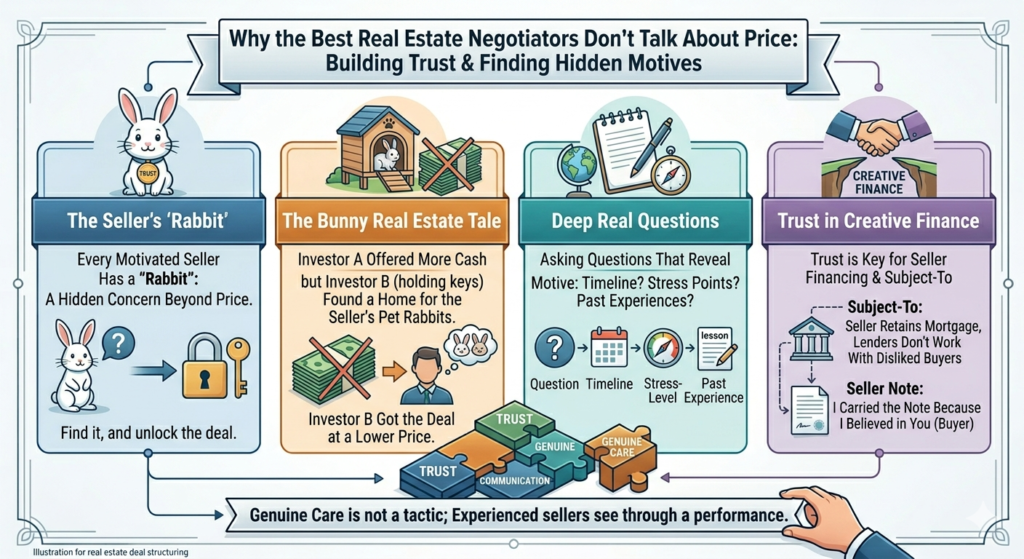
The Real Estate Negotiation Tip Nobody Teaches: The Rabbit Story
Here’s a story that changed how I think about negotiation entirely.
A seller — an elderly woman approaching retirement — had a property she needed to sell. Thirty investors showed up. They all made offers. Some were higher than asking price. She turned all of them down.
One investor did something different. Instead of leading with numbers, he actually talked to her. Asked about her life, her plans, what she was worried about.
Turns out she had three enormous Flemish Giant rabbits. And she had no idea what was going to happen to them when she moved.
Nobody else asked. Nobody else cared. They were there to buy a house, not to talk about rabbits.
This investor found a home for the rabbits. Problem solved.
She sold him the property — below what others had offered.
The rabbits weren’t really about the rabbits. They were about a woman who felt like no one was paying attention to what actually mattered to her. And the moment someone did — genuinely, not as a tactic — the deal was done.
This is the real estate negotiation tip most content never covers.
Every Seller Has a Rabbit
The rabbit is whatever the seller is actually worried about that has nothing to do with the sale price.
Sometimes it’s obvious:
- An elderly landlord who’s exhausted and just wants out fast — no drawn-out closing, no nickel-and-diming
- An estate sale where the family is grieving and the last thing they want is a complicated transaction
- A seller going through a divorce who needs the deal to close before a court date
Sometimes it’s less obvious:
- A landlord who feels guilty about leaving long-term tenants — they want to know the building will be managed well
- A seller who built the property themselves and has emotional attachment to what happens to it
- Someone who had a bad experience with a previous buyer who backed out — they need to trust that you’ll close
The price matters. Of course it does. But in a lot of motivated seller situations, the price is almost secondary to whether the seller trusts you and feels heard.
This is the real estate negotiation tip that separates investors who close from investors who keep losing deals to lower offers.
What These Real Estate Negotiation Tips Look Like in Practice
This doesn’t mean being fake. It doesn’t mean pretending to care so you can lowball someone. Sellers can smell that.
It means actually being curious. Asking real questions. Listening to the answers.
When you walk a property with a motivated seller, before you start mentally calculating rehab costs, have a real conversation:
“How long have you had this place?”
“What’s making you want to sell now?”
“What’s most important to you in this sale — timeline, price, certainty of closing?”
“Is there anything about this process that’s been stressful for you?”
You’re not interrogating them. You’re just being a human. And you’d be surprised how much information comes out.
A seller who needs to close in 21 days might take $20,000 less to get that certainty. A seller who’s worried about tenants might give you better terms if you put something in writing about your management approach. A seller who’s had buyers back out before might respond better to a larger earnest money deposit than to a higher offer price.
None of this is in the listing description. You only find out by asking.
Why These Real Estate Negotiation Tips Matter More in Creative Finance
If you’re trying to buy with seller financing, subject-to, or any structure outside the standard transaction — you need these real estate negotiation tips even more.
Because those deals require a seller to do something unusual. To trust you with something beyond just handing over a deed. To carry a note on their own property. To leave their name on a mortgage.
No seller is going to do any of that for someone they don’t trust. The creative finance structure might be perfect on paper. But if the seller doesn’t believe in you as a person, it doesn’t matter.
According to BiggerPockets, the most consistently cited factor in successful off-market real estate acquisitions isn’t price — it’s the buyer’s ability to understand and address the seller’s underlying concerns beyond the transaction itself.
The Practical Real Estate Negotiation Tips Before Your Next Seller Meeting
1. Research the situation, not just the property. Why are they selling? How long has it been listed? Is it an estate sale, a divorce, a tired landlord? The more context you have going in, the better questions you can ask.
2. Listen for the thing behind the thing. When a seller says “I just want a fair price” — what does fair mean to them? When they say “I need to close quickly” — what’s driving that timeline? When they say “I’ve had bad experiences with investors before” — what happened, and what would make this time different?
The answer to those questions is your rabbit. Find it, solve it, and you’ve done something none of the other thirty investors bothered to do.
A Note on Authenticity
These real estate negotiation tips only work if you actually care.
Going into a seller conversation with a checklist of empathy tactics is worse than just talking numbers. Sellers — especially older, experienced ones who’ve owned property for decades — have finely tuned radar for people who are performing versus people who are genuine.
The investors who are best at this aren’t running a script. They’re just genuinely interested in people.
The deals that nobody else can close — the ones with the most creative structures, the best terms, the most motivated sellers — almost always go to the person who took the time to find the rabbit.
Use the Exit Strategy Picker to figure out which deal structure fits a motivated seller’s situation before you walk into that conversation — knowing your options makes you a better listener.
Not financial advice — just someone doing a lot of research and asking a lot of questions.