Rental units financial freedom — it’s not just a vague goal. I’ve been thinking about it in a very specific, I’m-looking-at-four-unit-buildings-in-Germantown kind of way.
So when I came across a video where an experienced investor broke down exactly how many rental units financial freedom actually requires — and why the number is probably higher than you think — I had to sit with it for a while.
Here’s what I learned. And here’s what the road actually looks like from zero to financial freedom through rental units.
The Number That Sounds Great But Isn’t
The investor in the video started with 60 units.
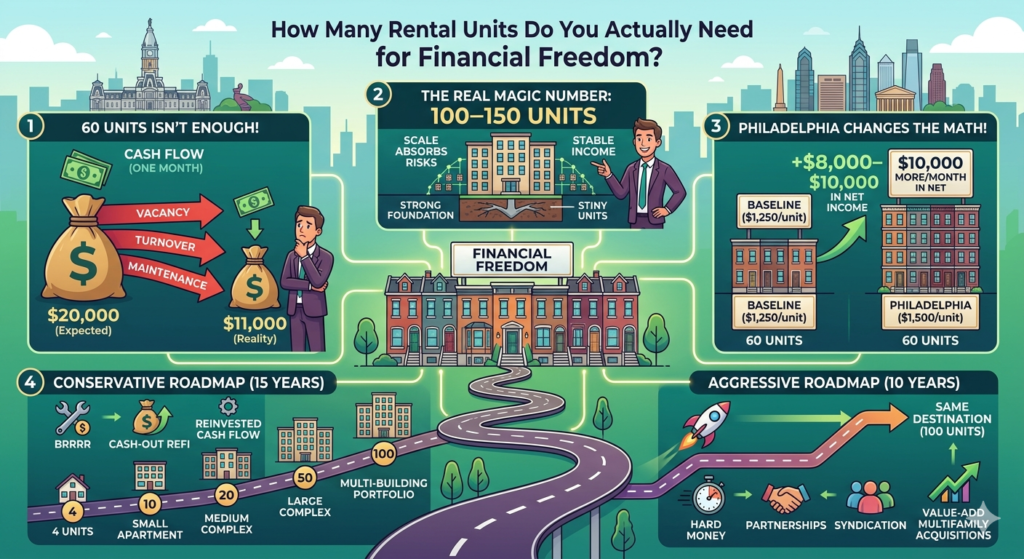
At full occupancy, 60 units generating $1,250/month each = $75,000 in gross rent. After mortgage, taxes, insurance, property management, and maintenance — net income lands around $20,000/month.
$20,000 a month sounds incredible. Until reality shows up.
Two units go vacant. That’s -$2,500 in lost rent. Turning those two units costs $1,500 each. That’s -$3,000. Add unexpected maintenance — a furnace, a roof patch, a plumbing issue. Another -$3,000 or more.
Suddenly your $20,000 month looks like $11,000. And that’s not a bad month. That’s a normal month.
This is why 60 rental units isn’t the financial freedom number.
The Real Magic Number for Rental Units Financial Freedom: 100–150 Units
At 100–150 units, the math changes fundamentally.
Two vacant units out of 120 is a 1.7% vacancy rate — barely a blip. Maintenance costs spread across more units become predictable and manageable. A bad month in one building gets absorbed by a good month in another.
This is what rental units financial freedom actually looks like — not zero problems, but enough scale that the problems don’t threaten your livelihood.
Why Philadelphia Changes the Rental Units Financial Freedom Math in Your Favor
The video used $1,250/unit as the baseline. In Philadelphia — specifically in neighborhoods like Germantown — the numbers are already higher.
Current Germantown rents:
- 1 bedroom: ~$1,500/month
- 2 bedroom: ~$2,200/month
Run the same 60-unit math at $1,500/unit:
- Gross: $90,000/month
- Net (after expenses): closer to $28,000–$30,000/month
Same number of units. Significantly better outcome. Philadelphia’s rental market — still affordable relative to NYC and DC but rising — is one of the reasons I keep coming back to this city as a starting point for building rental units financial freedom.
According to Census.gov, Philadelphia’s median rent has risen steadily over the past five years while remaining significantly below comparable East Coast metros — which means strong rental demand with still-accessible entry prices for investors.
The Roadmap: From Zero to 100 Rental Units
Here’s where it gets real. 100 units sounds like a lot. But it’s not unreachable if you have a plan and you start.
Conservative Plan — 15 Years
Years 1–2: The Foundation (4 units) Buy a 4-unit property using house hacking or BRRRR. Live in one unit, rent the other three. Learn how to be a landlord without it consuming your life.
Years 3–4: First Expansion (10 units) Use cash flow and savings to acquire a second small multifamily. Net income: $3,000–$5,000/month after expenses.
Years 5–6: Refinance and Scale (20 units) Cash-out refinance on appreciating properties. Use equity to fund next acquisition. Net income: $6,000–$10,000/month.
Years 7–10: Building Momentum (40–50 units) BRRRR strategy in full effect. Possibly bring in a partner or investor capital. Net income: $12,000–$18,000/month.
Years 11–15: The Destination (100 rental units) Portfolio stabilized and professionally managed. Vacancy and maintenance absorbed by scale. Net income: $25,000–$35,000/month. Rental units financial freedom achieved.
Aggressive Plan — 10 Years
Years 1–2: 4 units. Same start — house hack, learn the game.
Years 2–3: 15 units. Move faster on second acquisition. Use hard money + BRRRR to accelerate.
Years 3–5: 30 units. Syndication or partnership to access larger multifamily.
Years 5–7: 60 units. Refinance across portfolio. Bring in private money partners.
Years 8–10: 100+ rental units. Portfolio operating at scale. Property management in place. Net income: $30,000+/month.
The difference between conservative and aggressive: capital access, risk tolerance, and how many hours you’re willing to put in on the front end.
Where I Am Right Now
I’m at zero units. Looking at four-unit buildings in Germantown.
That feels small against a goal of 100. But here’s how I’m thinking about it: the investor in the video with 100+ units started somewhere. Everyone does. The four-unit I’m evaluating right now isn’t “just” a four-unit — it’s the foundation of a 15-year plan toward rental units financial freedom.
Philadelphia in 2026 — rising rents, still-affordable entry prices, strong grant programs for first-time buyers — might be one of the better places in the country to start that plan.
I’m not waiting until I have more capital, more experience, or more certainty. Four units first. Then ten. Then we’ll see.
Use the Multi-Unit Cash Flow Calculator to run your own rental units financial freedom numbers — including vacancy assumptions, maintenance reserves, and net income projections at different portfolio sizes.
Not financial advice — just someone doing a lot of research and asking a lot of questions.