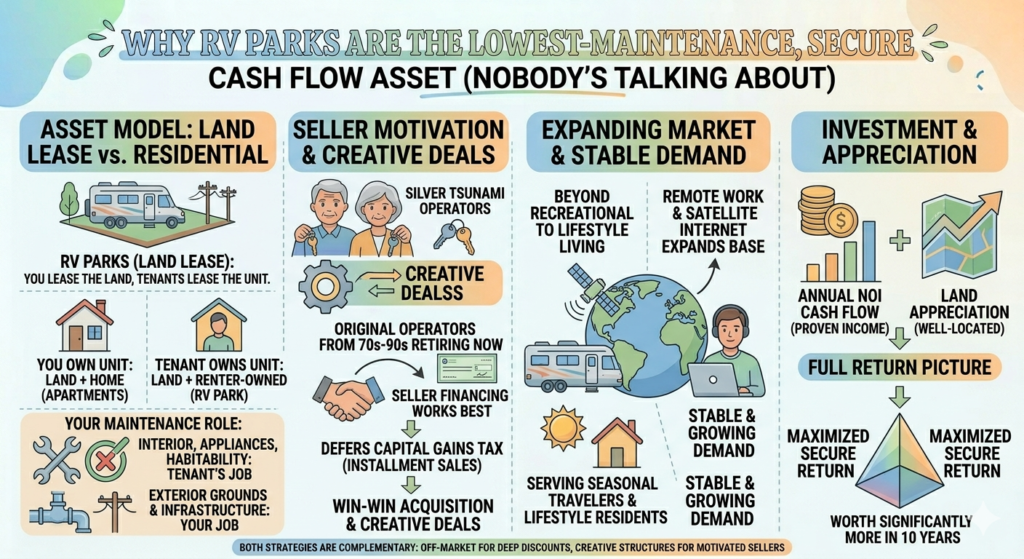
RV park investing is one of the most underrated commercial real estate strategies — and the business model is almost absurdly simple. You own land. People park their RVs on it. They pay you. When they leave, the biggest repair you might need to make is raking the gravel.
That’s the whole thing.
What RV Park Investing Actually Is (As a Business)
An RV park is not a hotel. It’s not an apartment complex. It’s not even a traditional rental property.
RV park investing is a land lease business.
You’re not providing walls, a roof, plumbing, a kitchen, or appliances. You’re providing a pad — a flat, connected spot where someone can park a vehicle they already own. The tenant brings everything that matters. The infrastructure you maintain is minimal: utility hookups, common area roads, maybe a bathhouse.
When a residential tenant moves out of an apartment, you might be looking at carpet replacement, paint, appliance repairs, bathroom work. When an RV guest checks out, you’re looking at a vacant pad. Maybe some cleanup. Maybe gravel leveling.
The maintenance cost differential in RV park investing is not subtle.
The Numbers Behind RV Park Investing
Let me walk through what a real RV park deal looks like.
A 500-unit RV park generating $20,000–$22,000 per month in net operating income — after expenses — is a meaningful cash flow asset. That’s $240,000–$264,000 annually in NOI from a single property.
At a 5% cap rate, that NOI supports a valuation of $4.8M–$5.3M. At a 4% cap rate in a desirable location, it’s higher.
The acquisition structure that makes RV park investing work without conventional financing:
An owner who’s held an RV park for 20+ years faces a significant capital gains tax liability if they sell for cash. By structuring the sale as seller financing — receiving installment payments over time — they can spread that tax liability across years and potentially reduce the total tax burden.
A seller who couldn’t get $4.3M through traditional channels might happily accept $5M structured as seller financing at 4% interest — because the net after-tax outcome is better for them than a conventional sale at a lower price.
This is the creative financing insight that makes large RV park investing deals accessible without institutional capital.
Why RV Park Investing Is Easier to Manage Than Apartments
No landlord-tenant law complexity.
In most states, RV parks operate under different legal frameworks than residential rentals. Guests are often classified as licensees rather than tenants, which means standard landlord-tenant protections may not apply in the same way. When someone stops paying, the resolution process is typically faster and simpler than a residential eviction. This matters enormously at scale.
No interior maintenance.
The tenant owns the RV. If their air conditioning breaks, it’s their air conditioning. If their plumbing has a problem, it’s their plumbing. Your responsibility as the RV park investing owner is the infrastructure — utility hookups, roads, common areas. The living space itself is the tenant’s asset and the tenant’s problem.
Capital expenditures are predictable and limited.
Major capex events at an apartment complex — roof replacement, HVAC system failure, elevator repairs, plumbing issues across 50 units — can wipe out years of accumulated cash flow in a single event. At an RV park, major capex is more likely to be road repaving, utility system upgrades, or bathhouse renovation. Still real costs, but more predictable and less catastrophic when they occur.
The Silver Tsunami Opportunity in RV Park Investing
A significant portion of existing RV park inventory in the United States was built or acquired by operators in the 1970s, 80s, and 90s. Those owners are now in their 60s, 70s, and 80s. They want to exit — but a conventional sale triggers a large capital gains tax event.
This creates the conditions for seller financing conversations. An owner who wants to exit, wants their asking price, and wants to manage their tax liability is exactly the profile where RV park investing creative financing structures work best.
The window for this opportunity — buying from aging original operators before the asset changes hands again or is institutionalized — is real and probably time-limited.
The Demand Side: Why RV Park Investing Has Structural Tailwinds
Remote work and location independence. The expansion of reliable remote work has created a growing population of people who can work from anywhere. Satellite internet — now widely available — removed one of the last practical barriers to full-time RV living. This isn’t a fringe demographic anymore. It’s a growing lifestyle segment with real purchasing power and consistent demand for quality RV park infrastructure.
Affordability pressure. As housing costs have risen in major metros, RV living has become an economically rational choice for some households. An RV paid off or nearly paid off, with monthly site fees of $500–$1,000, can be significantly cheaper than renting an apartment in many markets. This expands the RV park investing demand base beyond recreational travelers to include long-term residents choosing RV living as a housing strategy.
The Exit Strategy in RV Park Investing
You’re buying land. Land near national parks, recreational destinations, or highway corridors with strong demand doesn’t depreciate. It tends to appreciate as surrounding development increases and alternative uses become viable.
An RV park generating $240,000 in annual NOI today might support a valuation of $5M at current cap rates. In 10 years, if demand has grown and surrounding land values have increased, that same asset might support a valuation of $10M–$12M.
You’ve collected cash flow for 10 years and doubled your equity. That’s the full RV park investing return picture — not just the monthly NOI.
According to BiggerPockets, RV park investing has attracted increasing institutional interest over the past five years precisely because of its low maintenance intensity and strong NOI margins — making it one of the few commercial real estate categories where individual investors can still find motivated sellers before institutional capital dominates the space.
What Makes RV Park Investing Hard
Finding the right asset takes time. Good RV parks in strong locations with motivated sellers who are open to creative financing don’t show up on LoopNet every week. This is a relationship-driven search — finding operators through industry associations, direct outreach, and referral networks.
Zoning and permitting are local and complex. RV parks are regulated at the local level, and regulations vary significantly. Some existing parks have grandfathered status that would be lost if ownership changes trigger a permitting review.
Management systems matter. Even with low physical maintenance, RV parks need operational systems — reservation management, utility billing, rule enforcement, security. A well-run park generates consistent income. A poorly run park with high turnover is a different investment entirely.
Use the Rental Property ROI Calculator to model RV park investing returns — plug in projected NOI, cap rate, and purchase price to see how the commercial land lease math stacks up against your residential alternatives.
Not financial advice — just someone doing a lot of research and asking a lot of questions.