Self storage investing doesn’t get talked about enough. It’s not glamorous. Nobody posts about it on Instagram. And that’s exactly why the numbers work.
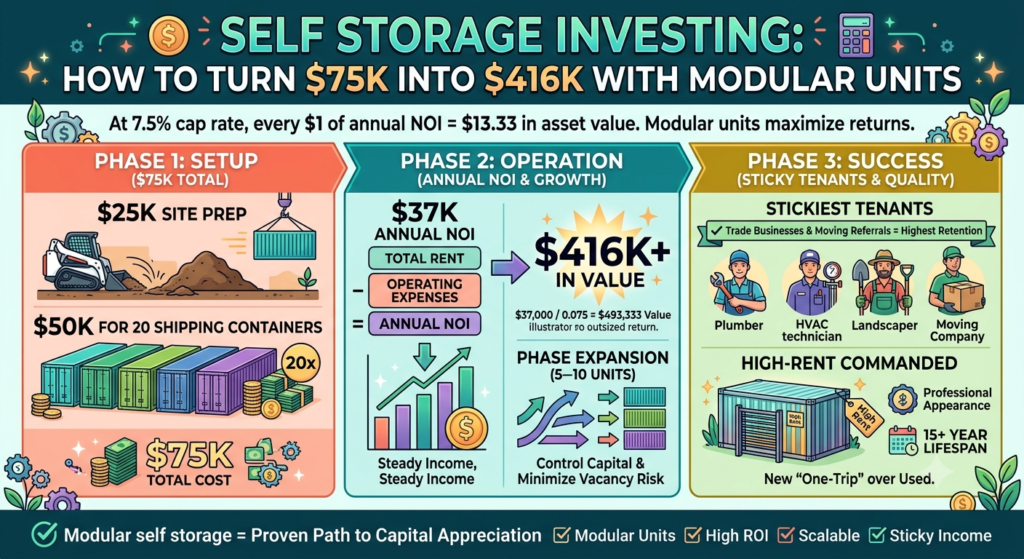
Tyler Cauble laid out a case study that shows how $75,000 in modular container units added over $400,000 in asset value to an existing self storage property. Here’s the math and the strategy behind it.
Why Self Storage Investing Produces Outsized Returns
Self storage is valued like all commercial real estate — on income, not comps. That means every dollar of NOI you add goes directly into the asset’s appraised value at a multiplier.
At a 7.5% cap rate, $1 of annual NOI = $13.33 of asset value.
That relationship is what makes self storage investing so powerful when you can add units cheaply. You’re not just collecting more rent — you’re engineering a higher appraised value that you can refinance against or sell at.
The gap between what it costs to add a unit and what that unit produces in NOI — multiplied by the cap rate — is where the wealth gets created.
The Modular Strategy That Creates Immediate Value
Most self storage investors think about adding value through rent increases or better management. Those matter. But the biggest lever in self storage investing is using underutilized land to add units without building a traditional structure.
The modular approach works like this:
Step 1 — Find the dead space. Every self storage property has it. Unused corners, underutilized outdoor areas, awkward lots between buildings. That space is generating zero income right now.
Step 2 — Add shipping containers. Twenty-foot containers can be sourced, delivered, and placed on a gravel pad. No complex permitting. No long construction timeline. Tyler’s case study used 20 containers on a prepared site.
Step 3 — Phase the expansion. Don’t install all 20 at once. Start with 5 to 10, lease them up, then add more. This controls capital outflow and minimizes vacancy risk on new units.
The cost breakdown in the case study:
- Site prep (grading and gravel): $25,000
- 20 containers purchased and installed: $50,000
- Total investment: $75,000
The Math Behind Self Storage Investing Returns
At $200 per month per unit, 20 containers generate $4,000 in monthly rent. After basic expenses, that’s approximately $3,100 in additional monthly NOI — or roughly $37,000 annually.
Apply a 7.5% cap rate:
$37,000 ÷ 0.075 = $493,000 in added asset value
The case study is conservative at $416,000. Either way, you invested $75,000 and created over $400,000 in appraised value. That’s the self storage investing math that makes this strategy worth understanding.
Run your full self storage numbers through the Rental Property ROI Calculator before you commit to any expansion. Know your target NOI, your cap rate, and your projected appraised value before you spend a dollar on containers.
Who to Target: Sticky Tenants That Stay Forever
Self storage investing returns depend on occupancy. The difference between 75% and 95% occupancy on a 20-unit expansion is significant — so who you rent to matters as much as how many units you have.
Trade businesses are the best tenants. Plumbers, HVAC contractors, landscapers, home staging companies — these businesses need storage as a permanent operating expense. They’re not moving out because they found a deal across town. They’re staying because their tools, equipment, and inventory live there. Turnover is low. Late payments are rare.
Moving company partnerships are the highest-leverage acquisition channel. When someone hires a moving company, they often need storage — temporarily or long-term. A referral agreement with a local moving company puts a consistent flow of pre-qualified prospects in front of you without advertising spend.
These two channels — trade businesses and moving company referrals — are what separate self storage investing operators who run at 90%+ occupancy from those who struggle to fill units.
Design Considerations That Affect Returns
Bad layout decisions in self storage investing cost money for years. A few things worth getting right from the start:
Truck access is non-negotiable. A 24 to 26-foot moving truck needs to pull up directly in front of a unit, load or unload, and exit without a complicated maneuver. Minimum aisle width of 15 to 25 feet depending on unit configuration. If trucks can’t access units easily, customers go somewhere else.
New containers over used. Used containers are cheaper upfront. They’re also inconsistent in condition, prone to rust, and signal lower quality to prospective tenants. New one-trip containers cost more but last 15+ years and look professional. In self storage investing, the appearance of the facility directly affects what rent you can command.
Mix the unit sizes. Ten-foot, twenty-foot, and forty-foot containers serve different customers. A landscaping company needs a forty-foot. An individual storing seasonal items needs a ten-foot. Variety increases the addressable market for each unit you add.
According to the Self Storage Association, the self storage industry has maintained occupancy rates above 90% nationally for the past several years — driven by demand from both residential customers and small businesses that need flexible storage without long-term commercial leases.
Why Self Storage Investing Fits the Current Market
In a high-rate environment where apartment deals are harder to underwrite and flipping margins are compressed, self storage investing offers something unusual: low operational complexity, low tenant turnover, and a clear value-add path that doesn’t depend on market appreciation.
You’re not betting on rents going up or cap rates compressing. You’re adding units cheaply, leasing them to sticky tenants, and letting the NOI math do the work.
That’s a strategy that works in most market conditions — which is exactly why experienced commercial investors keep coming back to it.
Not financial advice — just someone doing a lot of research and asking a lot of questions.