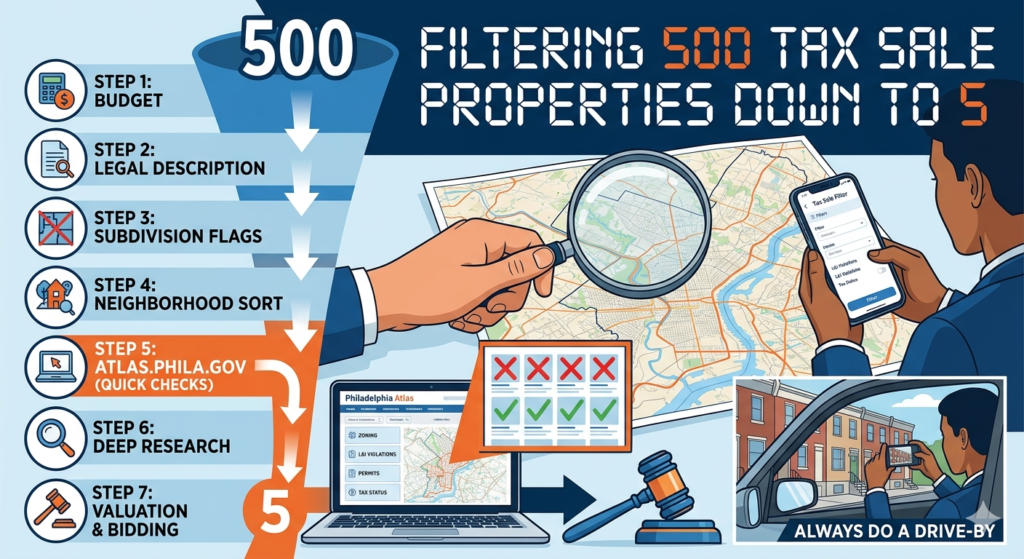
Tax sale property research done wrong wastes days. Done right, it takes minutes per property — and leaves you with a short list of deals actually worth pursuing.
The biggest mistake new tax sale investors make isn’t bidding on the wrong property. It’s spending equal time on every property in the list. Philadelphia tax sale auctions can have hundreds of listings. If you spend 20 minutes researching each one, you’ve burned through days of work before you’ve figured out which ones deserve a second look.
The investors who do this well aren’t trying to find reasons to buy. They’re trying to find reasons to eliminate — as fast as possible.
Here’s the 8-step filtering process that turns an overwhelming list into a manageable shortlist.
Before You Start Tax Sale Property Research: Know Your Market
Before you touch the property list, you need baseline knowledge of Philadelphia’s neighborhoods.
What to know before you filter:
Which zip codes and neighborhoods fit your strategy? If you’re flipping, you need neighborhoods with active buyer demand and comparable sales to support your ARV. If you’re holding for rent, you need stable tenant demand.
What are the zoning and building regulations? Philadelphia’s L&I department enforces strict building codes. Some areas have deed restrictions or overlay districts that limit what you can build or renovate.
What’s being developed nearby? New construction, transit improvements, and commercial development indicate neighborhood trajectory. A vacant lot near a new development corridor is worth more than the same lot in a stagnant area.
Spend time on this market research before the auction list drops. When the list comes out, you want to be filtering — not learning the basics.
Step 1: Budget Filter
Go through the list and eliminate every property where the opening bid exceeds your budget. This takes seconds.
If you have $10,000 to work with, a property starting at $75,000 in accumulated taxes is not your deal — regardless of how interesting it looks. Remove it immediately. Don’t talk yourself into researching properties you can’t afford.
Step 2: Legal Description Check in Tax Sale Property Research
Every tax sale listing includes a legal description of what’s actually being sold. Read it.
This is where beginners get caught. The address sounds promising, but the legal description reveals:
- A water retention area (you’re buying a drainage ditch)
- The “east 5 feet” of a lot (a strip too narrow to do anything with)
- A utility easement that renders the parcel unbuildable
- A partial interest in a property (not the whole thing)
If the legal description doesn’t describe something you can actually use — eliminate it immediately.
Step 3: Subdivision Red Flags
Look at the broader auction list and notice patterns.
If one subdivision or development has 15–20 properties all hitting the tax sale at the same time, that’s a red flag. Common reasons:
- The HOA collapsed and fees went unpaid en masse
- The area has building restrictions that made lots unsellable
- Access issues — no road frontage, landlocked parcels
- Environmental problems affecting the whole area
One or two properties from a given area can be coincidence. A flood from the same place usually signals a systemic problem. Skip the entire cluster and move on.
Step 4: Neighborhood Sort in Tax Sale Property Research
Sort by desirability based on your earlier market research.
Keep: Properties in neighborhoods that fit your investment strategy — active buyer markets, stable rental demand, development activity nearby.
Remove: Properties in neighborhoods with high vacancy, declining values, high crime, or limited buyer pools.
For Philadelphia specifically — neighborhoods like parts of Germantown, West Philly, Kensington’s edges, and Strawberry Mansion have active investor markets with real buyer demand. Deep North Philly blocks with high vacancy and few comparable sales are harder to exit.
Step 5: Digital Quick Scan — 60 Seconds Per Property
For every property that’s survived the first four filters, spend 60–90 seconds on a digital scan. This is not deep tax sale property research — it’s a quick check for immediate disqualifiers.
Tools to use:
Philadelphia’s Atlas (atlas.phila.gov) — The city’s official property information system. Enter the address or parcel ID and instantly see ownership history, zoning, L&I violations, permits, and tax status.
Google Maps / Street View — Look at the property and the surrounding block. Is the street lined with abandoned buildings? Is the property clearly demolished?
Philadelphia GIS — Aerial imagery shows the actual footprint. Is there a building on it? Is it underwater? Does it have road access?
What you’re looking for in 60 seconds:
- No road frontage (landlocked parcel)
- Designated park, conservation area, or utility corridor
- Property already demolished or collapsed
- Zoning that doesn’t match your intended use
- Flood zone designation
If any of these appear — eliminate and move on.
Step 6: Deeper Tax Sale Property Research
You’ve filtered hundreds of properties down to a much smaller list. Now you do the real work.
Zoning verification: Confirm the zoning designation and what it allows. Residential? Commercial? Mixed use? Can you build what you’re planning?
L&I violation history: Philadelphia’s Atlas shows all open and closed L&I violations. A long history of code violations may signal structural issues beyond cosmetic renovation.
Title and lien research: Check for liens that might survive the tax sale. At a Judicial Sale, most liens are wiped. At an Upset Sale, they’re not.
Ownership history: How long has the current owner held it? Are there multiple parties with potential claims?
This step takes time — which is exactly why you filtered aggressively before reaching it. You’re only doing this deep tax sale property research on properties with a real chance of being worth bidding on.
Step 7: Valuation
For the properties that survive Step 6, run the actual numbers.
For a flip:
- What do comparable renovated properties sell for? (ARV)
- What’s a realistic renovation budget with a 20% contingency?
- What are your carrying costs and selling costs?
- Work backward: ARV minus all costs equals your maximum bid
For a rental:
- What do comparable properties rent for?
- Apply the 1% rule: monthly rent should be approximately 1% of total investment
If your maximum bid is below the opening bid — this isn’t your deal at this auction. Pass.
Step 8: Drive-By
For any property you’re seriously considering bidding on — go look at it.
You can’t see inside most tax sale properties. But you can drive past, walk the exterior, observe the block, and get a ground-level sense of what you’d be getting into that no tax sale property research from a computer screen can provide.
What to look for:
- Structural integrity visible from the exterior (roof condition, foundation, walls)
- Signs of active occupation (squatters, recent activity)
- Condition of surrounding properties
- Access and parking
- Any obvious environmental issues
If anything disqualifies the property at this stage — eliminate it.
According to BiggerPockets, the investors who consistently profit from tax sale property research are those who eliminate aggressively — spending the majority of their time on the 1–3% of properties that survive every filter, not on the 97% that should have been cut in the first five minutes.
The Mindset: Find Reasons to Eliminate
Most investors approach a property list looking for reasons to buy. They get excited about a price and then try to make the deal work in their heads.
Flip it: approach every property looking for the fastest reason to eliminate it.
The goal isn’t to find one perfect property through exhaustive tax sale property research on everything. The goal is to eliminate 495 properties as quickly as possible so you can focus your time on the 5 that might actually be worth bidding on.
Use the Sheriff Sale Bid Calculator to run the valuation step on any surviving property — plug in ARV, renovation budget, and carrying costs to confirm your maximum bid before you raise your hand.
Not financial advice — just someone doing a lot of research and asking a lot of questions.