
Vacant lot vs teardown — it’s a question most new investors never think to ask. And it might be costing them.
I was watching a video recently — two guys standing in front of what used to be a house. Completely burned down. Just a pile of debris and a slab.
And they were smiling.
Because they just bought it. On purpose.
Vacant Lot vs Teardown: Why Would Anyone Buy a Burned House?
That was my first reaction too. But the more I thought about it, the more it made sense.
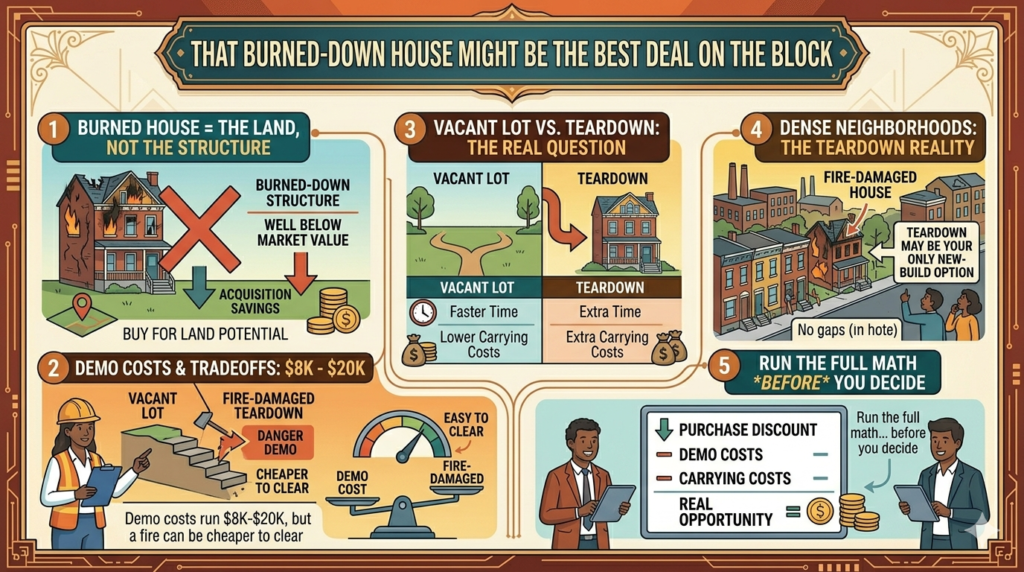
They weren’t buying the house. They were buying the land. And because nobody else wanted to deal with a burned-out structure, they got it for way below land value. The negotiation alone — getting a seller to take less because of the demo headache — is a skill in itself.
The area they were in was 50+ years old. Dense, established neighborhood. No vacant lots sitting around waiting to be developed. If you want to build new there, this is your only option. Find the worst property on the block, buy it cheap, tear it down, and build.
And looking around in that video — new duplexes already going up nearby. The neighborhood is turning. They saw it early.
What Does Demo Actually Cost?
This is the part people get nervous about. Demo isn’t free.
Depending on the size of the structure and your market, you’re typically looking at somewhere between $8,000 and $20,000 for a standard residential demo. A burned structure can actually be cheaper — the fire already did some of the work.
So yeah, you’re paying for demo. But if you bought the lot at $30,000–$40,000 under what a clean vacant lot would cost? You’re still ahead. Significantly.
According to the National Association of Realtors, land and lot values in established urban neighborhoods have been rising steadily — which is exactly why getting in cheap on a teardown can make sense in a supply-constrained market.
What to Watch Out For With a Burned Structure
Not all teardowns are created equal — and burned houses come with a specific set of risks that a regular demo doesn’t.
First, environmental testing. Depending on the age of the structure, there may be asbestos, lead paint, or other hazardous materials that need professional abatement before demo can even start. That’s an added cost and an added timeline — sometimes weeks.
Second, the slab. If the foundation was compromised by the fire or by water from firefighting, you may not be able to reuse it. A new foundation adds significant cost to your new construction budget.
Third, permits. Some municipalities require additional inspections on fire-damaged properties before issuing a demo permit. Philadelphia is no exception — factor in the extra steps before you assume a quick turnaround.
None of this is a dealbreaker. But it changes the math. And the math is the whole point.
The Vacant Lot vs Teardown Counterargument
Clean vacant lot buyers aren’t stupid either.
When you buy a lot that’s already cleared, permitted, and ready to build — you’re paying a premium, sure. But you’re also buying something real: time.
Construction loans and hard money aren’t free. Every week you’re not building, you’re paying interest. If demo takes 2–4 weeks, plus permits, plus any environmental surprises from a burned structure — that timeline adds up fast.
Is the money you saved on acquisition actually being eaten up by carrying costs while you deal with the mess?
That’s not a rhetorical question. It’s a math question. And the answer is different for every deal.
How to Actually Solve the Vacant Lot vs Teardown Question
“It’s cheaper” isn’t good enough. You need to know if it’s actually cheaper after you factor in demo costs, carrying costs, and the time difference between a teardown lot and a move-in-ready lot.
Sometimes the teardown wins by a landslide. Sometimes the numbers are closer than you’d think.
Run the numbers through the Teardown vs Vacant Lot Calculator before you decide. That’s exactly what it’s built for.
Not financial advice — just someone doing a lot of research and asking a lot of questions.