
1031 exchange real estate strategy is one of the most powerful legal tax tools available to investors in the United States. And I almost missed it entirely.
When I first came to America, I ended up working at a CPA firm in Los Angeles — not as an accountant, just helping with paperwork and organizing documents. My English wasn’t strong enough for the real work. But I listened.
And one day, one of the accountants sat down next to me and said something I’ve never forgotten.
“Celine, if you invest in real estate and do it right, you can go your entire life without paying capital gains tax. You just keep moving up. And when you die, your kids get everything tax free.”
I didn’t fully understand it at the time. Now I do.
What Capital Gains Tax Actually Costs You
Before I explain the 1031 exchange real estate strategy, let me show you what you’re trying to avoid.
In 2026, long-term capital gains are taxed at 0%, 15%, or 20% federally depending on your income. Most investors fall into the 15% bracket. Pennsylvania adds another 3.07% on top.
So if you buy an investment property for $100,000 and sell it for $500,000:
- Federal: $400,000 × 15% = $60,000
- Pennsylvania: $400,000 × 3.07% = $12,280
- Total tax bill: ~$72,280
That’s $72,280 gone before you can reinvest a single dollar. Multiply that over a 20 or 30 year investing career and the number gets staggering.
The 1031 exchange real estate strategy exists to stop that from happening.
What a 1031 Exchange Real Estate Strategy Actually Is
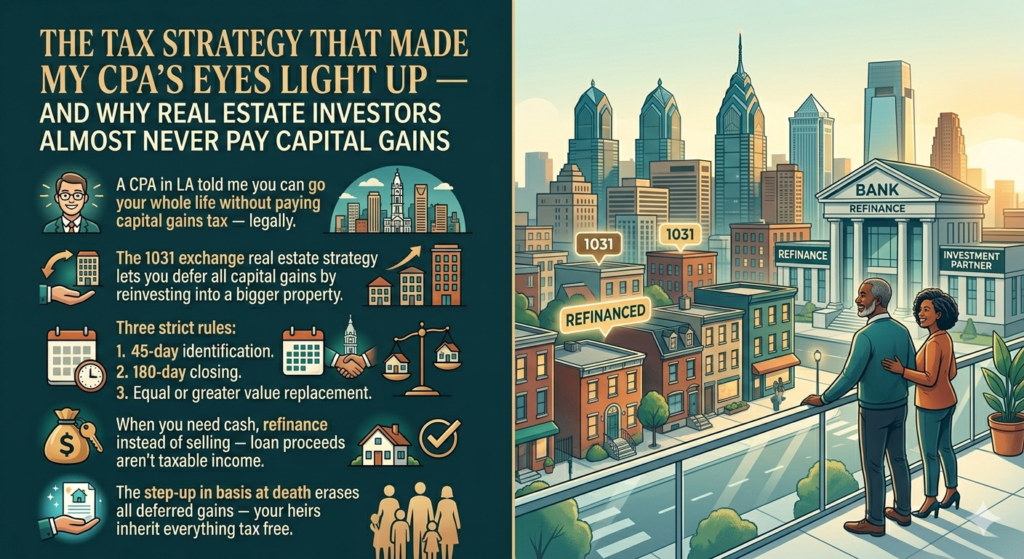
A 1031 Exchange — named after Section 1031 of the US tax code — allows you to sell an investment property and defer all capital gains taxes, as long as you reinvest the proceeds into another investment property of equal or greater value.
You don’t pay the tax now. You push it forward. Then you do it again. And again.
According to the IRS, like-kind exchanges under Section 1031 have been part of the US tax code since 1921 — this isn’t a loophole, it’s a congressionally designed incentive to encourage real estate investment.
The simple version:
- Buy a $150,000 investment property in Philadelphia
- It appreciates to $300,000
- Instead of selling and paying ~$22,000 in taxes, you 1031 exchange into a $350,000 property
- That property appreciates to $600,000
- Instead of paying ~$45,000 in taxes, you 1031 exchange into an $800,000 property
- Repeat for your entire investing career
Every time you would have written a check to the IRS, you put that money into a bigger property instead.
The Three Rules of a 1031 Exchange Real Estate Deal
The strategy is powerful but has strict deadlines:
The 45-day rule. From the day you sell, you have 45 days to identify your replacement property in writing. Miss this and the exchange fails entirely.
The 180-day rule. From the day you sell, you have 180 days to close on the replacement property.
The equal or greater value rule. Your replacement must be equal to or greater in value than what you sold. If you sell a $300,000 property and buy a $200,000 one, the $100,000 difference — called “boot” — is taxable.
Want to run the numbers on a 1031 exchange? The 1031 Exchange Calculator will show you exactly how much tax you’re deferring and what your next property needs to look like.
What If You Need Cash?
The 1031 exchange real estate strategy is all-or-nothing when it comes to deferring taxes. If you take cash out of the deal, that cash is taxable.
But here’s what that CPA told me years ago — the part that changed everything.
You don’t have to sell to get cash. Instead of selling and triggering a taxable event, you refinance. Loan proceeds are not taxable income. You get the cash you need, the property stays in your portfolio, and the 1031 exchange clock never starts ticking.
Buy. Appreciate. Refinance when you need cash. Exchange when you want to upgrade. Never sell.
The Step-Up in Basis — The Final Piece
When you die and pass investment property to your heirs, they receive a “stepped-up basis.” Their cost basis resets to the fair market value at the time of your death — not what you originally paid.
All those deferred capital gains from decades of 1031 exchanges? Gone. Completely erased. Your heirs can sell the property the day after they inherit it and pay zero capital gains tax.
This is not a loophole. Congress designed it this way to encourage real estate investment and economic activity.
What This Means for Philadelphia
Philadelphia’s price points make the 1031 exchange real estate strategy accessible in a way that LA or New York simply don’t.
You can start a 1031 exchange chain with a $150,000 rowhouse in Germantown. You don’t need to be wealthy to begin. You need to buy right, hold, and understand the rules well enough to execute when the time comes.
I’m not there yet. But I understand exactly where I’m going.
Not financial or tax advice — always consult a licensed CPA or tax attorney before executing a 1031 Exchange.