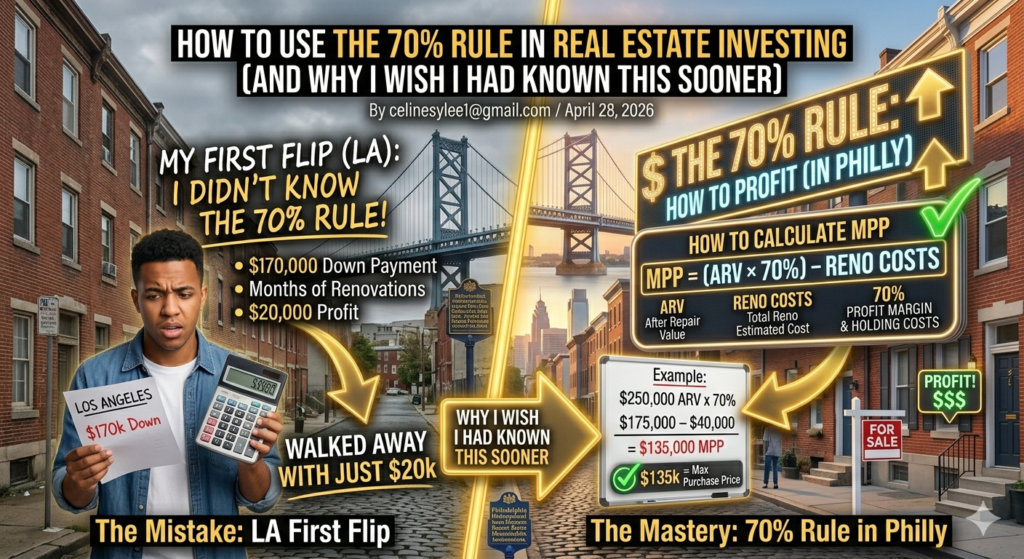
The 70% rule real estate is one of the most important concepts you’ll ever learn as a fix-and-flip investor. I’m going to be honest with you — when I did my first flip in Los Angeles, I had no idea this rule existed. I put down $170,000 as a 20% down payment, spent months watching renovations, and walked away with just $20,000 in profit. Something felt off, but I didn’t have the knowledge to understand why.
Now I do. And I’m going to explain the 70% rule real estate from two angles — how you use it to evaluate deals, and how hard money lenders use it to decide whether to fund you.
What Is the 70% Rule Real Estate?
The 70% rule is a quick formula that real estate investors use to figure out the maximum price they should pay for a fix-and-flip property.
Maximum Purchase Price = (ARV × 70%) − Renovation Costs
ARV stands for After Repair Value — the estimated market value of the property after all renovations are complete. This is not what the house is worth today. This is what it will be worth once it’s fully fixed up and ready to sell.
The 70% is your safety margin. It accounts for your profit, holding costs, closing costs, agent commissions, and unexpected expenses that always seem to show up during a renovation.
A Simple Example
Let’s say you find a property in Philadelphia. After researching comparable sales in the neighborhood, you estimate the ARV is $250,000. You get contractor bids and estimate renovations will cost $40,000.
$250,000 × 70% = $175,000 $175,000 − $40,000 = $135,000
That means the maximum you should pay for this property is $135,000. If the seller is asking $160,000, the deal doesn’t work. Walk away.
Simple. Powerful. And if I had known this before my first flip, I would have asked very different questions before signing anything.
Why Did I Only Make $20,000 on My First Flip?
This is the part I wish someone had explained to me before I wired that $170,000 down payment with shaking hands.
When I did my first flip in Los Angeles through a company that handled everything — finding the deal, managing renovations, selling the property — I trusted them completely. I was a beginner. I had just immigrated, my English wasn’t strong, and I was figuring out how to rebuild my life. I didn’t know what questions to ask.
What I didn’t realize was that every cost gets deducted from the sale price before you see a dollar of profit. Hard money loan interest running over $3,000 per month. Renovation costs. Holding costs. The company’s fees. Agent commissions on the sale. By the time all of that came out, my share was $20,000 on a property that sold for hundreds of thousands of dollars.
Was the 70% rule real estate being applied? Maybe. But I had no way to verify it, because I didn’t know it existed.
The 70% Rule Real Estate: How It Works in Philadelphia
One of the reasons I love the Philadelphia market for fix-and-flip investing is that the numbers actually work here. In Los Angeles, ARVs are so high that even small mistakes get swallowed up. In Philadelphia, where you can buy properties for $80,000 to $150,000 and achieve ARVs of $200,000 to $300,000 after renovation, the 70% rule real estate gives you real room to work with.
A rowhouse in Germantown — a neighborhood I walk through every day looking at properties. The house needs significant work but has great bones. Comparable sales suggest an ARV of $220,000. Renovation estimate comes in at $45,000.
$220,000 × 70% = $154,000 $154,000 − $45,000 = $109,000
If you can buy that house for $109,000 or less, the deal has potential. If the seller wants $130,000, you either negotiate down or move on.
How Hard Money Lenders Use the 70% Rule Real Estate
This is the angle most beginner content skips entirely — and it’s just as important as knowing how to use the rule yourself.
Hard money lenders aren’t banks. They’re not evaluating your credit score. They’re evaluating the deal itself — specifically, whether the numbers make enough sense that they’ll get their money back if everything goes sideways.
When you bring a flip deal to a hard money lender, they’re running their own version of the 70% rule real estate calculation before they say yes or no. They’re typically lending 70–75% of ARV. That buffer between what they lend and what the property will be worth after repair is their protection. If you default, they foreclose, sell the property, and get their money back.
If your deal doesn’t fit inside that math, they’re exposed. And exposed lenders say no.
Here’s a real example:
You find a property with an ARV of $200,000. You’re buying it for $90,000 and your rehab estimate is $45,000.
- Total cost: $135,000
- 70% of ARV: $140,000 ✅
That deal works — barely, but it works. A lender sees a $65,000 cushion between your total cost and the ARV.
Now flip it. Same ARV, but you’re paying $110,000 and your rehab is $50,000.
- Total cost: $160,000
- 70% of ARV: $140,000 ❌
You’re $20,000 over. No experienced hard money lender is going to fund that deal.
What lenders actually want to see:
Solid ARV backed by real comps — not Zestimate, not optimistic projections. Actual recent sales of comparable properties within a tight radius. A realistic rehab estimate with contractor bids or detailed scope of work. A purchase price that makes the math work. A clear exit strategy — selling or BRRRR refinance.
Where Beginners Get the 70% Rule Real Estate Wrong
The most common mistake is letting optimism drive the ARV.
You fall in love with a property. You convince yourself it’ll sell at the top of the market. And suddenly your ARV is inflated just enough to make the math work on paper.
Lenders don’t care about your vision. They care about what comparable properties in that exact neighborhood have actually sold for in the last 90 days. If your ARV isn’t supported by real comps, the deal falls apart in underwriting.
The discipline is running conservative numbers before you ever make an offer. If the deal only works with an optimistic ARV, it’s not a deal.
The Limits of the 70% Rule Real Estate
The 70% rule real estate is a starting point, not a guarantee. According to Zillow Research, home values in Philadelphia have continued to shift — which is exactly why running this formula before every offer matters.
Here’s what it doesn’t account for:
Inaccurate ARV estimates. If your comparable sales analysis is wrong, your entire calculation is wrong. This is the most common mistake beginners make.
Renovation cost surprises. Experienced investors build a contingency buffer — usually 10–20% on top of contractor estimates — because something always costs more than expected.
Market timing. A property that looks great on paper today might sit on the market for six months if you’re selling into a slow market. Every extra month of holding costs eats into your profit.
Final Thoughts
If there’s one thing I want you to take away from this: learn the numbers before you touch the money.
When I did my first flip, I was newly divorced, still finding my footing in America, and my English wasn’t strong enough to ask the right questions. So I trusted a company run by people from my own community. I assumed shared background meant shared interests. It didn’t.
The 70% rule real estate takes five minutes to understand and could save you from years of regret. No one is going to protect your money the way you will.
You have to study. There are no shortcuts.
I learned that the hard way in Los Angeles. You don’t have to.
Use the Philly Flip Profit Calculator to run the actual numbers on any Philadelphia deal — including ARV, renovation costs, and your maximum purchase price — before you make any offer.
Not financial advice — just someone doing a lot of research and asking a tool of research and asking a lot of questions.