How to Invest in Philadelphia Real Estate: A Beginner’s Guide
If you’ve been wondering how to invest in Philadelphia real estate, you’re not alone. Philadelphia has quietly become one of the most attractive markets for beginner and experienced investors alike. With home prices significantly lower than other major East Coast cities, strong rental demand, and neighborhoods still in early stages of revitalization, Philly offers real opportunity for those willing to do their homework.
Is Philadelphia a Good Place to Invest in Real Estate?
The short answer is yes — and here’s why.
Philadelphia is the sixth largest city in the United States with over 1.5 million residents. More than 50% of those residents are renters, which means consistent demand for rental properties across every price point. The city is also home to over 100,000 college students, a massive healthcare industry, and a growing tech sector — all of which fuel steady demand for housing.
Compared to New York, Boston, or DC, Philadelphia’s entry prices are remarkably accessible. You can still find investment-grade properties in the $100,000–$200,000 range in neighborhoods with strong rental demand — something that’s virtually impossible in most other major East Coast markets.
How to Invest in Philadelphia Real Estate: Step by Step
Step 1: Define Your Strategy — And Learn From My Mistakes
When I first started thinking about real estate investing, I was living in Los Angeles after my divorce, trying to figure out how to rebuild. I had always been drawn to real estate, but I was intimidated. I’d immigrated later in life, my English wasn’t strong, and I’d spent most of my time in Koreatown — a world away from property investment.
So when I found a company in LA that handled everything — finding deals, managing renovations, splitting profits 50/50 — it felt like the perfect entry point. No experience required. Just show up.
And I did. Every weekend, about ten of us would tour properties while the team walked us through each one — what to keep, what to gut, when to open up a floor plan. I absorbed everything I could.
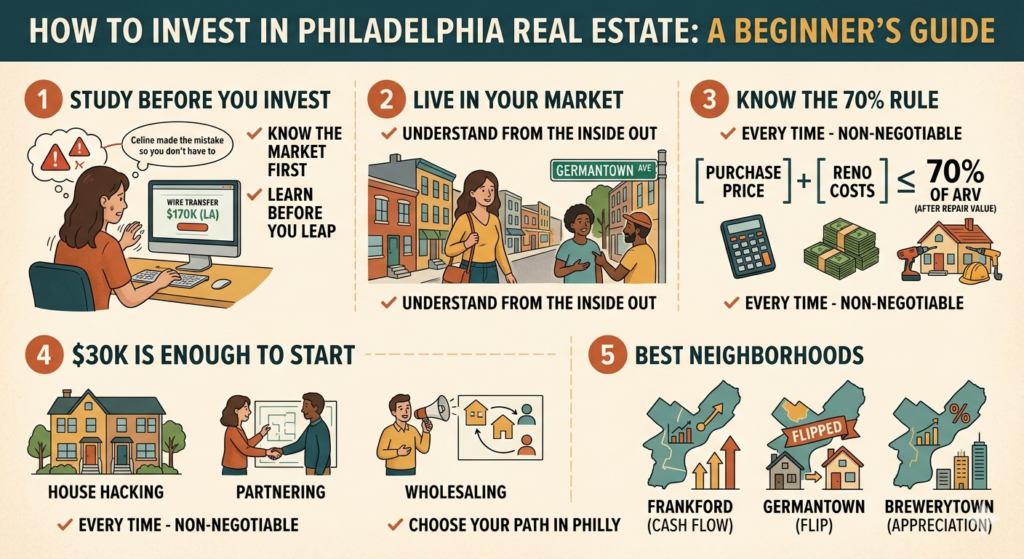
Then came the moment of truth. I wired $170,000 with my hands literally shaking. This was right as COVID was hitting and I was terrified the market would collapse. Looking back, I was starting in an expensive LA market when I should have been looking at Philadelphia from day one.
Here’s what those early flips actually looked like: first flip, four months, $20,000 profit. Second flip, eight months, $20,000. Third flip, thirteen months, $20,000. The hard money loan interest alone was running over $3,000 a month eating into every dollar.
The lesson: study first. Not after you sign. Before you ever put a dollar on the table. If you’re not ready, watching from the sidelines is perfectly fine. There is no shame in waiting until you know enough to protect yourself. That experience is exactly why I moved to Philadelphia and started this blog.
Step 2: Choose the Right Neighborhood for How to Invest in Philadelphia Real Estate
Choosing the right neighborhood is everything — and for me, this wasn’t just a spreadsheet decision. It was a life decision.
After LA, I knew I needed to be closer to the market I wanted to invest in. So I actually moved to Germantown Avenue. Not to visit. I moved here — because the best way to understand a market is to live inside it.
Every day I walk these streets. I check what’s listed, what’s sitting, what’s been renovated and what still needs work. I notice which blocks are improving and which ones are still waiting. That kind of ground-level knowledge is something no Zillow algorithm can replicate.
If you’re serious about investing in Philadelphia real estate, spend time in the neighborhoods you’re considering. Drive them at different times of day. Talk to people. Walk the blocks. The numbers on a spreadsheet will only tell you so much.
Step 3: Understand Your Numbers
This is where most beginner investors make mistakes. Before making any offer, you need to know your ARV (After Repair Value), estimated renovation costs, expected rental income, and operating expenses.
The formula to remember: Purchase Price + Renovation Costs ≤ 70% of ARV. This is the 70% rule — the foundation of fix-and-flip investing in Philadelphia.
Step 4: Build Your Team
Real estate investing is a team sport. You’ll need a reliable contractor, a real estate attorney, a property manager if you’re doing rentals, and a lender who understands investment properties. Build these relationships before you need them — it will save you enormous time and stress.
Step 5: Secure Your Financing
There are several options for Philadelphia real estate investors:
- Conventional mortgages — good for buy-and-hold if you have strong credit and verifiable income
- Hard money loans — popular for fix-and-flip, closes fast, less documentation
- Private money lenders — great once you have a track record
Thinking about a DSCR loan? Check if your deal qualifies with the DSCR Loan Qualifier.
How to Invest in Philadelphia Real Estate with $30K
One of the most common questions beginners ask is whether it’s possible to start with limited capital. Yes — but you need to be strategic.
With $30,000 in Philadelphia, your best options are:
House hacking a small multi-family using an FHA loan — as little as 3.5% down. On a $200,000 duplex, that’s $7,000 down, leaving capital for reserves and repairs.Run your house hacking numbers with the Philadelphia House Hacking Calculator.
Partnering with another investor to pool resources and split profits. Many successful Philly investors started this way.
Wholesaling — requires almost no capital but significant time and hustle. Find deeply discounted properties, assign the contract to another investor for a fee.
Where to Invest in Real Estate in Philadelphia
If you’re just getting started, these neighborhoods are worth paying attention to in 2026:
Frankford for cash flow. Germantown for fix-and-flip. Port Richmond for stability. Brewerytown for appreciation. Kensington for long-term high-risk high-reward plays.
Each offers a different risk/reward profile — the right choice depends on your strategy and capital position. For a full breakdown, check out the Best Neighborhoods to Invest in Philadelphia guide.
Final Thoughts
Philadelphia real estate investing rewards those who take the time to learn the market, understand their numbers, and build the right team. Low entry prices, strong rental demand, and ongoing neighborhood revitalization make it one of the most compelling investment markets on the East Coast right now.
Whether you’re starting with $30,000 or $300,000, there is a strategy in Philadelphia that can work for you.
Not financial advice — just someone doing a lot of research and asking a lot of questions.