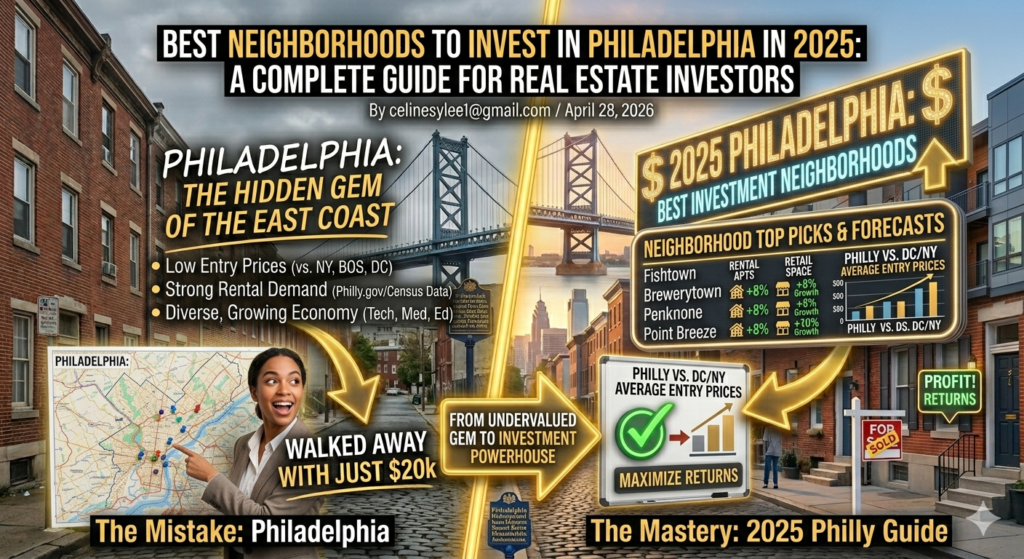
Philadelphia has quietly become one of the most compelling real estate investment markets on the East Coast. While cities like New York, Boston, and Washington D.C. get most of the attention, savvy investors have been quietly building wealth in Philly for years. The reason is simple: relatively low entry prices, strong rental demand, and a diverse economy that continues to attract young professionals, students, and working-class families alike.
In this guide, we’ll break down the best neighborhoods to invest in Philadelphia in 2025, what to expect in terms of returns, and what type of investor each neighborhood is best suited for.
Why Philadelphia in 2025?
Before diving into specific neighborhoods, let’s look at why Philadelphia makes sense as an investment market right now.
Philadelphia is home to over 1.5 million residents, making it the sixth largest city in the United States. The city has a massive renter population — over 50% of residents rent rather than own — which creates consistent demand for rental properties across all price points.
Compared to other major East Coast cities, Philadelphia’s median home prices remain significantly lower. While the average home in Manhattan sells for over $1 million, Philadelphia’s median sits around $200,000 to $250,000, making it accessible for investors who don’t have unlimited capital.
The city is also home to over 100,000 college students attending institutions like the University of Pennsylvania, Drexel University, Temple University, and Jefferson University. This creates a reliable pipeline of renters year after year.
Finally, Philadelphia’s ongoing neighborhood revitalization efforts — driven by both private investment and city initiatives — mean that early investors in up-and-coming areas stand to benefit from significant appreciation over the next five to ten years.
1. Kensington — Best for High-Risk, High-Reward Investors

Kensington has been one of Philadelphia’s most talked-about neighborhoods in recent years, and for good reason. While the area has faced significant challenges, including the well-documented struggles with drug activity, the city and private investors have been pouring resources into revitalization efforts.
For investors with a long-term mindset and a higher risk tolerance, Kensington presents an opportunity that is hard to ignore. Property prices in Kensington remain among the lowest in the city, with many rowhouses available in the $50,000 to $100,000 range. Investors who are willing to wait five to ten years could see substantial appreciation as the neighborhood continues to transform.
Average property price: $60,000 – $120,000 Average monthly rent: $900 – $1,300 Best for: Long-term buy-and-hold investors, fix-and-flip with caution Key risk: Neighborhood still in transition, property management can be challenging
2. Frankford — Best for Cash Flow Investors

Frankford is one of Philadelphia’s best-kept secrets for cash flow investors. Located in the Northeast section of the city, Frankford offers some of the strongest price-to-rent ratios in Philadelphia. You can typically purchase a rowhouse for $80,000 to $150,000 and rent it out for $1,200 to $1,600 per month, which translates to strong monthly cash flow after expenses.
The neighborhood has a stable, working-class population with consistent rental demand. Vacancy rates are low, and tenants tend to stay longer compared to more transient neighborhoods near universities.
Frankford is also benefiting from spillover investment from neighboring areas that have already seen significant price appreciation, meaning that the window for buying at current prices may not stay open forever.
Average property price: $80,000 – $150,000 Average monthly rent: $1,200 – $1,600 Best for: Cash flow investors, first-time landlords Key risk: Limited appreciation compared to trendier neighborhoods
3. West Philadelphia — Best for Student Rental Investors
West Philadelphia, particularly the area surrounding University City, is one of the most reliable rental markets in the entire city. The presence of the University of Pennsylvania, Drexel University, and several hospitals and medical research institutions creates an enormous and consistent demand for rental housing.
Properties near University City command premium rents, with one-bedroom apartments easily renting for $1,500 to $2,000 per month. Multi-unit properties in this area are particularly attractive, as investors can maximize income by renting to students or young professionals on a per-room basis.
Beyond the university corridor, the broader West Philadelphia neighborhood offers more affordable entry points while still benefiting from the spillover demand generated by the large student and medical professional population.
Average property price: $150,000 – $350,000 Average monthly rent: $1,400 – $2,200 Best for: Student rental investors, multi-unit property investors Key risk: Properties near universities require more active management due to tenant turnover
_____________________________________________________________________________________
4. Germantown — Best for Fix-and-Flip Investors
Germantown is one of Philadelphia’s most historically rich neighborhoods, featuring stunning Victorian and Colonial-era architecture that attracts buyers willing to pay a premium for character and craftsmanship. For fix-and-flip investors with an eye for potential, Germantown offers some of the most exciting opportunities in the city.
I actually moved to Germantown Avenue in February of this year — specifically because I wanted to be closer to the fix-and-flip opportunities I’d been researching. I’ll be honest: moving in during one of the coldest winters Philadelphia has seen in years didn’t exactly give me the best first impression. I spent most of those early weeks indoors, wondering what I’d gotten myself into.
Then spring hit.
When the flowers started blooming and the trees filled in along the avenue, I couldn’t believe how beautiful the street was. Germantown Avenue is long — and as you head north toward Chestnut Hill, the neighborhood shifts noticeably. Suddenly there are charming cafes, boutique shops, and a crowd that genuinely surprised me. I’m talking well-dressed, fashion-forward women who looked like they’d stepped out of a magazine. I actually caught myself thinking — wait, people in Philly dress like this?
From an investor’s perspective, that Chestnut Hill end of the avenue has already seen significant price appreciation. For someone like me — working with tighter capital — the more interesting opportunity lies further south, where there are still plenty of properties that need work and haven’t been touched yet. The bones are there. The location is there. The upside is very much still there for investors willing to roll up their sleeves.
A skilled investor who can accurately estimate renovation costs and execute efficiently can generate strong profits in this market. The neighborhood has been steadily improving over the past decade, with new restaurants, coffee shops, and community organizations drawing a younger, more affluent demographic — and that trend shows no signs of stopping in 2025.
Average property price: $100,000 – $250,000 After Repair Value (ARV): $200,000 – $400,000 Best for: Fix-and-flip investors, renovation specialists Key risk: Renovation costs can escalate quickly; accurate ARV estimation is critical
_____________________________________________________________________________________
5. Port Richmond — Best for Stable Long-Term Investment
Port Richmond is widely regarded as one of Philadelphia’s most stable and reliable investment neighborhoods. Located along the Delaware River in the northeastern part of the city, Port Richmond has a strong blue-collar identity and a tight-knit community that has maintained relatively low vacancy rates for decades.
Property prices in Port Richmond are reasonable, typically ranging from $150,000 to $250,000 for a well-maintained rowhouse. Rental demand is steady, driven by working-class families and young professionals who appreciate the neighborhood’s affordability and convenient access to major employment centers.
Port Richmond has also been attracting attention from developers and investors in recent years, as its location along the riverfront positions it well for long-term appreciation as Philadelphia continues to develop its waterfront assets.
Average property price: $150,000 – $250,000 Average monthly rent: $1,300 – $1,700 Best for: Conservative investors, first-time real estate investors Key risk: Appreciation may be slower compared to up-and-coming neighborhoods
6. Brewerytown — Best for Appreciation Play
Brewerytown has been one of Philadelphia’s hottest neighborhoods over the past five years, and the momentum shows no signs of slowing down in 2025. Located just north of Fairmount and adjacent to the Philadelphia Art Museum area, Brewerytown has undergone a dramatic transformation from an industrial neighborhood to a trendy destination filled with renovated rowhouses, new restaurants, and young professionals.
Investors who got in early have already seen significant appreciation, but there is still opportunity for those willing to pay a higher entry price in exchange for continued upside. The neighborhood’s proximity to Center City and its improving amenities make it attractive to a growing demographic of buyers and renters.
Average property price: $200,000 – $350,000 Average monthly rent: $1,600 – $2,200 Best for: Appreciation-focused investors, buy-and-hold with premium tenants Key risk: Higher entry price means thinner cash flow margins
How to Choose the Right Neighborhood for Your Investment Strategy
Choosing the right neighborhood depends entirely on your investment goals, risk tolerance, and available capital.
If you are focused on cash flow, Frankford and Port Richmond offer the strongest returns relative to purchase price. If you are chasing appreciation, Brewerytown and Germantown offer the most upside. If you have a higher risk tolerance and a long-term horizon, Kensington could deliver outsized returns for patient investors. And if you want stable, predictable income with minimal headaches, West Philadelphia’s university corridor is hard to beat.
Final Thoughts
Philadelphia’s real estate market in 2025 offers something for every type of investor. Whether you’re a first-time investor looking for a safe entry point or an experienced operator hunting for your next fix-and-flip project, the city’s diverse neighborhoods provide genuine opportunity at price points that remain accessible compared to other major East Coast markets.
The key to success in Philadelphia — as in any market — is doing your homework, understanding your numbers, and having a clear strategy before you buy. With the right approach, Philadelphia can be an incredibly rewarding market for years to come.