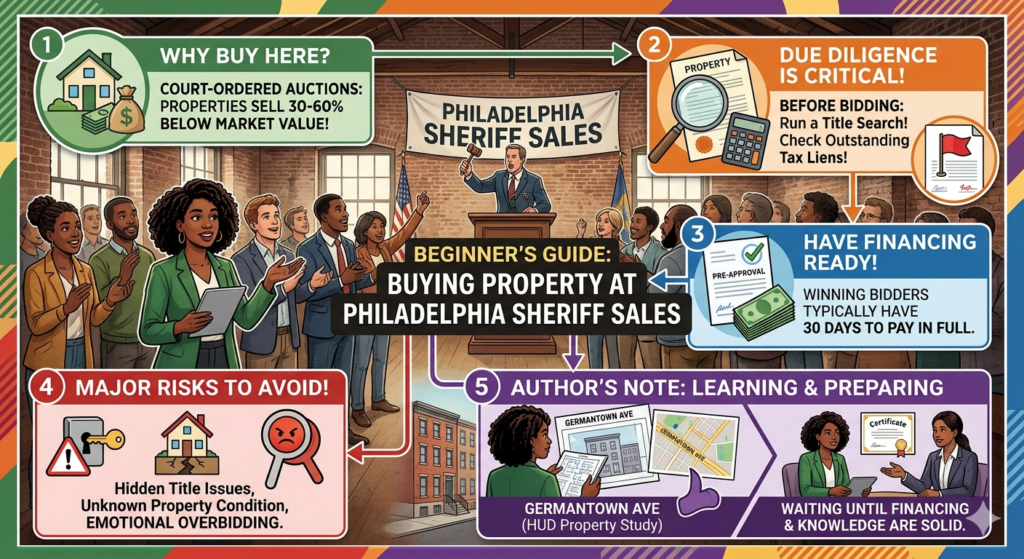
If you’ve been researching real estate investing in Philadelphia, you’ve probably come across the term Philadelphia Sheriff Sale. It sounds intimidating — and honestly, the first time I heard it, I had no idea what it meant either. But after spending months studying the Philadelphia market from my apartment on Germantown Avenue, I’ve learned that Philadelphia Sheriff Sale auctions are one of the most powerful tools available to investors who are willing to do their homework.
I haven’t attended one yet. But I’m studying them carefully — and this is everything I’ve learned so far.
What Is a Philadelphia Sheriff Sale?
A Philadelphia Sheriff Sale is a court-ordered public auction of a property. It happens when a homeowner has failed to pay their mortgage (foreclosure) or their property taxes (tax lien foreclosure) and the court orders the property to be sold to satisfy the debt.
Philadelphia Sheriff Sales are held monthly by the Philadelphia Sheriff’s Office. Properties are auctioned off to the highest bidder, often at prices significantly below market value — which is exactly why real estate investors pay close attention to them.
The key thing to understand: you are not buying from the homeowner. You are buying at a public auction, and the sale is administered by the court.
Two Types of Philadelphia Sheriff Sales: Tax Foreclosure vs. Mortgage Foreclosure
Here’s something that tripped me up early on — and trips up a lot of beginners. There are actually two completely different types of foreclosure sales at the Philadelphia Sheriff Sale, and if you mix them up, you’re going to be confused fast.
Tax Foreclosure — The city is coming after the property because the owner didn’t pay their property taxes. These typically appear on Bid4Assets, the online auction platform Philadelphia uses for tax-related sales.
Mortgage Foreclosure — The bank is coming after the property because the owner stopped paying their loan. These go through the traditional Sheriff Sale process run by the Sheriff’s Office.
Same auction ecosystem. Totally different rules.
The key difference that matters most:
Tax foreclosures in Pennsylvania can have a redemption period — meaning the former owner may have the right to come back after the sale, pay off what was owed plus costs, and reclaim the property. The length varies depending on the type of tax sale, so always verify the specific terms before you bid.
Mortgage foreclosures generally do not have a redemption period in Pennsylvania. Once the court confirms the sale, the title transfer is more final. The previous owner typically cannot come back and reclaim the property.
This doesn’t mean mortgage foreclosures are automatically better deals — they come with their own complications. But understanding which type of sale you’re looking at changes how you plan your timeline and budget.
Bid4Assets vs. the Sheriff Sale: They’re Not the Same Thing
Philadelphia Sheriff Sale = the legal process run through the Sheriff’s Office, where mortgage foreclosure properties typically land.
Bid4Assets = an online auction platform Philadelphia uses specifically for tax-related sales. More accessible, more listings visible upfront, and you can browse without showing up anywhere in person.
Both are worth watching. But they’re not interchangeable — and knowing which pipeline a property came through tells you a lot about what you’re dealing with.
Why Do Investors Love Philadelphia Sheriff Sales?
The simple answer is price. Properties at a Philadelphia Sheriff Sale can sell for 30% to 60% below their market value — sometimes even more. In a city like Philadelphia, where you can already find investment properties at reasonable prices, that kind of discount creates enormous opportunity.
Here’s a realistic example. A rowhouse in Frankford with a market value of $180,000 might appear at a Philadelphia Sheriff Sale with a starting bid of $80,000. If no one else bids aggressively, you could walk away with a property at less than half its market value.
That’s the dream scenario. The reality, as with everything in real estate, is more complicated.
How Philadelphia Sheriff Sales Work
Step 1: Find the Listings
Philadelphia Sheriff Sale listings are posted on the Philadelphia Sheriff’s Office website. New listings are posted monthly, and the auction schedule is published in advance. You can also find listings on the Philadelphia Courts website and through third-party services that aggregate this data.
Each listing includes the property address, the debt owed, and the upset price — which is the minimum bid required to cover the outstanding debt.
Step 2: Do Your Due Diligence
This is the most critical step — and the one that separates experienced investors from beginners who get burned.
Before bidding on any Philadelphia Sheriff Sale property, you need to research:
Title issues. Unlike a traditional real estate purchase, Sheriff Sales in Pennsylvania do not always come with a clean title. There may be additional liens, back taxes, or other encumbrances on the property that survive the sale and become your responsibility. Always run a title search before bidding.
Property condition. You typically cannot inspect the interior of a Sheriff Sale property before bidding. You are buying it as-is, sight unseen. Drive by the property. Look at it from the outside. Research the neighborhood. Check public records for any code violations or outstanding permits.
Comparable sales. Research what similar properties in the same neighborhood have sold for recently. This tells you what the property is actually worth after renovation — your ARV — and helps you determine your maximum bid.
Outstanding taxes. Philadelphia properties can carry significant back tax balances. Check the Philadelphia Revenue Department’s website to see if there are any outstanding tax liens on the property.
Step 3: Register to Bid
To participate in a Philadelphia Sheriff Sale, you must register in advance. You’ll need to bring a cashier’s check for the deposit — typically 10% of your intended bid amount — on the day of the auction. You cannot pay with personal checks or cash.
Step 4: Attend the Auction
Philadelphia Sheriff Sales are held on the Bid4Assets online platform as well as in-person at the Sheriff’s Office. The auction moves quickly. Properties are called one by one, bids are placed, and the highest bidder wins.
If you win, you’ll pay your deposit immediately and have a set period — usually 30 days — to pay the remaining balance in full. This means you need your financing lined up before you bid, not after.
Step 5: Close and Take Possession
After paying in full, you’ll receive a Sheriff’s Deed transferring ownership to you. At this point, you own the property — but if the previous owner is still living there, you may need to go through the eviction process to take possession.
Philadelphia Sheriff Sale Risks You Need to Know
Title problems. Not all liens are wiped out in a Philadelphia Sheriff Sale. Junior liens — second mortgages, HOA fees, certain tax liens — may survive the sale. Always get a title search done and budget for title insurance.
Unknown property condition. You cannot walk through the property before buying it. Investors have won bids only to discover the interior had been completely stripped — no copper pipes, no HVAC, no electrical panels. This is why your renovation budget needs a significant contingency.
Competition from experienced investors. Philadelphia has a very active investor community. At popular Sheriff Sales, experienced buyers show up with deep pockets and years of experience. As a beginner, you may find yourself outbid on the most attractive properties.
Emotional bidding. It’s easy to get caught up in the auction atmosphere and bid more than your numbers allow. Set your maximum bid before you walk in the door — based on your ARV and 70% rule calculations — and do not go above it. Not even by a dollar.
What a Real Philadelphia Sheriff Sale Deal Actually Returns
I want to share a real example — not a success story, but an honest one.
An investor purchased a property at Philadelphia Sheriff Sale for $331,000, with fees and taxes bringing the total all-in cost to $335,000. He’d never seen the inside.
When he finally walked through, there was good news and bad news.
Good news: the previous owner had partially renovated — new flooring, modern bathroom tile work already in progress. Better than expected.
Bad news: the basement was completely destroyed. Three months without electricity meant water damage, mold, and a full gut job on the lower level.
Repair budget: $35,000.
Original target sale price: $450,000. Revised down to $435,000 after accounting for a softening market.
After repairs, agent commissions, taxes, and closing costs — net profit: $23,000. A 6.3% cash-on-cash return.
He called it a “single, not a home run.” And here’s the part worth paying attention to: he had originally planned to use financing. When he ran the numbers and realized the margins were too thin to absorb interest costs, he switched to all-cash and prioritized a fast sale over maximum profit.
That’s the reality of Sheriff Sale investing in a tighter market. Not every deal is a windfall. Some are just okay — and okay is fine, as long as you go in knowing that’s the realistic range.
The deals that go wrong are the ones where the investor needed a home run and got a single instead — and didn’t have the cash reserves to absorb the difference.
Is a Philadelphia Sheriff Sale Right for You?
Philadelphia Sheriff Sales make the most sense for investors who:
- Have done thorough due diligence on the specific property they’re bidding on
- Have financing lined up before the auction
- Understand the title search process or are working with a real estate attorney
- Have experience estimating renovation costs accurately
- Are emotionally prepared to lose a bid — or to win one and discover unexpected problems
For complete beginners, I’d recommend attending a few Philadelphia Sheriff Sales as an observer before ever placing a bid. Watch how experienced investors move. Listen to how they evaluate properties. Learn the rhythm of the auction before you put real money on the table.
Use the Sheriff Sale Bid Calculator to run your numbers before you bid — plug in the ARV and renovation costs and it’ll tell you your maximum bid before you ever walk into the auction room.
Not financial advice — just someone doing a lot of research and asking a lot of questions. Consult a real estate attorney familiar with Philadelphia Sheriff Sales before bidding on any property.