Real estate tax benefits are one of the most powerful wealth-building tools available to investors — and most people leave them sitting on the table.
The federal tax code treats real estate investors differently than W-2 employees. While a salaried worker pays taxes on every dollar earned, a real estate investor can generate significant cash flow and pay little to nothing in taxes — legally — by understanding how the system actually works.
Here’s what the IRS allows, and how to use it.
Depreciation: The Real Estate Tax Benefit Nobody Talks About Enough
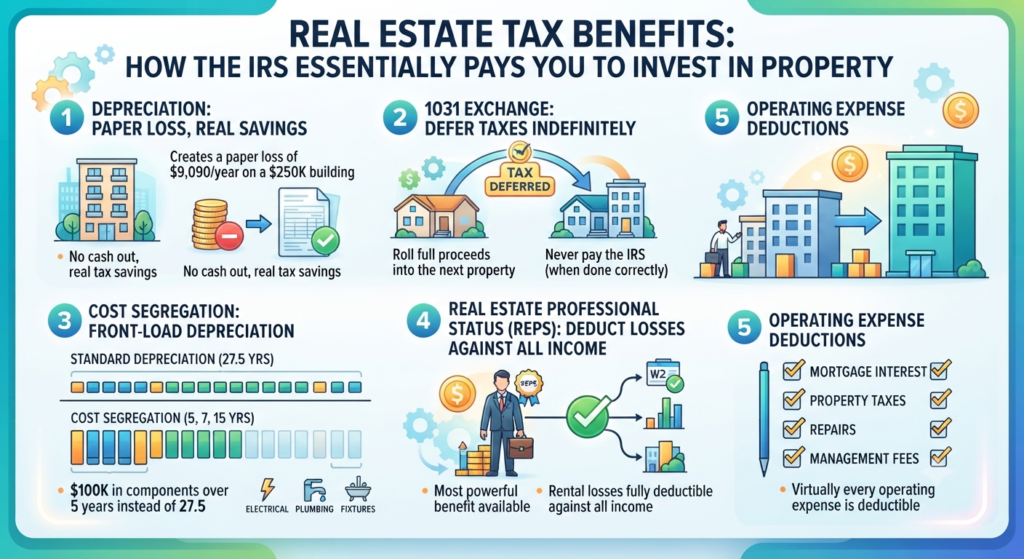
Depreciation is the foundation of real estate tax benefits. It’s a paper loss — meaning no cash leaves your account — that reduces your taxable income every single year you hold a rental property.
The IRS assumes residential rental properties wear out over 27.5 years. That means you divide the building value (not the land) by 27.5 and deduct that amount from your rental income every year.
Example: You buy a rental property for $300,000. The land is worth $50,000, so the depreciable building value is $250,000.
$250,000 ÷ 27.5 = $9,090 annual depreciation deduction
If your property generates $12,000 in annual rental income, depreciation alone drops your taxable income to under $3,000 — even though you collected the full $12,000 in cash.
Commercial properties depreciate over 39 years, but the same principle applies. The deduction is real. The cash outflow is zero.
Use the Depreciation & Tax Savings Calculator to see exactly how much your property’s depreciation is worth in annual tax savings.
1031 Exchange: The Real Estate Tax Benefit That Lets You Never Pay Capital Gains
When you sell an investment property at a profit, you normally owe capital gains tax. A 1031 like-kind exchange lets you defer that tax indefinitely by rolling the proceeds into a new property.
The rules:
- The replacement property must be identified within 45 days of selling
- The purchase must close within 180 days
- The replacement property must be of equal or greater value
The wealth-building power is in the compounding. Instead of paying 20%+ in capital gains tax and reinvesting what’s left, you reinvest the full amount. Every dollar that would have gone to the IRS keeps working for you.
Done correctly over a career, a 1031 exchange strategy can allow you to move from a single-family rental to a duplex to a small apartment building to a larger commercial asset — without ever triggering a capital gains bill.
Run your exchange numbers through the 1031 Exchange Calculator before you list any investment property for sale.
Cost Segregation: Accelerating Real Estate Tax Benefits in the Early Years
Standard depreciation spreads your deduction evenly over 27.5 years. Cost segregation front-loads those deductions into the first few years — when you need cash flow most.
A cost segregation study breaks your property into components. Carpeting, appliances, fixtures, landscaping, and certain electrical components depreciate over 5, 7, or 15 years instead of 27.5. That means larger deductions now instead of spreading them out over decades.
For a $500,000 property, a cost segregation study might identify $100,000 in components that can be depreciated over 5 years instead of 27.5. That’s an additional $16,000+ in annual deductions in the early years of ownership — deductions that would otherwise be spread thin over decades.
Cost segregation studies require a specialist and aren’t free. They make the most sense on properties valued at $500,000 or more, or on commercial properties where the component values are higher.
QBI Deduction and Passive Loss Rules
Two more real estate tax benefits worth understanding:
Qualified Business Income (QBI) deduction. If your rental activity qualifies as a trade or business under IRS guidelines, you may be able to deduct up to 20% of your net rental income from your taxable income. This is a newer deduction and the rules are specific — a CPA familiar with real estate is essential here.
Passive activity loss rules — and the exception. Rental losses are generally considered passive and can only offset passive income. But there’s an important exception: if your adjusted gross income is under $100,000 and you actively participate in managing your rentals, you can deduct up to $25,000 in rental losses against ordinary income.
If you qualify as a Real Estate Professional under IRS rules — meaning more than 50% of your working hours and more than 750 hours per year are spent in real estate activities — rental losses become fully deductible against all income. This is one of the most powerful real estate tax benefits available, and one of the most misunderstood.
Standard Deductions Every Rental Property Owner Should Be Taking
Beyond the big strategies, real estate tax benefits include deductions for virtually every legitimate operating expense:
Mortgage interest, property taxes, insurance premiums, repairs and maintenance, property management fees, legal and accounting fees, travel to inspect or manage properties, and depreciation on appliances and improvements.
According to the IRS Publication 527, all ordinary and necessary expenses related to managing, conserving, or maintaining rental property are deductible. Most investors underestimate how many expenses qualify.
The combination of these deductions — especially depreciation — means many real estate investors show a tax loss on paper while generating positive cash flow in reality. That gap between taxable income and actual cash received is the core of how real estate tax benefits work.
One Important Note
These strategies are legal and widely used. They are also complex. The QBI deduction, Real Estate Professional status, and cost segregation all have specific IRS requirements that vary by situation. Work with a CPA who specializes in real estate investors — not a general tax preparer — to make sure you’re capturing every benefit you’re entitled to without triggering an audit.
The strategies are real. The implementation requires professional guidance.
Not financial advice — just someone doing a lot of research and asking a lot of questions.