A duplex development strategy is one of the most accessible entry points into real estate development — and most people overlook it because they’re looking at the wrong lots.
Jerome Maldonado’s framework is simple: stop looking for empty land. Start looking for lots where zoning already allows more than what’s sitting on them. The profit is in the gap between what the land is permitted for and what the current owner is using it for.
Here’s how the duplex development strategy actually works.
Three Ways to Find Duplex Development Strategy Sites
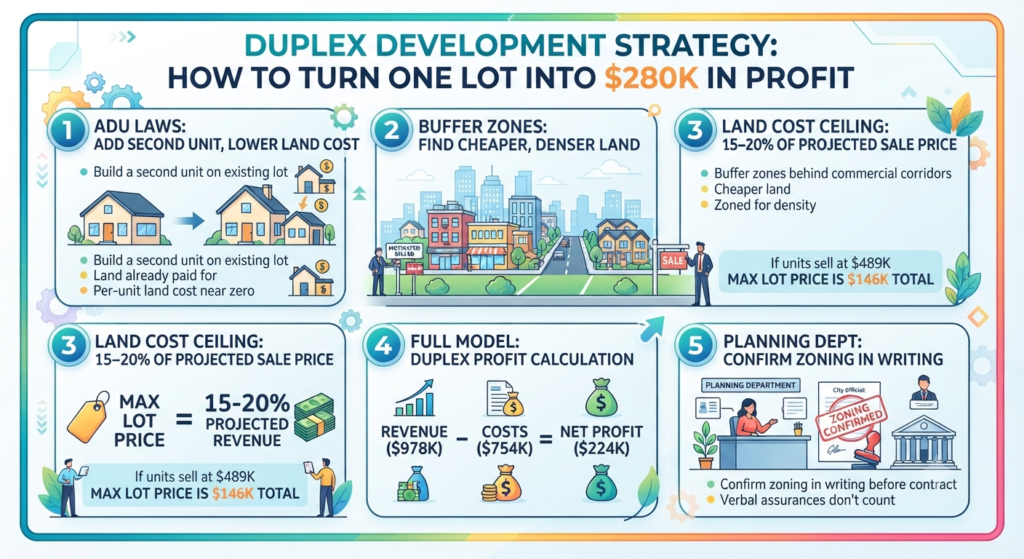
1. ADU laws — the free land play
Across the U.S. — California, Arizona, Washington, and growing — municipalities are relaxing ADU (Accessory Dwelling Unit) regulations to address housing shortages. What this means in practice: you can often add a second unit to an existing residential lot without subdividing.
The existing house is already there. The land behind or beside it is essentially free — you’ve already paid for it in the purchase price. Build a second unit, sell or rent it, and your land cost per unit drops dramatically.
The site criteria that makes this work: the existing structure sits toward the front of the lot, and there’s at least 12 feet of side yard clearance for vehicle access. That 12-foot minimum is what allows a driveway to the rear unit — without it, most municipalities won’t approve the ADU.
Before you make an offer on any residential property, look up the parcel on your city’s zoning map and check ADU eligibility. In Philadelphia, the city’s Atlas platform shows zoning designation and lot dimensions for every parcel.
2. Buffer zones — the overlooked opportunity
The strip of residential land directly behind commercial corridors is one of the most underutilized development opportunities in any city.
These buffer zone parcels sit between retail streets and established neighborhoods. They’re not quiet enough for premium single-family buyers, which keeps prices lower. But they’re zoned for higher density — duplexes, triplexes, townhouses — precisely because municipalities recognize they’re transitional areas.
Find the commercial corridors in your target market. Then look one block back. That’s where the buffer zone lots are — cheaper to acquire, already zoned for density, and often owned by people who’ve held them for decades and are ready to sell.
3. Downzoning from commercial — easier than you think
Converting a commercially zoned parcel to residential use — what planners call downzoning — is significantly easier than the reverse. Most commercial zones already include residential uses as permitted or conditional uses.
A C-1 or mixed-use parcel on a secondary street that’s no longer viable for retail is often a straightforward duplex development site. The zoning already accommodates it. The municipality is often supportive because you’re adding housing supply, not fighting for a use change.
The move: take the parcel number to the city planning department and ask directly — “What density is allowed here, and does the city support residential development on this parcel?” That one conversation can tell you in thirty minutes what would take weeks to research independently.
The Duplex Development Strategy Numbers That Make It Work
Jerome’s minimum threshold: $80,000 net profit per unit before he’ll proceed. On a duplex, that’s $160,000 minimum. Here’s the full model.
Land cost rule: The lot price should not exceed 15 to 20% of the projected sale price per unit.
If each unit will sell for $489,000, your per-unit land cost ceiling is approximately $73,000 — meaning the total lot price for both units should stay at or below $146,000.
This single filter eliminates most deals before you waste time underwriting them.
Construction cost target: National average builder-grade construction runs around $141 per square foot. The duplex development strategy targets $135 per square foot by using trend-forward but cost-efficient finishes — the kind of tile and fixtures that photograph well and appeal to buyers without blowing the budget on materials.
The full model (two-unit example):
- Total revenue (2 units × $489,000): $978,000
- Land cost: $146,000
- Construction cost: ~$400,000
- Financing, permits, contingency: ~$150,000
- Selling commissions (6%): ~$58,000
- Total costs: ~$754,000
- Net profit: ~$224,000 — approximately $112,000 per unit
Run your specific numbers through the Philly Flip Profit Calculator before you commit to any duplex development site. The model only works if your local comps support your target sale price — and that’s the first number to verify.
How to Underwrite a Duplex Development Strategy Deal
Before you spend a dollar, three data points need to be confirmed.
Comps first. What are finished duplexes or comparable new construction units selling for within a half mile? Not asking prices — sold prices, within the last six months. That number is your revenue ceiling. Everything else in the model builds down from there.
Zoning confirmation. Pull the parcel number and confirm in writing — ideally from the planning department — that your intended use is permitted. Verbal assurances from sellers or brokers don’t count. Get it in writing before you go under contract.
Construction bid. Get at least two bids from licensed contractors before you finalize your numbers. Builder-grade $135 per square foot is a target, not a guarantee. Your actual cost depends on your specific market, the site conditions, and what finishes your comp analysis says you need to hit your sale price.
According to the National Association of Home Builders, construction costs vary significantly by region — which is exactly why local contractor bids matter more than national averages when underwriting a duplex development strategy deal.
Why Philadelphia Makes Sense for Duplex Development Strategy
Philadelphia’s zoning landscape has been shifting toward higher residential density in response to persistent housing supply shortages. RM-1 and RM-2 zoning designations — common across large swaths of West Philadelphia, Germantown, and parts of North Philadelphia — permit rowhouse and multi-unit development as of right.
The buffer zone opportunity is significant along corridors like Germantown Avenue, Cheltenham Avenue, and parts of Kensington — where residential parcels sit directly behind commercial strips at prices that still allow the duplex development strategy math to work.
The ADU opportunity is expanding as Philadelphia has moved to align with state-level housing density initiatives. Lots that previously supported one structure may now support two.
The key is doing the parcel-level research before you make an offer — not assuming the math works because the neighborhood feels right.
Not financial advice — just someone doing a lot of research and asking a lot of questions.