A small warehouse investment is one of the most overlooked wealth-building strategies in real estate — and it’s hiding in plain sight on the edge of every mid-size city in America.
No tenant management headaches. No late-night maintenance calls. No vacancy drama. The structure of a small warehouse investment shifts almost every expense onto the tenant — and that changes the math entirely.
Here’s how it works.
The Small Warehouse Investment Structure That Makes It Work
The setup is simpler than most people expect.
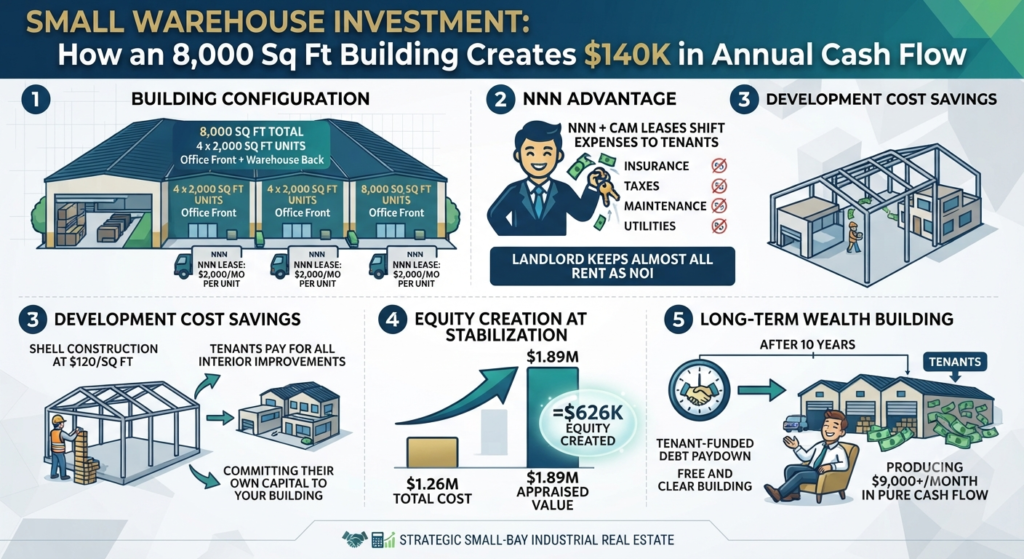
Find a parcel of land under one acre. Build an 8,000 square foot building. Divide it into four 2,000 square foot units — each with a small office component in the front and open warehouse space in the back. Lease all four units on NNN terms.
That’s the entire model.
The rent structure per unit:
- Office space (approximately 400 sq ft) at $25 per square foot annually: $10,000
- Warehouse space (approximately 1,600 sq ft) at $12 per square foot annually: $19,200
- Monthly rent per unit: approximately $2,000
- Annual rent across four units: $96,000
The tenants who fill these spaces — data centers, auto detailers, dog groomers, small contractors, light manufacturers — are not residential tenants. They sign multi-year leases. They don’t call at midnight. They treat the space as their business infrastructure, which means they take care of it.
Why NNN and CAM Change the Small Warehouse Investment Math
This is the structural advantage that separates small warehouse investment from residential rental.
Triple net (NNN) leases require tenants to pay property insurance, real estate taxes, and building maintenance costs — proportional to the space they occupy. The landlord collects rent. The landlord does not pay operating expenses.
Common Area Maintenance (CAM) charges pass through water, landscaping, parking lot maintenance, and exterior upkeep directly to tenants. Again, proportional to occupancy.
The result: your NOI is close to your gross rent. The expense leakage that erodes residential cash flow — vacancy reserves, repairs, management fees, utilities — is largely eliminated by contract.
On a $96,000 gross rent building with NNN leases and CAM charges, annual NOI comes in around $113,000 after accounting for minimal landlord-side expenses. That’s the number that goes into your cap rate calculation.
Use the Rental Property Analyzer to model your small warehouse investment NOI before you commit to a site. The cap rate math is simple — but only if your expense assumptions are accurate.
Shell Construction and Tenant Improvements: The Cost Structure
Here’s where small warehouse investment gets particularly efficient.
You build the shell. Exterior walls, roof, concrete slab, basic utilities to the building. Target cost: approximately $120 per square foot. On an 8,000 square foot building, that’s $960,000 in construction cost — plus land at roughly $300,000, bringing total project cost to approximately $1,260,000.
The tenants build the interior. Whatever they need inside — electrical for a data center, plumbing for a dog grooming operation, HVAC for a medical supply business — they pay for it themselves as Tenant Improvements. Their business requirements drive their build-out. Your cost is zero.
This is not a concession. It’s a feature. Tenants who invest their own capital in a build-out are committed tenants. They’re not leaving at the end of a twelve-month lease. They have $50,000 to $200,000 of their own money in the walls.
The Small Warehouse Investment Value Creation Math
At completion, here’s what the project looks like:
- Total project cost (land + construction): $1,260,000
- Annual NOI: $113,157
- Cap rate applied: 6%
- Appraised value: $113,157 ÷ 0.06 = $1,885,950
- Immediate equity created: $1,885,950 − $1,260,000 = $625,950
You spent $1.26 million to build something worth $1.89 million. That $626,000 in equity exists the day the building is leased and stabilized — before you’ve held it for a single year.
The construction loan covers approximately 75% of appraised value — $1,414,000 — which exceeds your total project cost. Done correctly, you can structure this so your initial capital is returned within 30 to 60 days of project stabilization.
The Long-Term “Cash Machine” Strategy
The real power of small warehouse investment is what happens over time.
Years 1–10: Tenants pay rent. Rent covers debt service. The loan pays itself down. You manage almost nothing.
Year 10+: The loan is paid off. The building is free and clear. Every dollar of rent is now pure cash flow.
On a stabilized building producing $113,000 in annual NOI with no debt service, that’s over $9,000 per month in net income — from a building that tenants have essentially been buying for you over a decade.
One of Jerome Maldonado’s buildings — leased to Frito-Lay — generates $15,000 per month in rent, free and clear, after the loan was retired. That’s $180,000 per year from one building that required active management for roughly zero hours per month.
According to the NAIOP Commercial Real Estate Development Association, industrial and flex warehouse properties have consistently outperformed other commercial real estate categories on a total return basis over the past decade — driven by e-commerce demand, supply chain reconfiguration, and the persistent shortage of small-bay industrial space in most U.S. markets.
Why Small Warehouse Investment Works in the Philadelphia Region
The Philadelphia metro — including Montgomery County, Delaware County, and Burlington County NJ — has significant demand for small-bay industrial and flex warehouse space from small businesses, contractors, and light industrial users.
Land suitable for small warehouse investment exists in transitional industrial corridors throughout the region — areas where land costs remain accessible relative to finished building values, and where municipal zoning supports light industrial and flex use.
The cap rate environment in the Philadelphia suburban market makes the value creation math work. A 6% cap rate on stabilized NOI of $113,000 produces the $1.89 million valuation used in the model above — and that’s a conservative cap rate for well-located flex industrial in this market.
Not financial advice — just someone doing a lot of research and asking a lot of questions.