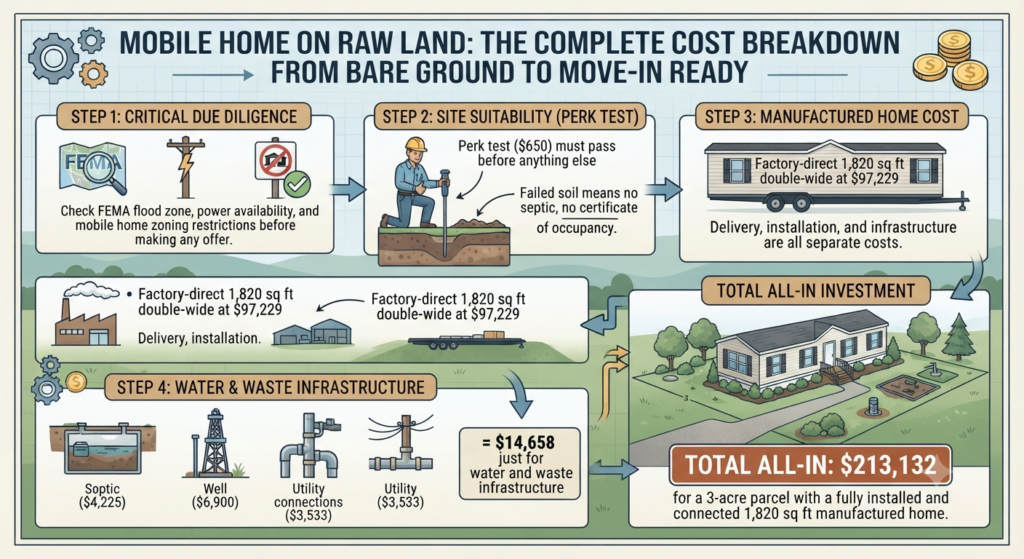
Putting a mobile home on raw land sounds simple. Buy the land, drop the house, done.
The reality is eleven steps and $213,132 — and if you skip step two, you can’t build at all.
Here’s the complete process, cost by cost, from bare ground to a fully functional 1,820 square foot home.
Step 1 — Find and Buy the Land ($55,000)
The starting point is finding a parcel that works for a mobile home on raw land — and that requires more due diligence than most buyers expect.
Before you make an offer, check three things:
FEMA flood zone status. If the parcel is in Flood Zone A, your insurance costs will be significant and your financing options will be limited. Check the FEMA flood map before you fall in love with a piece of land.
Power availability. Is there an electric line nearby? Running power to a remote parcel can cost $10,000 to $50,000 depending on distance. That cost needs to be in your budget before you go under contract.
Mobile home restrictions. Some counties and HOAs prohibit manufactured housing. Confirm that mobile homes are permitted on the parcel before you sign anything. Zoning and deed restrictions are both worth checking.
The case study parcel: 3 acres purchased for $55,000. Confirmed flood-free, power accessible, and mobile home permitted.
Step 2 — Perk Test and Survey ($1,850)
This is the step that determines whether you can build at all.
Perk test (percolation test): $650. This test measures how well the soil drains water. If the soil fails — too much clay, too dense, wrong composition — you cannot install a septic system. No septic system means no toilet, no sink, no certificate of occupancy. A failed perk test can make a parcel completely unbuildable for a conventional home.
Get this done during your contract due diligence period — before you close on the land. A failed perk test is a reason to walk away, not something to discover after you’ve paid cash for acreage.
Land survey: $1,200. Establishes the exact boundaries of your parcel. Required before you can pull permits and essential for knowing exactly where your home can be placed relative to setback requirements.
Step 3 — Site Clearing and Driveway ($5,000)
A mobile home arrives in sections on large trucks. Those trucks need to reach the home site — which means the land has to be accessible before delivery.
Work includes bush hogging (clearing brush and small vegetation), tree removal as needed, grading the home site area, and constructing a 300-foot gravel driveway using lime rock. The driveway needs to be solid enough for heavy delivery equipment to travel without getting stuck.
Total site prep: $5,000.
Step 4 — Choose and Order the Home ($97,229)
Once the site is prepped, the home can be selected and ordered. Factory-direct purchasing — going directly to the manufacturer rather than through a dealer — typically produces better pricing.
The case study home: 1,820 square feet, double-wide configuration (two sections that are joined on site), purchased factory direct for $97,229. Delivery and installation are separate line items.
At this stage, the home’s dimensions are confirmed, which allows the septic system and well placement to be finalized.
Step 5 — Septic System ($4,225)
A septic system is required any time public sewer isn’t available — which is the case on most raw land parcels outside city limits.
The system includes a tank and drain field sized for the home’s expected occupancy. Sizing requirements vary by county. Installation cost on this project: $4,225.
The perk test from Step 2 determines whether a conventional septic system is feasible, and if so, what type and size the county will approve.
Step 6 — Well ($6,900)
Where there’s no municipal water supply, a well provides the water source. Depth and cost vary significantly by location — local geology determines how far down you need to drill to reach a reliable water table.
Well installation on this project: $6,900.
Use the House Build Cost Calculator to build a complete budget that includes infrastructure items like well and septic — these are easy to underestimate if you’re only pricing the home itself.
Step 7 — House Pad ($3,000)
The ground where the home will sit needs to be level and stable. A house pad involves grading and compacting the soil to create a flat, firm surface.
Without proper grading, a manufactured home can settle unevenly over time — causing doors that won’t close, floors that slope, and structural stress on the frame.
House pad preparation: $3,000.
Step 8 — Permits and Impact Fees ($2,180)
Impact fees are charged by local governments to offset the cost of infrastructure — roads, schools, utilities — that new development creates demand for. They’re non-negotiable and vary significantly by county and state.
Mobile home permit plus impact fees on this project: $2,180.
Permit requirements for manufactured housing vary by jurisdiction. Some counties process permits quickly; others require inspections at multiple stages. Budget time, not just money, for this step.
Step 9 — Delivery, Installation, and Setup ($18,415)
This is the most complex single step in placing a mobile home on raw land.
The home arrives in two sections on flatbed trucks. Installation includes:
- Joining the two sections (called the “marriage”)
- Setting the home on concrete block piers at the correct height
- Strapping the home to ground anchors for wind resistance (required in most states)
- Installing stairs at entry points
- Installing skirting around the base of the home
Delivery, installation, marriage, strapping, stairs, and skirting: $18,415.
Step 10 — Utilities Connection ($3,533)
The home is on site, but it needs power, water, and sewage.
This step includes installing a power pole and meter base, running the electrical connection from the pole to the home’s panel, connecting the well pump to the home’s water system, and connecting the septic system to the home’s drain lines.
Utility connections: $3,533.
Step 11 — HVAC ($5,800)
The final step is heating and cooling. A packaged HVAC unit — which combines heating and cooling in a single exterior unit — is the standard installation for manufactured housing.
HVAC installation: $5,800.
The Complete Mobile Home on Raw Land Cost Breakdown
| Item | Cost |
|---|---|
| Land (3 acres) | $55,000 |
| Perk test | $650 |
| Survey | $1,200 |
| Site clearing and driveway | $5,000 |
| Home (factory direct) | $97,229 |
| Septic system | $4,225 |
| Well | $6,900 |
| House pad | $3,000 |
| Permits and impact fees | $2,180 |
| Delivery and installation | $18,415 |
| Utility connections | $3,533 |
| HVAC | $5,800 |
| Total | $213,132 |
According to the Manufactured Housing Institute, the average cost per square foot for manufactured housing is significantly lower than site-built construction — making mobile home on raw land development one of the most cost-efficient paths to affordable homeownership or investment property in rural and semi-rural markets.
At $213,132 all-in for a 1,820 square foot home on 3 acres, the cost per square foot — including land and all infrastructure — comes in well below what comparable site-built construction would cost in most markets.
Not financial advice — just someone doing a lot of research and asking a lot of questions.