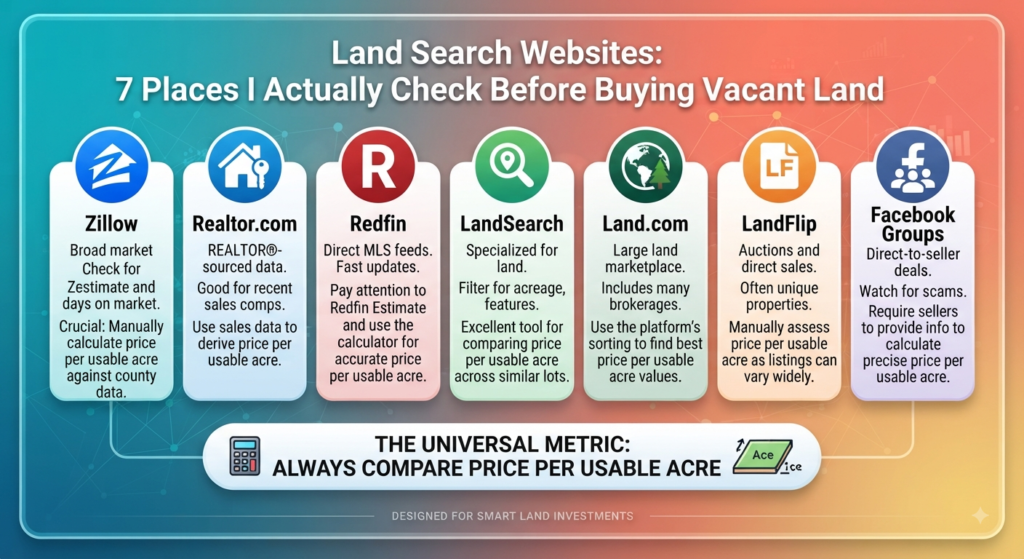
I used to think Zillow was basically the only game in town for finding land, until I realized half the good deals I was reading about online never showed up there at all. Once I started spreading my search across a handful of land search websites instead of just one, the quality of what I was finding went up noticeably — and so did the number of parcels priced under market.
Why One Site Isn’t Enough
No single platform has every land listing, and some of the best land search websites specialize in exactly the kind of parcel the big sites bury. Checking multiple sources isn’t extra work for no reason — it’s how you catch expired listings, price drops, and owner-financed deals that a single search would miss entirely.
Land Search Websites Pick 1: Zillow
Zillow is a decent starting point among land search websites for rural homes, vacant land, and — importantly — price history and price-drop flags. I use it less to find hidden gems and more to get a feel for what’s out there and whether a seller has already dropped their number once.
Land Search Websites Pick 2: Realtor.com
Realtor.com pulls from the MLS, so it’s useful as a cross-check against whatever else you’re finding, and it’s easy to widen the search into neighboring counties from here.
Land Search Websites Pick 3: Redfin
Redfin’s map-based search makes it easy to compare pricing visually across a region, and it tends to surface larger parcels well when you’re scanning a wide area instead of one specific town.
Land Search Websites Pick 4: LandSearch.com
This is one of the more specialized land search websites — built around homesteads, mini farms, hobby farms, and listings that mention owner financing, which matters a lot if bank financing on raw land isn’t realistic yet.
Land Search Websites Pick 5: Land.com Network
The Land.com network, which includes LandWatch and LandAndFarm, is good for filtering down to smaller parcels — anything under 20 acres is easy to isolate here, which cuts out a lot of the big-acreage listings that aren’t relevant.
Land Search Websites Pick 6: LandFlip.com
LandFlip tends to surface smaller parcels, discounted listings, auctions, and For Sale By Owner deals that don’t always make it onto the bigger platforms.
Land Search Websites Pick 7: Facebook
Facebook Marketplace and local land groups are the one entry on this land search websites list that isn’t a dedicated real estate platform, but county auction pages and local groups regularly post parcels that never make it to a major site at all.
Getting More Out of Land Search Websites
A few habits that make these sites work harder: set up alerts so price drops and new listings hit your inbox instead of relying on manually checking. Look 20 to 40 minutes outside popular towns — crossing a single county line can change pricing significantly. And pay attention to listings that have been sitting for 90-plus days, expired listings, inherited land, or anything with bad photos or a thin description, since those are often the ones nobody else is bothering to dig into.
Repository Listings: The Cheapest Corner of Land Search Websites
Beyond the standard land search websites, county repository lists are worth a look if you want genuinely cheap land — these are parcels that didn’t sell even at judicial or sheriff sale, sometimes priced under $1,000. I’ve been mapping out how sheriff sales work in Philadelphia specifically, which is worth reading if county-level auctions are new territory for you.
Don’t Just Chase the Cheapest Price
The number that actually matters isn’t total acreage, it’s price per usable acre — the portion of the lot you could actually build or farm on, not just what’s advertised. Cheap land isn’t automatically a good deal, and according to the USDA Economic Research Service, land values vary widely based on usability and location, not just raw size. Before I take any listing seriously now, I run it through my land potential analyzer to see whether the usable portion actually supports what I’m trying to do with it.
Not financial advice — just someone doing a lot of research and asking a lot of questions.