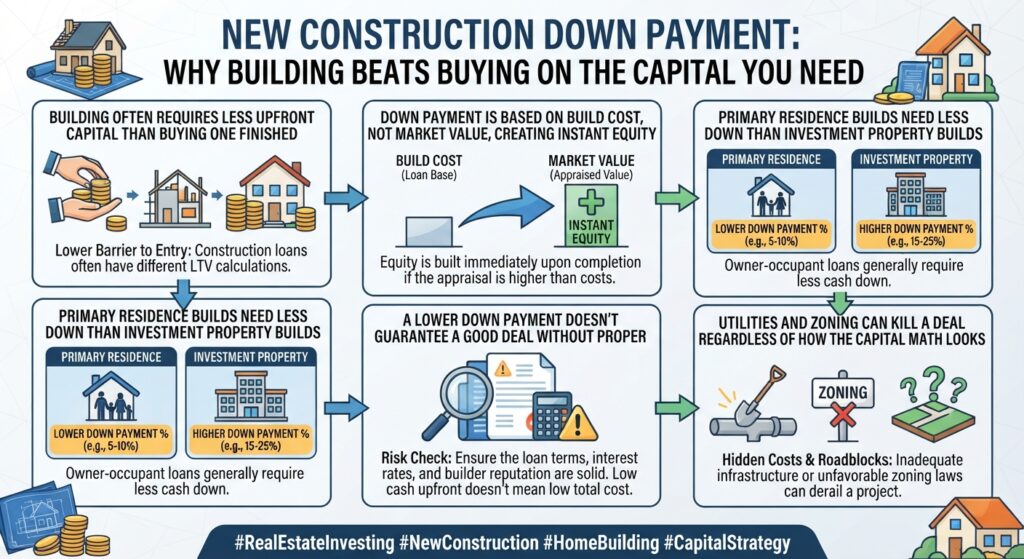
I always assumed building a house from scratch meant needing way more money upfront than just buying one that’s already finished — turns out that’s backwards, and the new construction down payment math actually works in the opposite direction once you break it down.
The Assumption That Trips Most People Up
If you’re looking at a finished $750,000 house on the market, a typical new construction down payment comparison starts here: you’d need roughly 7% of that purchase price for a primary residence, which covers the 5% down plus about 2% in closing costs. That’s around $52,500 just to get in the door.
Why Building Changes the Math Entirely
Here’s the part that surprised me. If you build that same house instead of buying it finished, your new construction down payment isn’t based on the $750,000 market value — it’s based on what it actually costs to build, which might be closer to $600,000. Seven percent of $600,000 is meaningfully less capital than 7% of $750,000, and the gap between what it cost to build and what it’s worth once finished becomes equity you didn’t have to pay for. Some people call this forced equity, and it’s baked into the new construction down payment structure from day one.
Primary Residence vs Investment Property Down Payments
This new construction down payment advantage looks different depending on intent. A primary residence build can often get by on that same 7% range. An investment property build is a different story — lenders typically want to see 15% to 20% down instead, since there’s no owner-occupant restriction protecting the loan the way there is with a primary residence.
Why the Numbers Aren’t the Only Thing That Matters
A lower new construction down payment doesn’t mean a lower-risk project. Underwriting the deal properly — land cost, build cost, margin, holding costs — still has to pencil out before the down payment math means anything. And if utilities aren’t available on the lot, or the zoning doesn’t allow single-family construction, no down payment number saves a deal that was never viable to begin with.
What This Means If You’re Weighing Build vs Buy
If the numbers hold up, a new construction down payment can be the more capital-efficient path into a property — but that only works if the underlying deal is sound. According to the National Association of Home Builders, construction costs and financing structures vary significantly by region and lender, which is exactly why running your own numbers matters more than any general rule of thumb. Before comparing a build against buying something finished, my pre-build cost estimator is a decent way to get a rough build cost figure to plug into your own new construction down payment math.
Not financial advice — just someone doing a lot of research and asking a lot of questions.