How Much House Can I Afford Philadelphia?
How much house can I afford Philadelphia — that’s the question I kept asking myself before I started seriously looking at properties here. And honestly, how much house can I afford Philadelphia depends way less on what your bank says and way more on what your actual life costs.
Your bank will give you one number. Your agent will give you another. Your parents will say something else entirely. And somewhere in the middle of all that noise, you’re supposed to make one of the biggest financial decisions of your life. I want to give you a different answer — not based on what a lender will approve you for, but based on what actually makes sense for your situation.
How Much House Can I Afford Philadelphia: What Banks Look At
When a lender evaluates your mortgage application, they look at two ratios.
The first is your front-end ratio — the percentage of your gross monthly income going toward your housing payment. Most conventional lenders want this below 28%.
The second is your back-end ratio — the percentage of your gross monthly income going toward all debt payments combined, including your new mortgage. Most lenders want this below 36% to 43% depending on the loan type.
These ratios exist for a reason. They’re designed to make sure you can make your payments. But they are not designed to make sure you can also eat, save for retirement, handle emergencies, and live a life outside of your mortgage.
A lender approving you for $350,000 does not mean a $350,000 house is the right decision for you. That’s an important distinction that a lot of first-time buyers miss entirely.
How Much House Can I Afford Philadelphia: What You Should Actually Look At
I think about affordability differently than most lenders do.
Before I commit to any monthly payment, I want to know three things.
First — what does this payment leave me with every month after all fixed expenses? If the answer is barely anything, I’m not buying that house regardless of what the bank says. A mortgage that wipes out every dollar of breathing room is not a mortgage you want to be carrying when something goes wrong — and something always goes wrong eventually.
Second — do I have reserves? Homeownership comes with unexpected costs. HVAC systems fail in January. Roofs leak in the middle of a rainstorm. Water heaters do not wait for a convenient time to stop working. Appliances break. Windows need replacing. If my mortgage payment has depleted my savings, I’m one emergency away from a serious problem.
Third — does this payment still make sense if my income drops? Job situations change. Contracts end. Hours get cut. If I lose 20% of my income next year, can I still make this payment without destroying everything else in my financial life? If the answer is no, I need a smaller number.
If all three answers are yes — I can afford the house. If not, I need to keep looking.
How Much House Can I Afford Philadelphia vs. Other Cities
How much house can I afford Philadelphia is a very different question than the same question in New York, Boston, San Francisco, or Los Angeles. In those cities, the affordability math is brutal. Median home prices are so high that even dual-income households with good jobs are stretched thin. The ratios work on paper but the reality is suffocating.
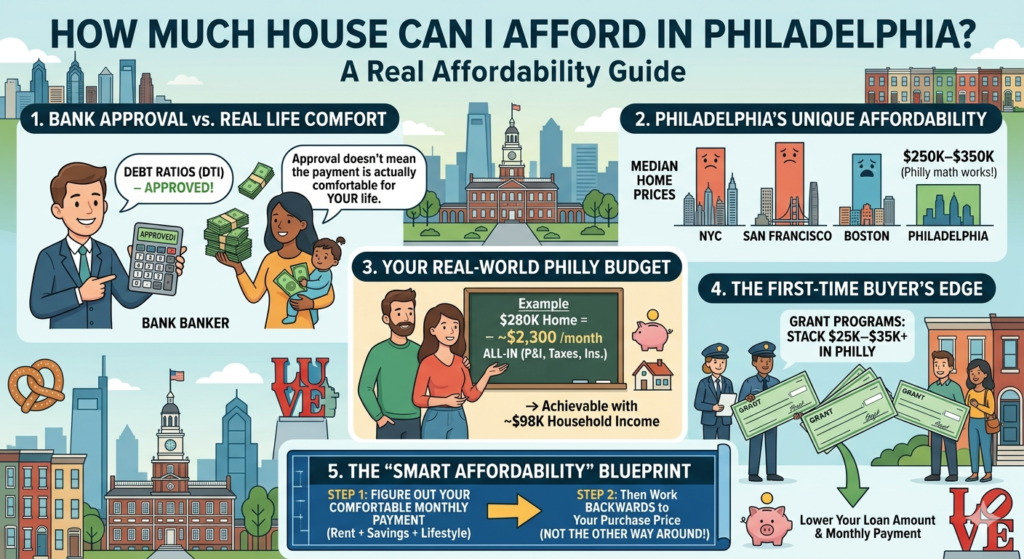
Philadelphia is genuinely different. You can buy a solid three-bedroom rowhouse in a good neighborhood for $250,000 to $350,000. That changes what affordability actually looks like in practice.
On a $280,000 purchase with 5% down at 6.5% interest, your monthly mortgage payment is approximately $1,682. Property tax in Philadelphia runs about $303 per month. Insurance and maintenance add another $300 to $350.
Total monthly housing cost: roughly $2,285 to $2,335.
To keep that within the 28% front-end ratio, you’d need a gross monthly income of about $8,200 — or roughly $98,000 per year household income. That is achievable for a lot of Philadelphia households. It is not achievable in Manhattan or San Francisco at the same quality of property.
This is one of the main reasons I think Philadelphia is one of the most underrated real estate markets in the country right now. The math actually works for regular people.
How Much House Can I Afford Philadelphia as a First-Time Buyer
How much house can I afford Philadelphia gets significantly better if you qualify for first-time buyer assistance programs — and Philadelphia has a lot of them.
Between the Philly First Home grant, the K-FIT program, the First Front Door match, and other city and state assistance programs, eligible first-time buyers can receive $25,000 to $35,000 or more in grant money. That money goes toward your down payment and closing costs — reducing what you need to bring to the table, lowering your loan amount, and lowering your monthly payment.
A lot of people assume they can’t afford to buy in Philadelphia. They run the numbers on the purchase price and stop there. They don’t factor in what $30,000 in grant assistance does to the monthly payment on a $280,000 home. It changes the math completely.
I’ve broken down all of these programs in detail elsewhere on this site. Read that before you write yourself off as someone who can’t afford to buy.
How Much House Can I Afford Philadelphia: The Number That Actually Matters
The most important number is not the maximum the bank will approve you for. It’s the monthly payment you can make comfortably — without stress, without sacrifice, without lying awake at night doing math.
So when people ask me how much house can I afford Philadelphia, my answer is always the same: figure out your comfortable monthly number first. Then work backwards to the purchase price. Then find a property that fits that number.
That’s the order. Not the other way around. Don’t fall in love with a house and then try to make the math work. Make the math work first, then find the house.
Use the free Philadelphia Mortgage Affordability Calculator below to find your real number before you start looking at properties.
Not financial advice — just someone doing a lot of research and asking a lot of questions.