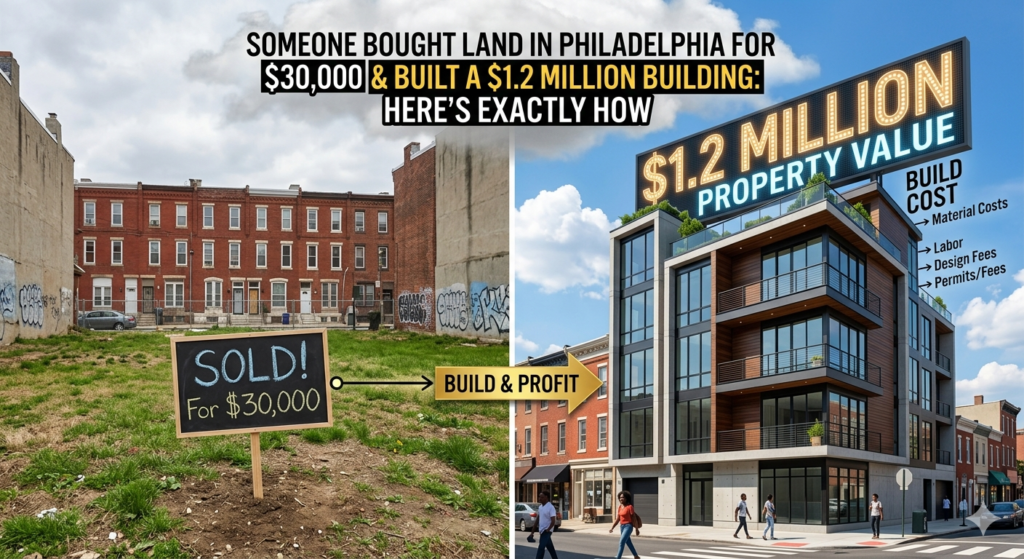
If you want to buy land Philadelphia still has available at prices that make development math work — this deal is proof. A real estate developer here showed exactly how he bought a vacant lot for $30,000, built a four-unit apartment building, and is now sitting on a property worth $1.2 million to $1.25 million.
Total invested: $455,000. Expected value: $1,200,000+. Projected profit: over $700,000.
My first reaction was skepticism. My second was to start doing the math.
Buy Land Philadelphia: The Deal in Plain Numbers
| Item | Cost |
|---|---|
| Land purchase | $30,000 |
| Construction | $425,000 |
| Total invested | $455,000 |
| Expected value | $1,200,000+ |
| Projected profit | $745,000+ |
On paper this looks almost too good to be true. But when you understand how Philadelphia’s real estate market works — and why you can still buy land Philadelphia offers at these prices — it starts to make sense.
How Do You Buy Land Philadelphia Style for $30,000?
This is the first question everyone asks. And it’s the right one.
In most major American cities, vacant land near the urban core costs hundreds of thousands of dollars. So how does someone buy land Philadelphia offers for just $30,000?
A few real paths:
Sheriff sale or tax lien auction. Philadelphia holds regular sheriff sales where properties — including vacant lots — sell for the amount of unpaid taxes owed. In some neighborhoods, that number is shockingly low.
Undervalued neighborhood timing. Philadelphia has entire blocks of vacant land in areas now seeing rapid development. Someone who bought two or three years ago in the right neighborhood could have found lots at these prices.
Condemned structure included. Sometimes a lot with a condemned building sells cheap because the buyer handles demolition. If demo costs are manageable, the net land cost stays very low.
Philadelphia Land Bank. The city sells publicly-owned vacant lots to developers at below-market prices to encourage development in underserved neighborhoods. This is a real program — not widely known, but not a secret either.
Any of these paths can get you to a $30,000 land purchase in Philadelphia. None of them are secret. All of them require knowing where to look.
The Construction: $425,000 for Four Units
The building on this land is a four-unit apartment building — a quadplex, each unit with its own electric meter, designed to generate rental income from four separate tenants.
At $425,000 for new construction of a four-unit building, the per-unit construction cost is approximately $106,000. Aggressive but achievable with the right contractor relationships and efficient project management.
The developer noted the original budget was $428,000 and came in essentially on budget. In construction, that’s genuinely impressive.
Why a Four-Unit Building Changes the Math Completely
A single-family home in Philadelphia might sell for $300,000 to $400,000 in a good neighborhood. A four-unit apartment building in the same neighborhood is valued completely differently.
Apartment buildings are valued on income, not comparable sales. If each unit rents for $1,500 per month, the building generates $6,000 per month — $72,000 per year. At a 6% cap rate, that income stream supports a valuation of $1,200,000.
That’s exactly the number the developer is projecting. The math works because the building produces income. A single-family home doesn’t.
What Made This Deal Possible
Three things came together.
The land price left enormous margin. At $30,000 to buy land Philadelphia offered, even a significant construction budget still left a massive profit gap.
The zoning was right. To build a four-unit building, you need land zoned for multi-family residential. Not every lot in Philadelphia allows this. Finding the right zoning at the right price is the actual skill here.
Construction came in on budget. This requires experienced contractors, detailed scopes of work, and constant project management. One major overrun on a project this size eliminates a significant portion of projected profit.
Buy Land Philadelphia: What I Think About This
I walk through Germantown every day. I see vacant lots. I see condemned buildings. I see blocks in transition — some properties renovated, some still waiting.
What this TikTok video showed me is that those vacant lots aren’t just eyesores. For someone with the right knowledge, financing, and contractor relationships, they are opportunities.
Philadelphia still has land available at prices that make this development math work. That window won’t stay open forever. The neighborhoods overlooked five years ago are being discovered now. The lots available today to buy land Philadelphia offers at $30,000 to $50,000 won’t be at those prices in five years.
This is not a beginner strategy. The financing, zoning analysis, construction management, city permit process — all of it requires experience and relationships that take time to build.
But knowing how the numbers work makes you a better investor even if you’re years away from executing this yourself.
Run your new construction numbers before you commit.study the deals. Run the numbers. Keep walking those blocks.
Not financial advice — just someone doing a lot of research and asking a lot of questions.