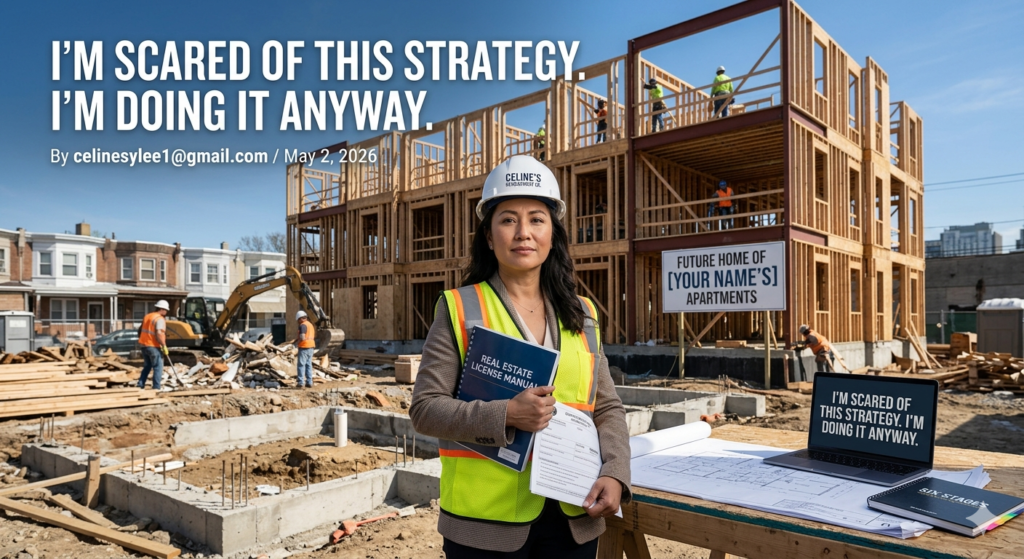
New construction development is the strategy I’ve been studying for weeks — and the one that still scares me more than anything else I’ve looked at.
Let me be honest with you.
I understand the six stages. I can explain what a bridge loan is, what LTC means, why you refinance into a construction loan after permits are approved. I’ve watched the videos, taken the notes, run the numbers.
And it still scares me.
Not because new construction development is complicated — though it is. Not because the numbers are big — though they are. But because I’m a minority immigrant woman who came to this country late, lost a significant amount of money to fraud twice, and spent the last ten years living small and playing it safe.
I’m writing this because I think a lot of you are asking the same question I am. And because the answer, I’ve decided, is yes.
New Construction Development Stage 1: Acquisition — Find the Ugly Duckling
The goal isn’t to find a great property. It’s to find a terrible one in a good location. You’re looking for the house everyone else has given up on. What you actually want is the land underneath it.
The key analysis: land value and ARV — what a brand-new building on that land could realistically sell for. In Philadelphia right now, neighborhoods like Germantown, Brewerytown, and parts of North Philly still have land at prices that make this new construction development math work.
New Construction Development Stage 2: Bridge Loan (Hard Money)
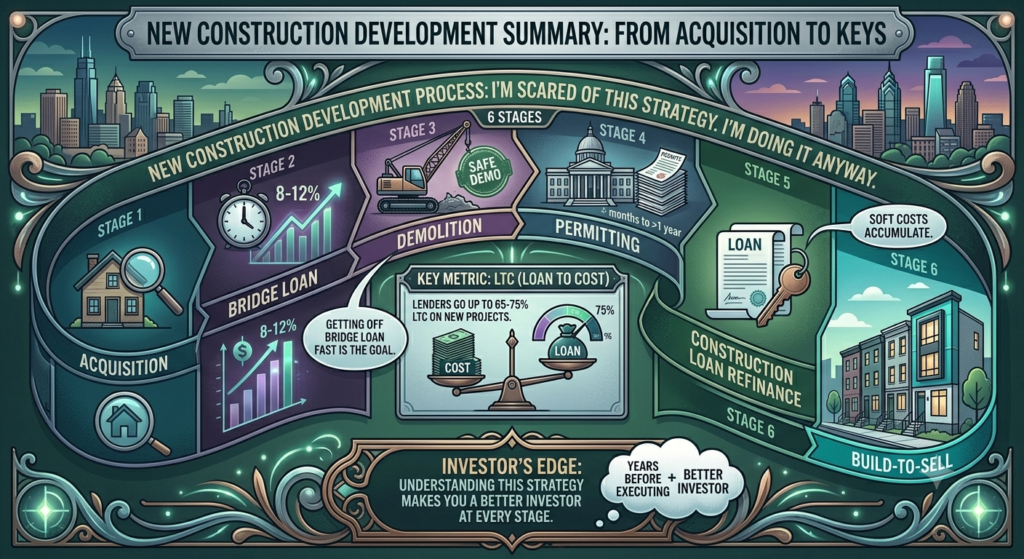
A bridge loan is a short-term, high-interest loan — typically 8–12% annually — that lets you acquire the property and begin demolition quickly. Approval is faster than conventional financing because the lender is primarily looking at asset value.
The goal is to get off this loan as quickly as possible. Which happens in Stage 5.
New Construction Development Stage 3: Demolition
Before demolition, you need a demo permit from the city. In Philadelphia, this is issued through the Department of Licenses and Inspections. Skipping this step isn’t just illegal — it can halt your entire project and create title issues that follow the property for years.
New Construction Development Stage 4: Permitting — The Patience Stage
Getting building permits approved is the slowest, most variable part of the entire new construction development process. In Philadelphia, this can take anywhere from a few months to over a year.
Soft costs accumulate here: architecture fees, engineering reports, surveys, zoning consultants. Your bridge loan is accruing interest the entire time. Time is money, literally.
New Construction Development Stage 5: Refinance Into a Construction Loan
Once permits are approved, you replace your expensive bridge loan with a construction loan. Funds are released in stages — called draws — as construction milestones are completed.
The key metric lenders watch: LTC (Loan to Cost) — the ratio of how much they’re lending versus total project cost. According to Investopedia, most lenders go up to 65–75% LTC on new construction development projects.
New Construction Development Stage 6: Build and Sell
Experienced developers often use a Cost Plus Contract: you pay the actual cost of materials and labor, plus a fixed fee for the contractor. It’s more transparent than a fixed-price contract and reduces the risk of corner-cutting.
Once the building is complete, you list, sell, and collect the difference.
The Part Nobody Puts in the New Construction Development TikTok Video
I’ve been swindled twice in this country. Once by a Korean business broker. Once by a contractor. Both times I lost money I couldn’t afford to lose. I was naive. I didn’t speak English well. I trusted people I shouldn’t have.
I’ve spent years being afraid — afraid to take risks, afraid to trust contractors, afraid that being a woman and an immigrant means I’ll always be one step behind.
But here’s what I’ve realized: that fear has cost me more than the fraud did.
My dream is to one day build an apartment building with my name on it. It feels impossibly big some days. Then I remind myself that I’ve already survived things that would have stopped most people.
I’ve spent ten years making myself small. I don’t have time for that anymore.
What New Construction Development Actually Requires
New construction development is not a beginner strategy. The capital requirements, the financing complexity, the contractor relationships, the permit process — all of it takes time to build.
But understanding it now — even years before you’re ready to execute — makes you a better investor at every stage of the journey.
Don’t let anyone — including yourself — tell you this isn’t for people like you.
Not financial advice — just someone doing a lot of research and asking a lot of questions.