Teardown property investing is something most builders completely overlook — and that’s exactly why it’s worth paying attention to.
Everyone chasing land for new construction is looking for the same thing: a clean, empty lot ready to build on. No mess, no demo, no headaches. I get it. But I’ve been thinking about this differently lately, and I think that instinct is actually costing builders money.
I came across a video recently that laid out five reasons why buying a teardown property — even a completely trashed, falling-apart house — can actually be the smarter play. And honestly, it clicked.
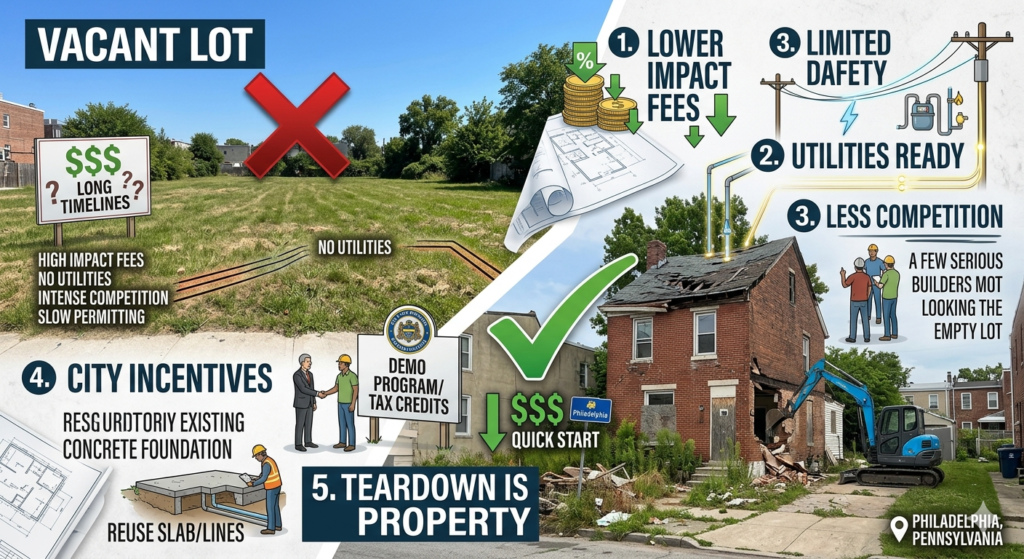
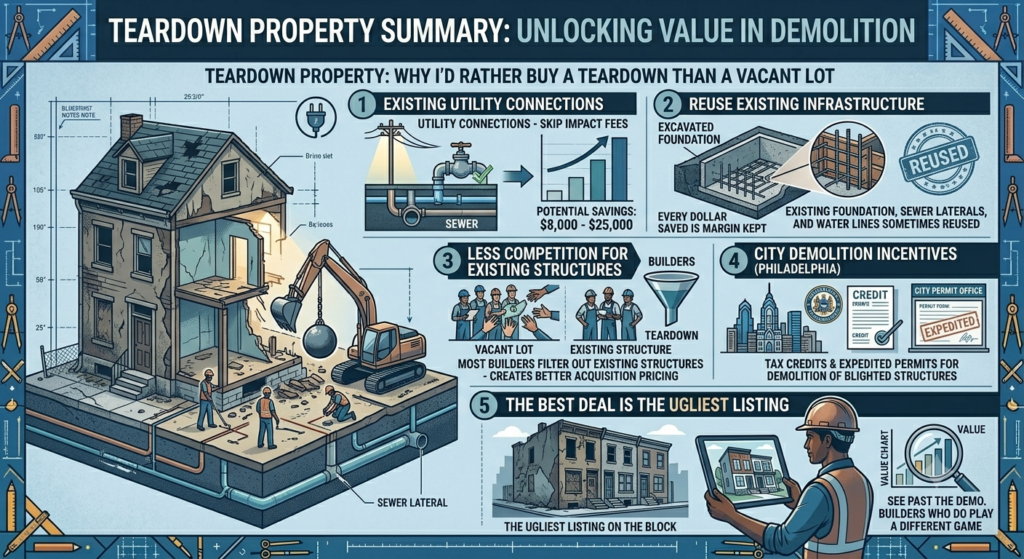
Teardown Property Advantage #1: Impact Fees Are Lower — Sometimes Significantly
When you build on vacant land, municipalities often charge impact fees to connect your new structure to city infrastructure. Water, sewer, roads — you’re paying for the privilege of tapping in fresh.
But if there’s already a house on that lot? Those connections likely already exist. The city already counted that parcel. You’re not a new burden on the system — you’re just replacing what was there.
Depending on the municipality, that difference can be thousands of dollars before you’ve broken ground. For teardown property investors, that’s margin you keep.
Teardown Property Advantage #2: Utilities Are Already Stubbed In
Related, but worth separating: water, electric, gas. Running new utility lines to a vacant lot isn’t just expensive — it takes time, permits, and coordination with multiple utility companies.
A teardown property almost certainly has live connections or at minimum, connections at the street. That’s a meaningful head start, especially when construction timelines are already stretched.
Teardown Property Advantage #3: Less Competition
This one’s underrated.
Most builders are filtering for vacant lots. Clean title, nothing to demo, straightforward path to permits. The moment they see “existing structure,” a lot of them scroll past.
That friction — the perceived hassle of demolition — is exactly what creates opportunity in the teardown property market. Fewer buyers means less competition at acquisition. Less competition means better pricing. Better pricing means more margin on the back end.
The ugliest listing on the block is sometimes the best deal on the block.
Teardown Property Advantage #4: Some Cities Will Actually Pay You to Tear It Down
Not everywhere, but it happens more than people realize. Cities dealing with blight, abandoned properties, and safety hazards have real incentive to see those structures come down.
Tax credits, demolition incentives, expedited permitting — the specifics vary by city. Philadelphia in particular has programs worth looking into if you’re building here. According to the City of Philadelphia, the city actively incentivizes removal of blighted structures in targeted neighborhoods.
Teardown Property Advantage #5: You Might Be Able to Reuse What’s Already There
This depends on condition, but it’s worth an inspection before you assume everything gets hauled away.
Existing slab foundations can sometimes be built on or poured over. Sewer laterals and water service lines can be reused if they’re in decent shape. Every dollar of existing teardown property infrastructure you can keep is a dollar you’re not spending on new construction.
The Teardown Property Mindset Shift
The video ended with a question — do you agree or disagree? And I think that’s actually the right frame.
This isn’t a universal rule. Demo costs money. Sometimes the structure is more trouble than it’s worth. Sometimes the lot is fine as-is.
But the broader point stands: teardown property that looks like a problem is often the one with the most upside. Builders who can see past the demo and run the real numbers are playing a different game than everyone else.
The teardown property nobody wants might be exactly what you’re looking for.
Not financial advice — just someone doing a lot of research and asking a lot of questions.