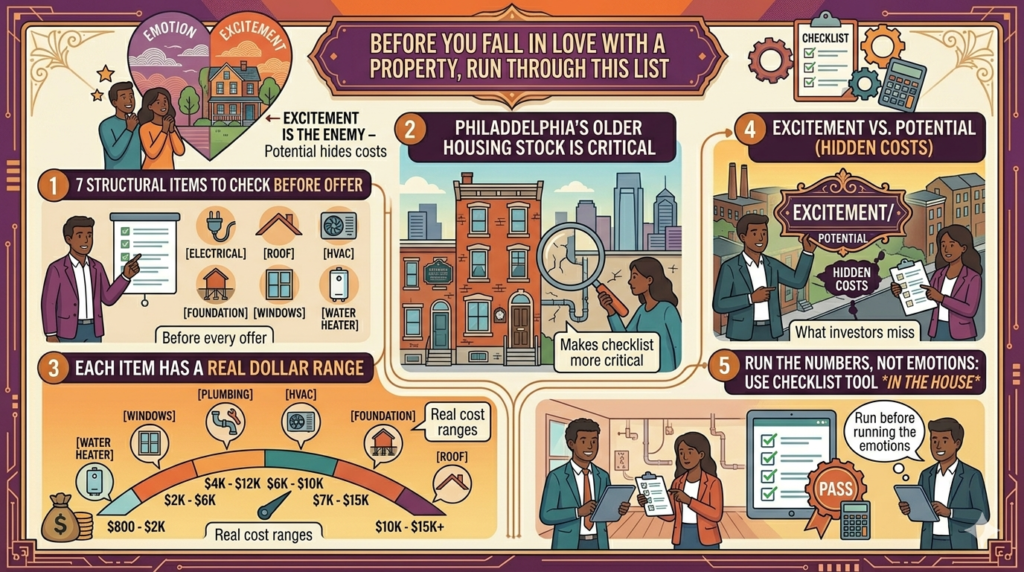
How to flip a house beginners style starts with one rule: run the numbers before you run the emotions.
I’ve walked through a lot of houses. And I mean a lot.
There’s a feeling you get when you walk into a place that has potential — you start mentally painting walls, imagining the after photos, running ARV numbers in your head. It’s exciting. And that excitement is exactly what gets people into trouble.
Because while you’re picturing the finished product, there are things hiding behind the walls, under the floors, and in that electrical panel that can quietly blow your budget before demo even starts.
I watched a video recently where an investor laid out a solid flip — $350k purchase, $60k rehab, targeting $550k ARV. Almost as an afterthought, he mentioned one thing: always check the electrical panel before you buy. That one tip stuck with me. Because it’s the kind of thing that sounds obvious until you’re $15k into a flip and your contractor tells you the panel needs upgrading before he can touch anything else.
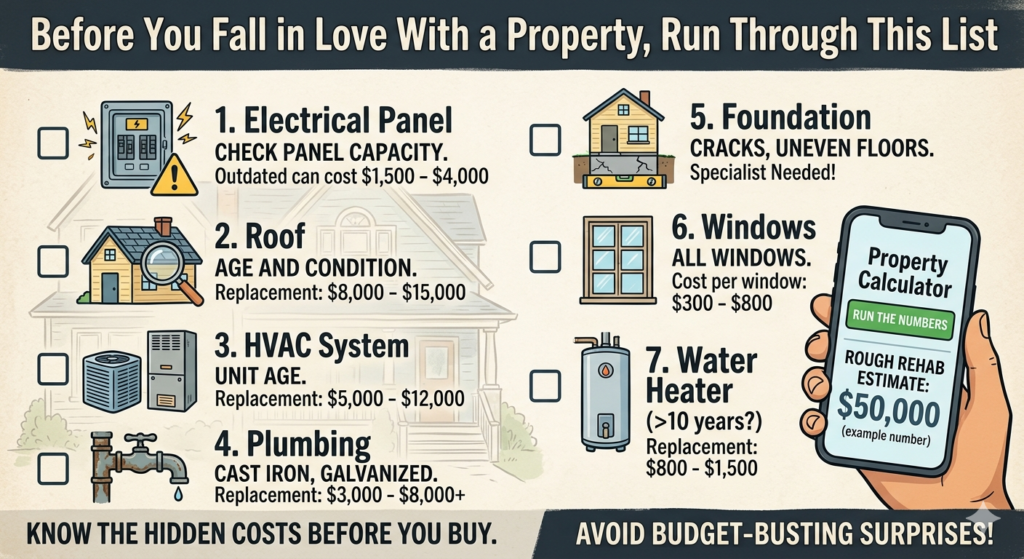
How to Flip a House Beginners Checklist: The Stuff That Kills Your Margins
There are cosmetic problems and there are structural problems. Cosmetic problems are fine — that’s literally what you’re there to fix. Structural problems are what you need to price in before you make an offer.
Here’s what I look at every single time:
Electrical panel — Older homes especially. If the panel is outdated or undersized for the renovation you’re planning, you’re looking at $1,500 to $4,000 to upgrade it. Not optional.
Roof — Walk around the outside and look up. Check the attic if you can. A full roof replacement can run $8,000 to $15,000 depending on size and material.
HVAC — How old is the system? If it’s original to a 1970s house, budget for replacement. $5,000 to $12,000 depending on the system and size of the home.
Plumbing — Old galvanized pipes, cast iron that’s deteriorating, signs of water damage on ceilings or under sinks. $3,000 to $8,000 for significant plumbing work, more if you’re opening walls.
Foundation — Cracks in the basement walls, uneven floors, doors that don’t close right. The hardest to price without a specialist — and the scariest to underestimate.
Windows — Easy to overlook but adds up fast if you’re replacing them all. $300 to $800 per window installed.
Water heater — If it’s over 10 years old, budget for replacement. $800 to $1,500.
According to the Census Bureau’s American Housing Survey, a significant portion of older urban housing stock still has outdated electrical and plumbing systems — which is exactly why this checklist matters more in cities like Philadelphia than anywhere else.
How to Flip a House Beginners Tool: Stop Doing This Math in Your Head
I got tired of trying to calculate rehab costs while walking a property. Or worse, doing it later on a spreadsheet when the adrenaline had already made me half-committed to the deal.
The Flip Checklist Calculator is what I use now. Pull it up on your phone, check off what you see, and by the time you walk out the door you have a rough rehab number staring back at you.
It’s not a substitute for a contractor walkthrough. But it’s enough to know whether a deal is worth pursuing before you spend time and money on due diligence.
Run the numbers before you run the emotions.
Not financial advice — just someone doing a lot of research and asking a lot of questions.