
Land Flipping Strategy: 3 Brutal Lessons I Learned Looking 30 Minutes Outside Philadelphia
I’ve lived in some expensive cities. Like, really expensive. LA, New York, New Jersey, DC — I’ve done all of them. I know what $3,000/month rent feels like, and I know what it feels like to watch your money disappear into someone else’s mortgage every single month.
So when I landed in Philadelphia, my first thought was honestly: this is so cheap. Coming from Manhattan prices, Philly felt like a gift. Houses that would cost $2M in Brooklyn were going for $300K here. I thought I’d found the cheat code.
Then I started actually looking into a land flipping strategy that could work here.
And that’s where it got interesting.
The dirty truth about Philadelphia land
If you’ve walked around Germantown, Kensington, Fishtown, or really anywhere inside the city — you know how tight it is. Rowhouse after rowhouse, wall to wall, zero gap. It’s charming, it’s got character, and honestly it reminds me of why I loved Williamsburg before it got expensive.
But for a land flipping strategy? There’s almost nothing to work with. The vacant lots that do exist are narrow, awkward, or tangled up in city liens and paperwork. And the ones worth having? Developers already found them.
So I did what any broke girl who moved to Philly specifically because it’s between New York and DC would do — I opened Google Maps and started looking at what was around Philadelphia.
That’s when the land flipping strategy I’d been reading about finally started to make sense.
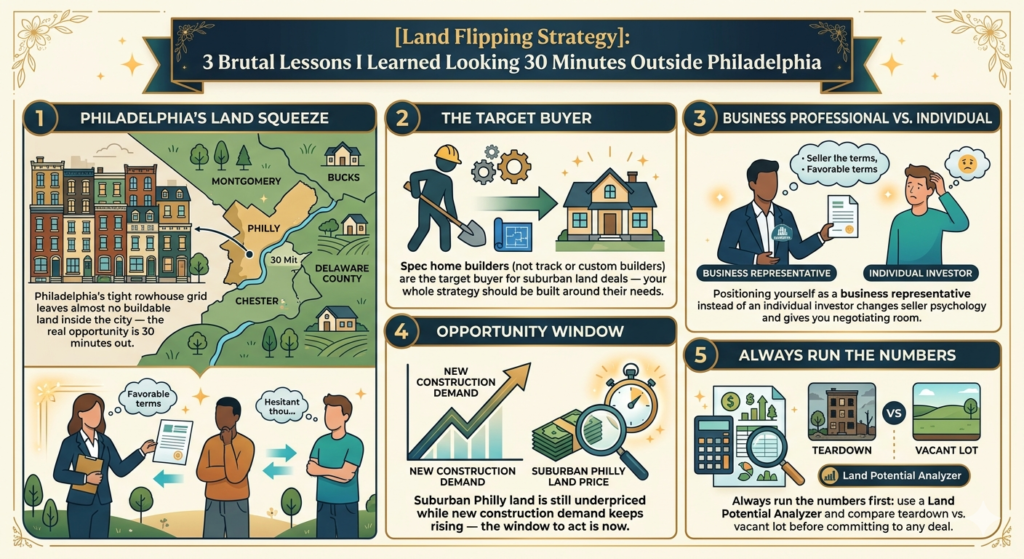
30 minutes out changes everything
Montgomery County. Bucks County. Delaware County. Chester County.
These aren’t glamorous names. Nobody’s making TikToks about Lansdale or Norristown. But here’s what they have that inner Philly doesn’t: actual land. Buildable land. Land that spec home builders actually want to buy.
According to the U.S. Census Bureau, new residential construction in suburban Philadelphia counties has been steadily outpacing the city core — which tells you exactly where the demand is moving.
Which brings me to something I learned recently that completely reframed how I think about a land flipping strategy.
Who actually buys land — and why it matters
This is the piece most beginner guides skip. There are basically three types of home builders:
Track home builders — the big guys. They want massive parcels, planned developments, dozens of lots at a time. Not our world.
Custom home builders — they build for clients who already own land. So they don’t need to buy from you.
Spec home builders — this is who you want. These are the builders who buy land, build a house on it without a buyer lined up, and then sell it on the open market. They’re basically flippers who build instead of renovate. And they need a constant supply of good lots to keep the machine running.
When you’re thinking about a land flipping strategy in the Philadelphia suburbs, spec builders are your buyer. Full stop. Your whole approach — how you find lots, how you price them, how you negotiate — should be built around what a spec builder needs.
The negotiation trick that changes the dynamic
Here’s something I picked up that I wish I’d known back when I was doing my LA flips.
When you’re negotiating to buy land from a seller, don’t show up as “me, the investor who wants to make money on this.” Instead, position yourself as someone working for a business — an agent, a representative, someone who has to bring the deal back to their partners for approval.
It sounds simple but the psychology is powerful. The seller stops seeing you as the enemy. You get breathing room — “I need to check with my partners” buys you time to think. You’re not on the hook to make a decision on the spot. And the seller is more likely to accept your terms because it feels like “company policy,” not personal lowballing.
Even if you’re a one-woman operation (hi, that’s me), this framing works. You’re not lying — you are accountable to your business, your numbers, your goals. It’s a small mindset shift that makes a real difference in how land flipping strategy negotiations actually play out.
Why this land flipping strategy feels right for this market, right now
Philadelphia is changing fast. I see it every day — old factories becoming loft apartments, warehouses turning into restaurants, young people flooding in from New York because they can’t afford Brooklyn anymore. I’ve watched this exact movie before. I know how it ends.
The suburbs around Philly are going to follow. They always do. And right now, land out there is still priced like nobody’s paying attention.
That window doesn’t stay open forever.
I’m not saying go buy random farmland in Chester County tomorrow. But if you’re looking for a way into real estate investing without the massive capital requirements of a full flip or new construction — a land flipping strategy focused on the Philly suburbs is worth a serious look.
Start with the numbers. Figure out what a lot is worth to a spec builder in that area, work backwards to what you can pay, and make sure there’s enough margin in between. I put together a Land Potential Analyzer to help you run those numbers before you commit to anything — plug in what you’re looking at and see if the deal pencils out. And if you’re trying to decide between a teardown and a vacant lot, the Teardown vs. Vacant Lot Calculator breaks that comparison down pretty clearly.
Not financial advice — just someone doing a lot of research and asking a lot of questions.